
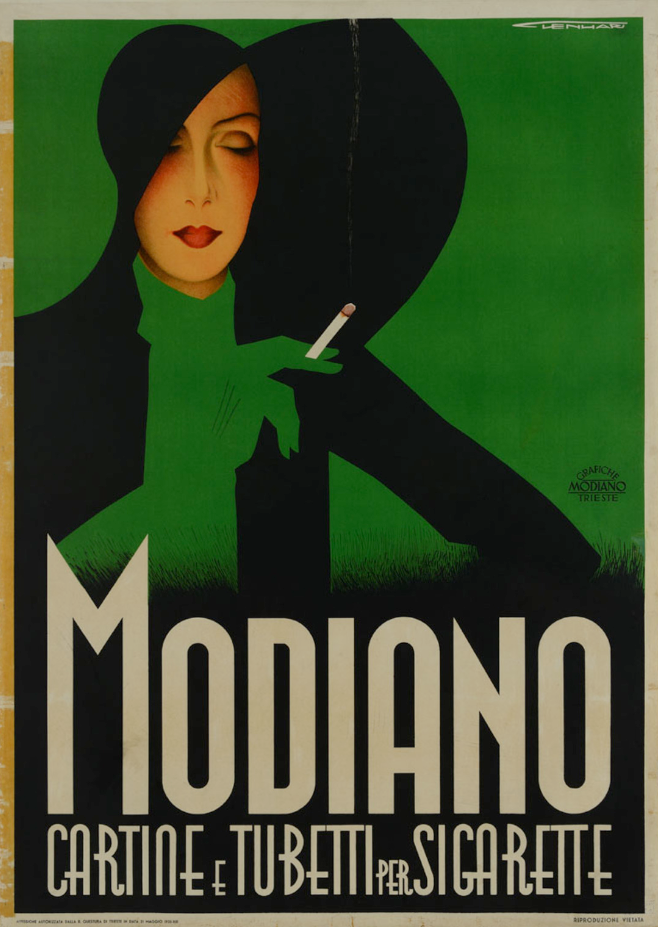
This manifesto dates from 1935 and was created by Franz Lenhart, an Austrian-born painter and graphic designer who became a naturalized Italian citizen. Lenhart was one of the foremost figures in Italian advertising poster design during the first half of the twentieth century.
Lenhart’s career centred on promoting tourism, particularly in the Dolomite region. His poster work celebrated mountain destinations including Cortina d’Ampezzo and Madonna di Campiglio, presenting them as ideal settings for sportive and fashionable visitors. During the 1930s, his practice expanded into illustration for Trieste-based shipping companies, where he designed brochures and promotional materials depicting life aboard cruise vessels.
About Franz Lenhart
Lenhart was born in Bad Häring in 1898 and spent much of his career in Italy, eventually settling in Merano, where he died in 1992. His extensive body of advertising work—186 original posters—is held by the Museo Nazionale Collezione Salce in Treviso, Italy’s largest public collection of graphic design. Additional notable examples of his poster work form part of the permanent exhibition at the Touriseum, the Provincial Museum of Tourism in Merano.
Details
- Creator: Franz Lenhart (1898–1992)
- Year: 1935
- Genre: Advertising poster
- Movement: Italian interwar graphic design
- Major collections: Museo Nazionale Collezione Salce, Treviso; Touriseum, Merano
Frequently asked questions
Who was Franz Lenhart?
Franz Lenhart was an Austrian painter and graphic designer naturalised as an Italian citizen. He became one of the major figures in Italian advertising poster design during the early twentieth century, specialising in tourism promotion for Alpine destinations and cruise lines.
What subjects did Lenhart typically illustrate?
Lenhart’s work focused predominantly on tourism marketing, depicting Alpine locations such as Cortina d’Ampezzo and Madonna di Campiglio as ideal destinations for sports enthusiasts and affluent travellers. From the 1930s onwards, he also created illustrated promotional materials for Trieste shipping companies.
Where can Lenhart’s work be seen today?
His posters are preserved in significant collections at the Museo Nazionale Collezione Salce in Treviso, which holds 186 of his original works, and at the Touriseum in Merano, which features his pieces in its permanent exhibition.

