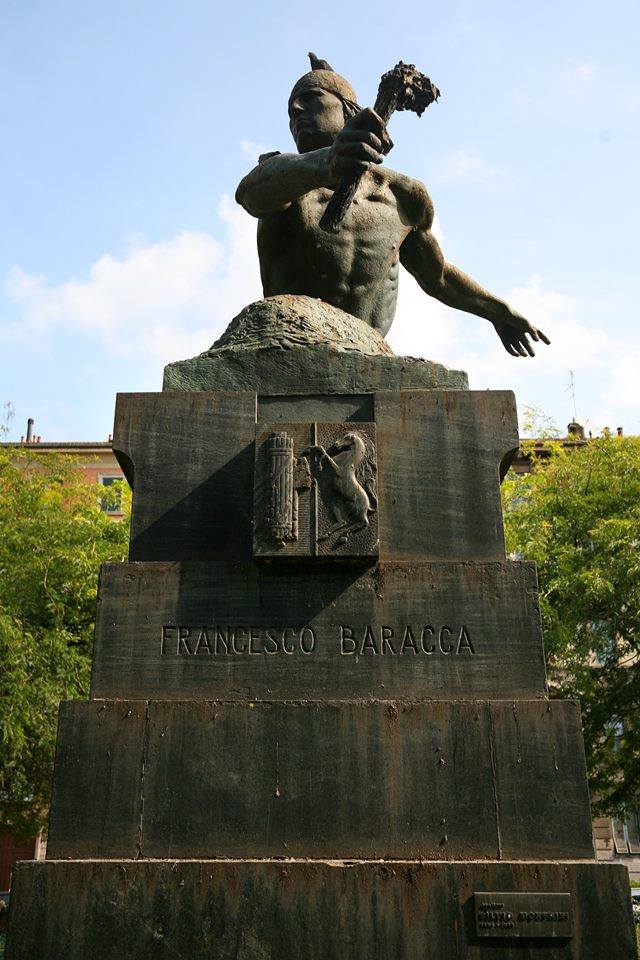
A bronze sculpture monument to Francesco Baracca stands in Piazzale Francesco Baracca in Milan, created by sculptor Silvio Monfrini and inaugurated on 27 September 1931.
The work was commissioned by a Milan group of Blackshirts dedicated to Baracca’s memory. Giuseppe Monfrini, a member of the fascist group, offered the bust executed by his brother Silvio, while architect Ulisse Stacchini designed the base. The sculpture depicts Baracca’s head and shoulders emerging from the plinth, turning to the right and holding a torch in his raised right hand. The front of the base bears the inscription “FRANCESCO BARACCA” crowned by a relief containing the prancing horse emblem and a fasces. The monument was inaugurated in the presence of Italo Balbo, then minister of aeronautics, and Baracca’s parents.
About Silvio Monfrini
Silvio Monfrini was a sculptor active in early twentieth-century Italy during the Rationalist period.
Details
- Sculptor: Silvio Monfrini
- Architect (base): Ulisse Stacchini
- Inaugurated: 27 September 1931
- Location: Piazzale Francesco Baracca, Milan
- Subject: Francesco Baracca, Italian aviator
Explore more: 193 heritage places in Milano
Frequently asked questions
Who created the monument?
Silvio Monfrini sculpted the bronze bust, and architect Ulisse Stacchini designed the base. The work was commissioned by a Milan Blackshirt group dedicated to Baracca.
What does the monument depict?
The sculpture shows Baracca’s bust turning to the right and holding a torch. The base features an inscription with his name, a relief of the prancing horse emblem, and a fasces.
When was it unveiled?
The monument was inaugurated on 27 September 1931, with Italo Balbo, then minister of aeronautics, and Baracca’s parents in attendance.
Sources
- S1 — Panzetta, Alfonso. Nuovo dizionario degli scultori italiani dell'Ottocento e del primo Novecento. AdArte, 2003. ISBN 978-88-422-1158-7.
- S2 — Gramigna, Giuliana, e Sergio Mazza. Milano: Un secolo di architettura milanese dal Cordusio alla Bicocca. Hoepli, 2001. ISBN 978-88-203-2913-6.
Spotted an error? Write to editorial@culturalheritageonline.com and we correct it the same day.