Between 1926 and 1928 two Italian-built airships flew from Europe to the top of the world. The first, the Norge, made the first verified journey of any kind to the North Pole; the second, the Italia, reached the Pole and crashed on the way back, setting off the most famous rescue drama of the polar age. Both stories run along the same physical route — Rome and Milan, the Baltic, the far north-east of Norway, a coal-mining settlement on Svalbard — and two steel mooring masts on that route are still standing. This is the story, and the map, of the airship road to the Pole.
The context, stated plainly
The polar flights were international ventures — conceived by the Norwegian explorer Roald Amundsen, designed and piloted by the Italian engineer Umberto Nobile, funded by the American Lincoln Ellsworth — and they were also, from the Italian side, propaganda events: the regime of the day claimed them loudly as national triumphs, and the quarrel between Amundsen and Nobile over credit for the Norge flight was bitter and public. The 1928 sequel ended in catastrophe: seventeen people died in the Italia disaster and its rescue operations, Amundsen himself among them. None of that is decoration to the story; it is the story, and it is stated here first.
An airship for the ice
The Norge was an N-class semi-rigid airship designed by Nobile and built in Italy from 1923: 106 metres long, 26 in diameter, 19,000 cubic metres of hydrogen, three Maybach engines and a top speed of 115 km/h. For the expedition it was sold to the Aero Club of Norway and renamed — hence the Norwegian name on an Italian hull. The plan was radical in its simplicity: fly the ship across Europe to Svalbard, wait for weather, and cross the entire unknown side of the Arctic Ocean to Alaska, passing over the Pole.
Rome to Kings Bay
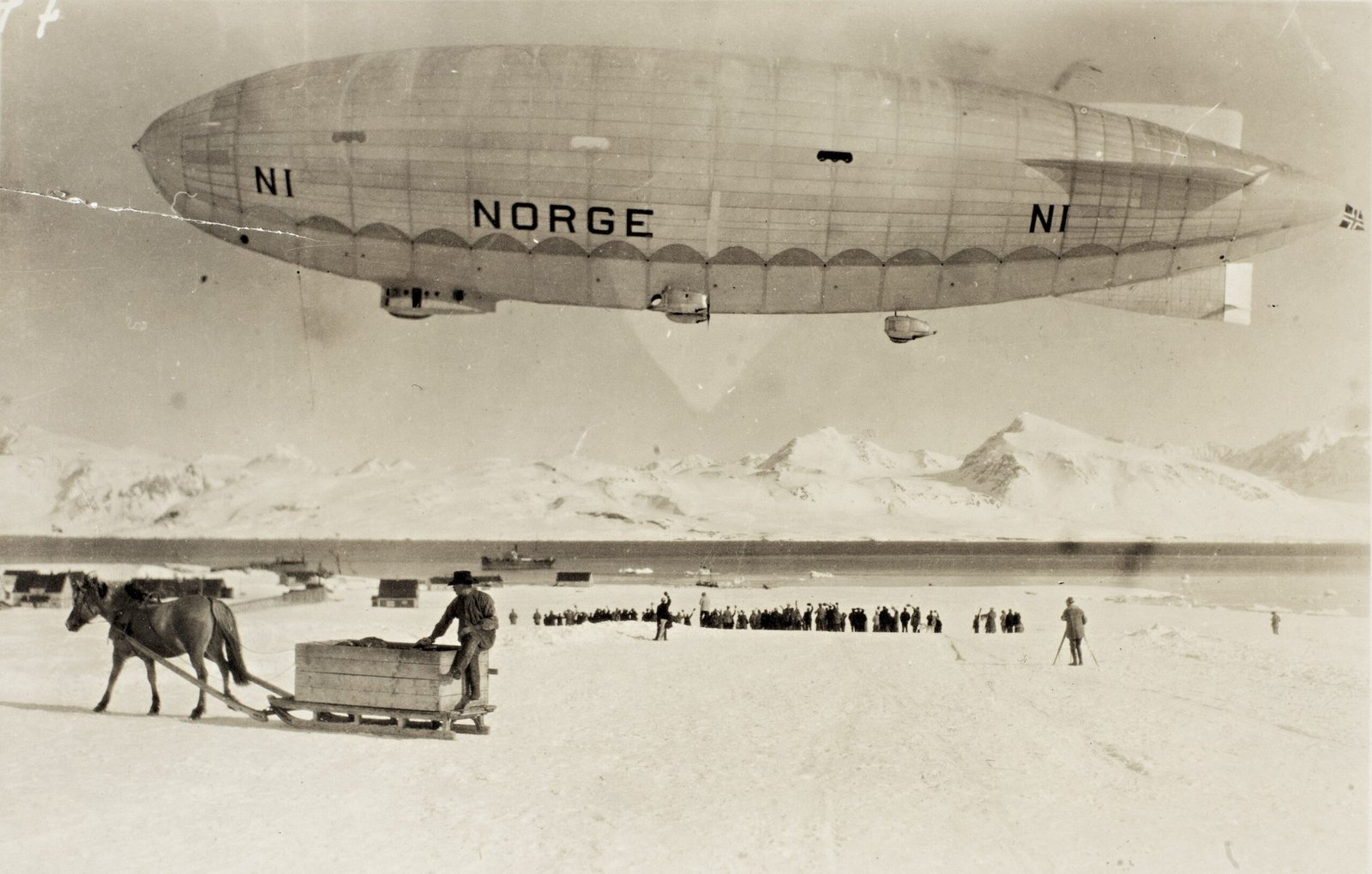
The Norge left Ciampino, outside Rome, at 09:25 on 10 April 1926 and worked north in stages: Pulham in England, Oslo, Gatchina outside Leningrad. On 5 May, at 09:40, it slipped its last mainland mooring at Vadsø, on the Varanger fjord in Norway’s far north-east, where a lattice steel mast had been raised on the flat island of Vadsøya. From there the route crossed the Barents Sea to Ny-Ålesund on Kings Bay, Svalbard — a coal town at nearly 79° North to which the expedition had added a hangar and a second mooring mast. The photographs of 7 May show the silver ship nose-to-mast above the snow, the whole settlement hauling on the lines.
Across the top of the world
The Norge left Kings Bay on 11 May 1926. At 01:25 GMT on 12 May it crossed the North Pole — the first verified attainment of the Pole by any means, on any vehicle — and kept going, down the far side of the Arctic that no one had ever seen, to land at Teller, Alaska, on 14 May. The ship was damaged in the landing, dismantled, crated for a refit that never happened; it never flew again. The record, contested at the time by claims later discredited, stands.
The Italia and the Red Tent
Two years later Nobile came back in command of his own expedition. The Italia took off from Milan at 01:15 on 15 April 1928, staged through Stolp on the Baltic, called at the same Vadsø mast in the first days of May, and reached Kings Bay on 6 May, with the support ship Città di Milano anchored in the bay. On its third polar flight the Italia reached the Pole at 00:24 on 24 May 1928; the crew dropped Italian flags and a cross from Pope Pius XI onto the ice. On the return, on 25 May, the control car struck the pack ice and was torn from the keel. Nine men and the ship’s dog were thrown onto the ice with the wreck of the cabin; the envelope, lightened, drifted away with six more aboard, never found.
The survivors’ camp — the Red Tent, dyed for visibility — drifted for weeks while an improvised international rescue converged on Svalbard. Amundsen, setting aside the old quarrel, boarded a French Latham 47 flying boat to join the search and disappeared with its crew en route. On 12 July the Soviet icebreaker Krassin reached the survivors; eight men of the Italia came home, Nobile among them, into an inquiry and a controversy over the crash and his own early evacuation that followed him for decades. Seventeen people, rescuers included, did not come home.
What survives on the route
Airships left history within the decade, but the road to the Pole is still marked. At Vadsø, the red lattice mooring mast still stands on Vadsøya island, with a plaque recording the Italia’s call; at Ny-Ålesund — today an international research settlement — the mast the Norge left from still stands at the settlement’s edge, against the same mountains that frame the 1926 photographs. They are among the very few structures anywhere built for airships that still exist, and the only ones tied to the conquest of the Pole. Both now have dedicated cards in this archive, and together they form a two-stop historical route across the European Arctic.
Places of this story in the archive
- Airship mooring mast, Vadsø — the last mainland stop, 1926 and 1928
- Airship mooring mast, Ny-Ålesund (Kings Bay) — the departure point for the Pole
Sources
- S1 — Nobile, Umberto. My Polar Flights: An Account of the Voyages of the Airships Italia and Norge. Frederick Muller, 1961. ISBN 978-0-405-03774-0.
- S2 — Amundsen, Roald, and Lincoln Ellsworth. First Crossing of the Polar Sea. George H. Doran, 1927. ISBN 978-1-4067-1725-9.
Spotted an error? Write to editorial@culturalheritageonline.com and we correct it the same day.