Padua grew fast between the wars. The city laid out new residential quarters on its edges, the university pushed a modern building programme into its medieval core, and the province filled with small, sharp commissions for a generation of architects trained on Futurism and converted to Rationalism. This RoadBook links five buildings that tell that story in about half a day: a shuttered cinema in the old centre, Gio Ponti’s university palazzo, a perfume factory with the prow of a ship, a brick parish church, and a rural party house eight kilometres west. One name appears twice. Quirino De Giorgio built the last of these before the war and the first of them after it, and the distance between those two commissions is the real subject of the route. All five stops are collected in the curated itinerary Padua Rationalism RoadBook, each with its full entry in the archive.
A cinema stacked three screens high
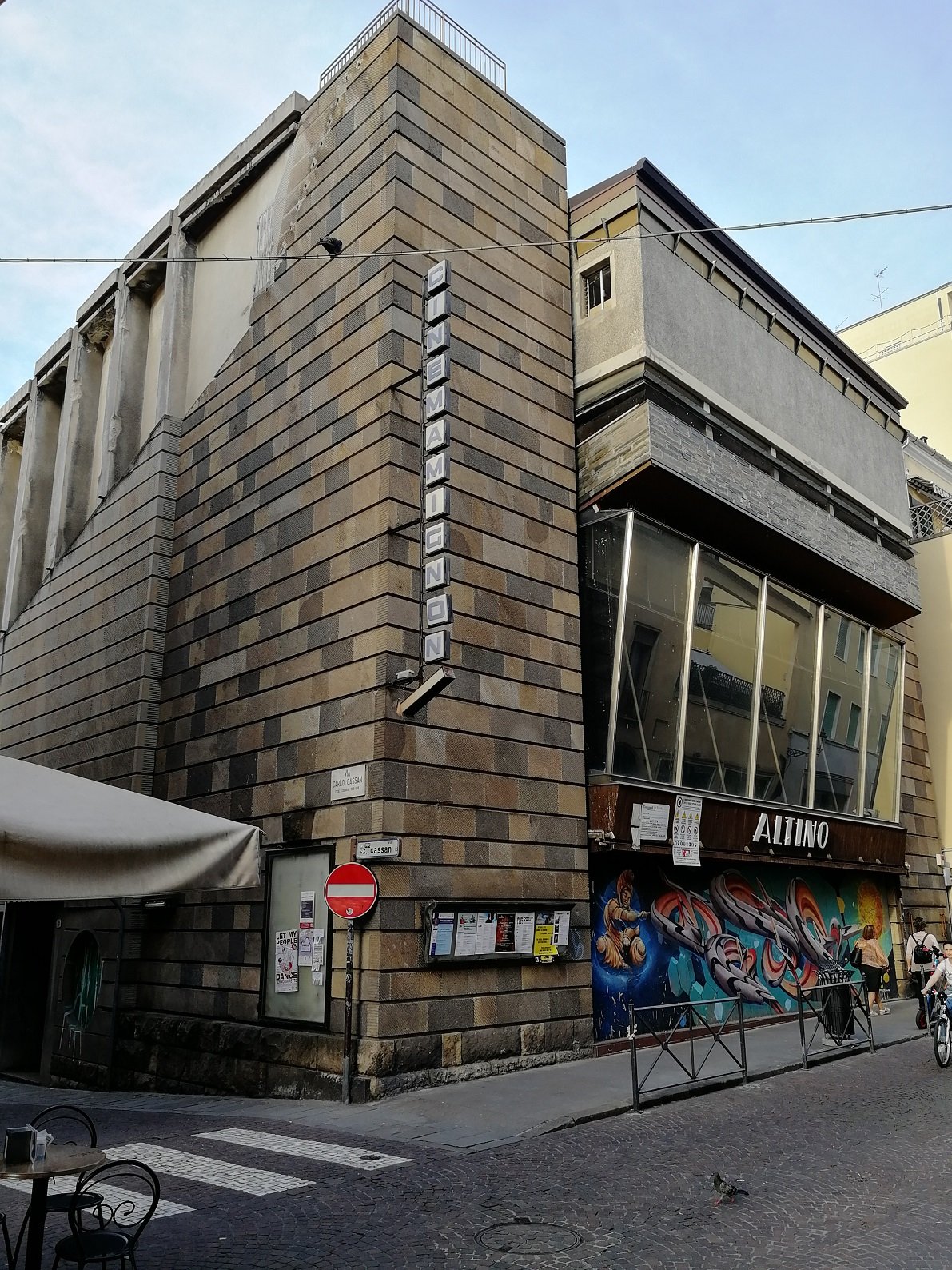
The route starts on Via Altinate, in the dense grid of the historic centre. The Cinema Altino is the late work here: De Giorgio designed it in 1946 and completed it in 1952, packing three projection spaces into a single urban block — a main auditorium, a smaller Mignon hall in the basement, and an open-air screen on the roof terrace. The official Italian census of contemporary architecture lists it as an opera di eccellenza and records it as the first multiplex on Paduan soil. The building has been closed since the early 2000s, and its recovery is still being argued over. For now it is read from the street, a rationalist face holding its corner of Via Altinate.
Ponti’s palazzo for the humanities
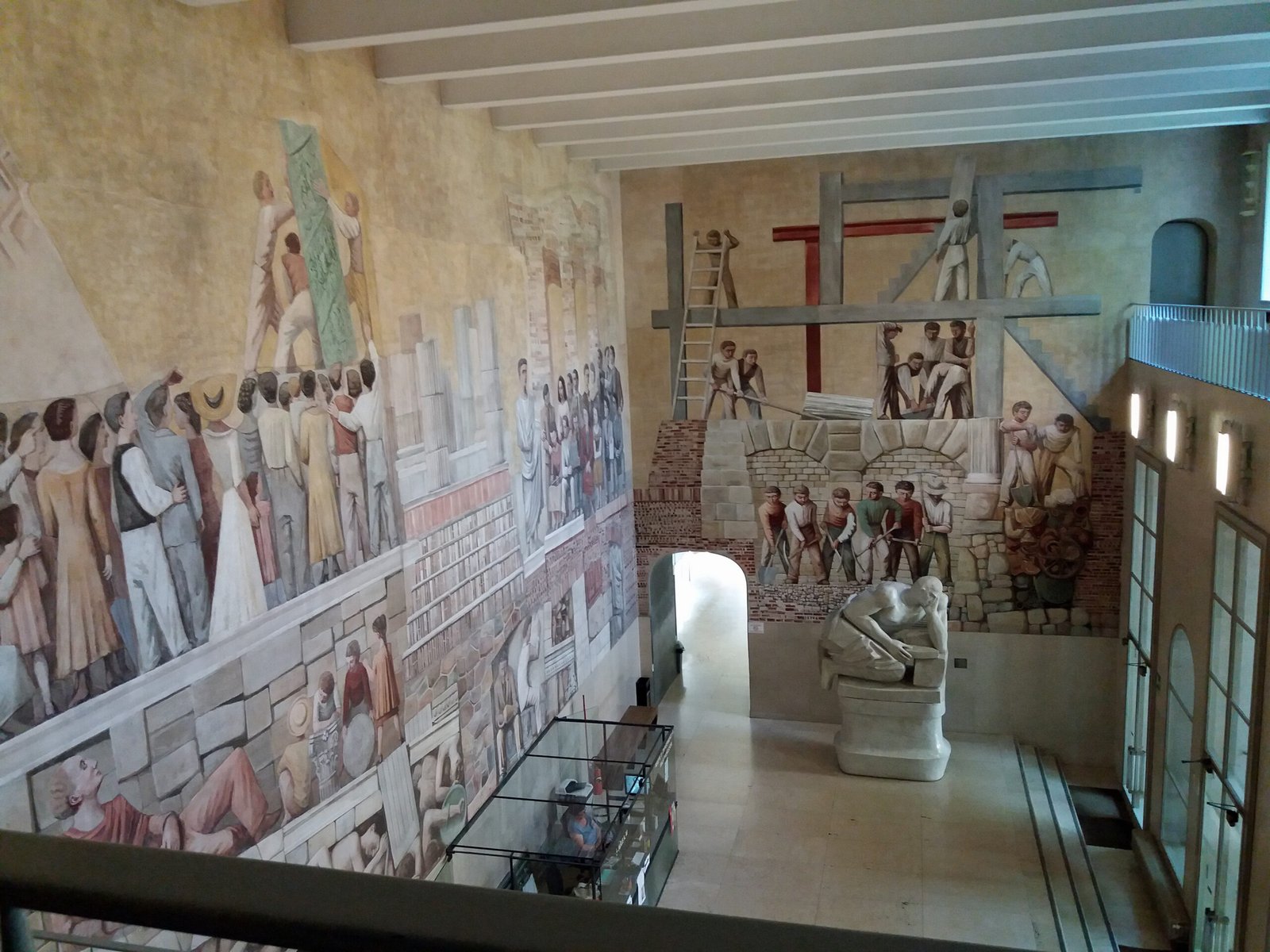
A few minutes away, Piazza Capitaniato opens inside the university’s medieval quarter, and the Palazzo Liviano fronts it. Gio Ponti won the competition in 1934, under rector Carlo Anti, and the site stayed active from 1937 until 1943, in spite of the war. The elevation is bipartite and very clear: a tall plinth of warm marble, a smooth rendered volume above it, narrow vertical cuts for windows. Inside, Ponti treated the building as a total work. Massimo Campigli frescoed the entrance atrium between 1939 and 1940, Arturo Martini carved a seated Livy completed in 1942, and the sixteenth-century Sala dei Giganti was absorbed into the complex rather than demolished. It still works for a living: the university’s humanities school and its archaeology museum occupy it today.
The factory that scented a district
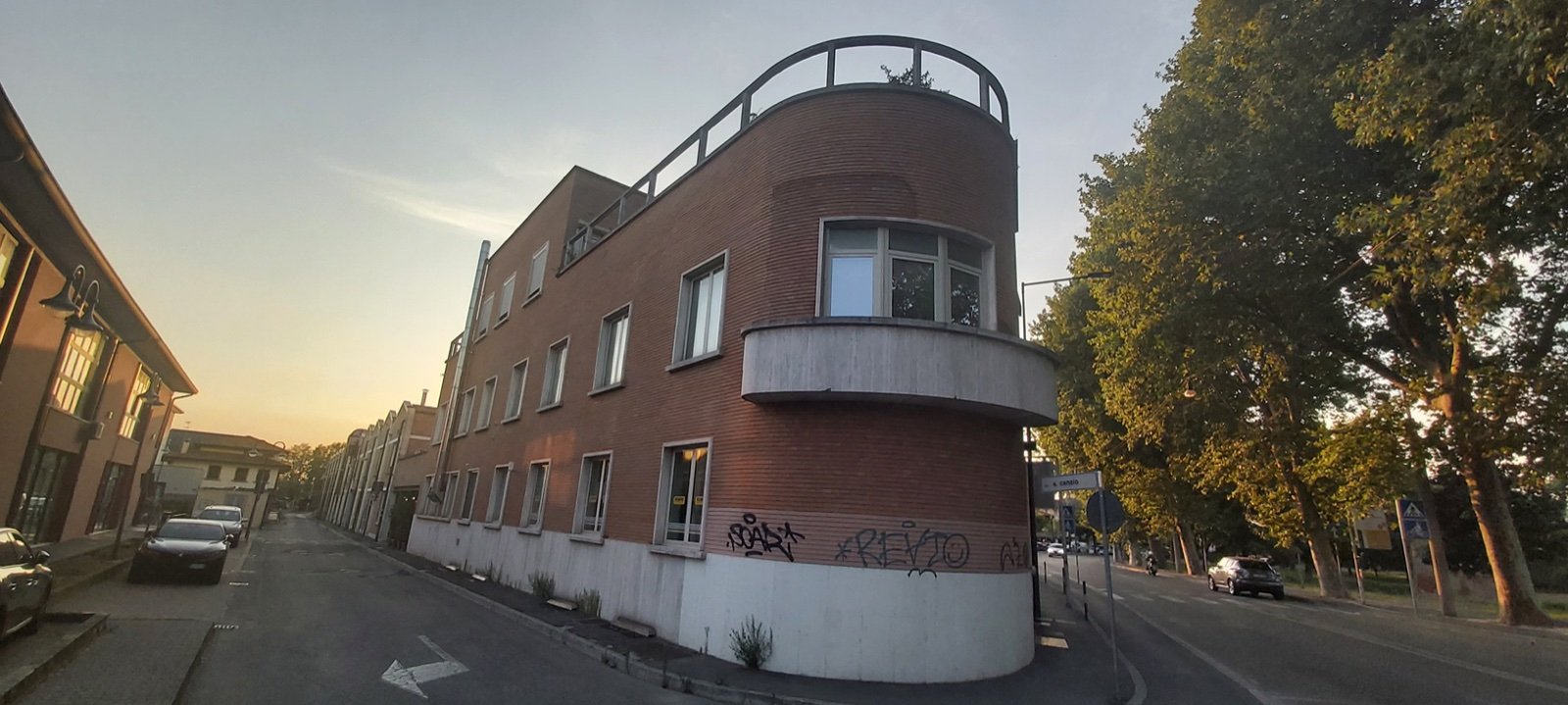
Away from the monumental centre, on a corner of Via Pilade Bronzetti, the route changes register. The former Kofler works made perfumes, face powders and above all talc, and for decades the surrounding streets smelled of the product; the neighbourhood still calls itself the Borgo del Talco, the borough of talc. The building performs its modernity at the corner: a full curve of brick like the prow of a ship, a ribbon window following it, a tubular railing along the roofline. Its founder, Iginio Kofler, was an Alpini officer and a president of Confindustria Padova who later restored Villa Molin and the Egyptian Room of the Caffè Pedrocchi. One caveat travels with this stop, and the archive entry states it plainly: no public source consulted gives the building’s exact date or names its architect. The oldest trace is a 1953 postcard of the works already in operation. We group it with the interwar years on the strength of its streamline form and of field documentation, and we say so.
A parish for a planned quarter
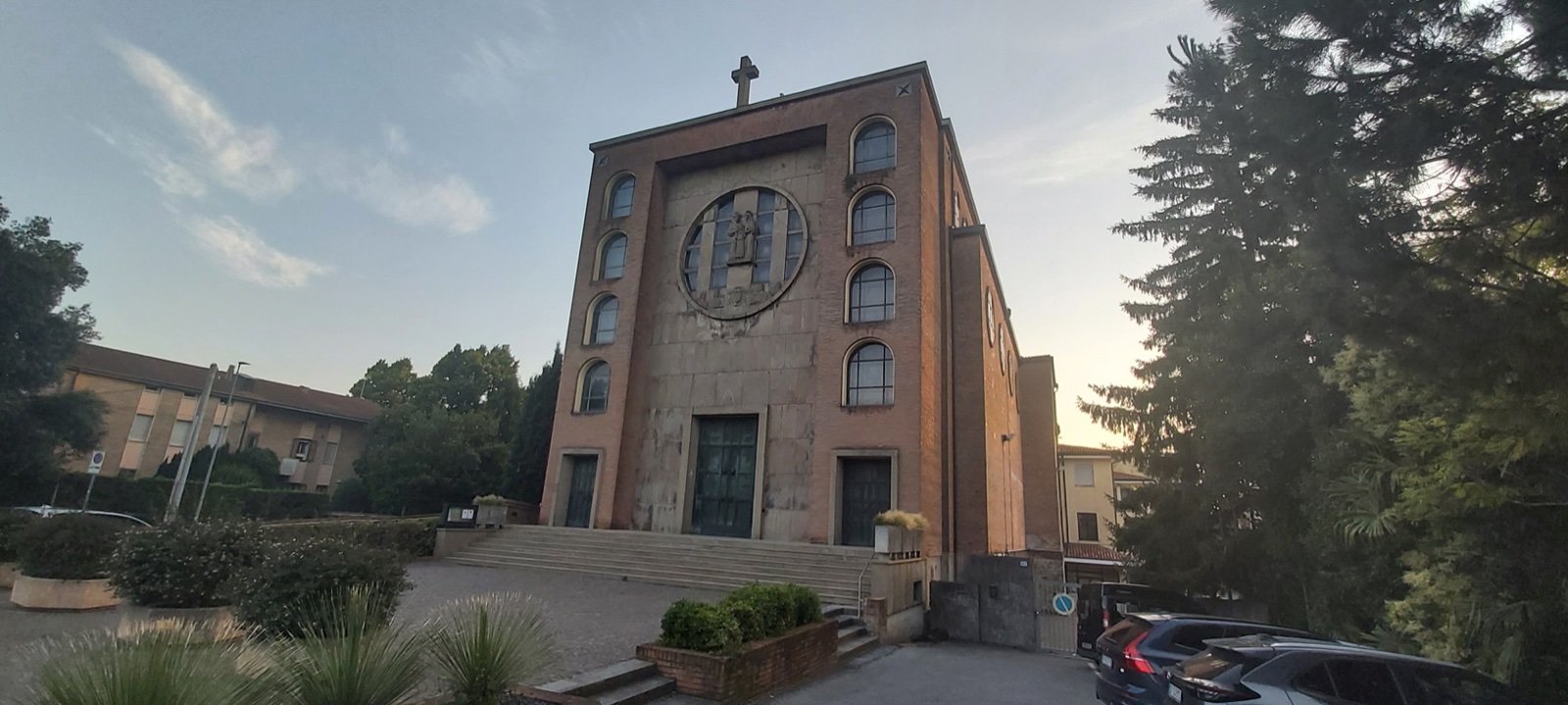
South-west of the centre, the Chiesa della Sacra Famiglia anchors San Giuseppe, one of the residential quarters Padua laid out between the wars. Built from 1936 and inaugurated in 1939, it is brick over an Istrian-stone base, a tall gabled screen reached by a broad flight of steps. A single strong image does all the work: a wide circular relief of the Holy Family set into the gable, framed by climbing rows of narrow arched windows, with a plain cross on the ridge. There is no bell tower competing with the front. The architect’s name is not recorded in the public heritage catalogues. The church is still an active parish, which makes it the one stop on this route that has never changed use.
Eight kilometres west, a stone slogan
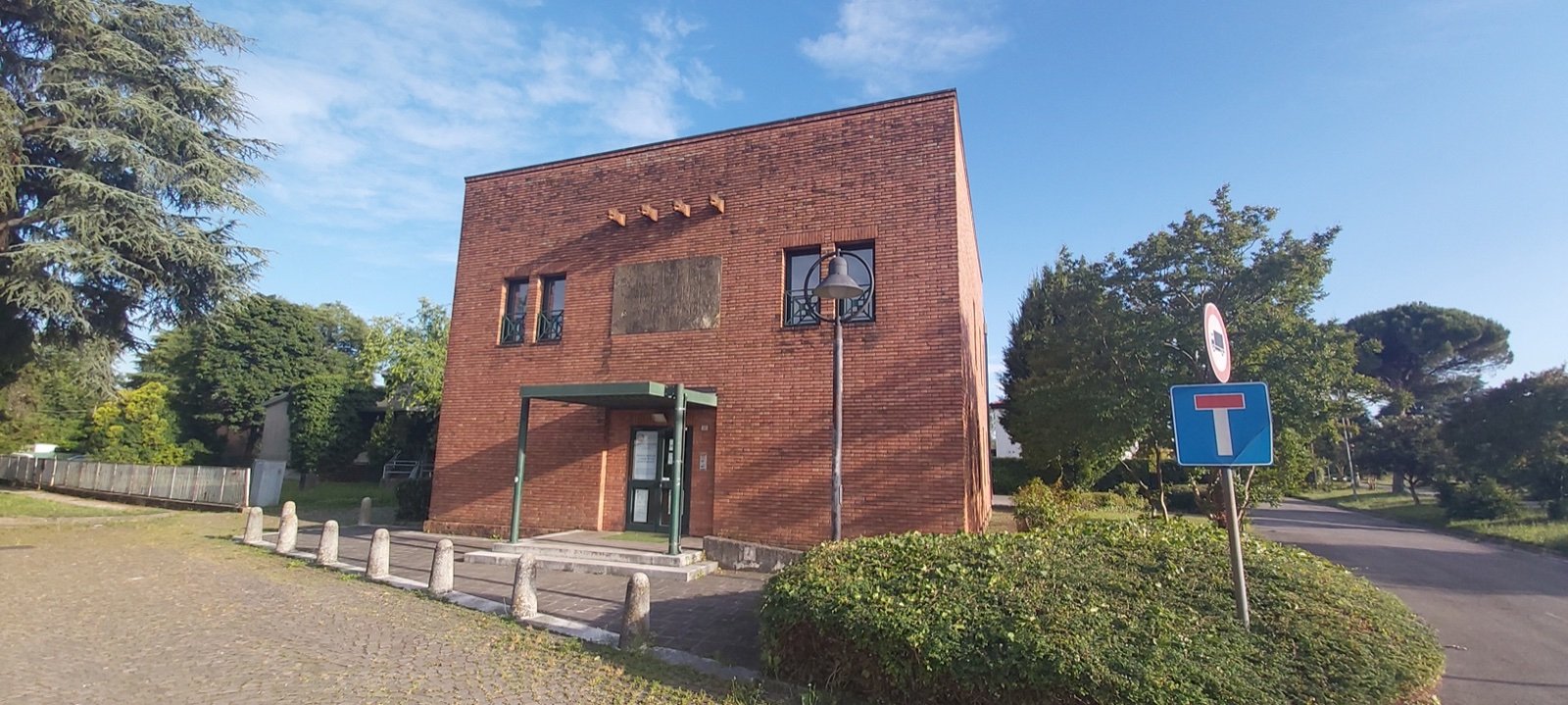
The last stop asks for a short drive or a bus ride. In Rubano, on a small paved square along the old road to Vicenza, stands the ex Casa del Fascio that De Giorgio built between 1937 and 1939, one of a run of rural party houses he produced across the province — at Vigonza, Sant’Urbano, Noventa Padovana, Pontelongo, Piazzola sul Brenta and here. It is a plain brick prism, organised by shallow pilasters that rise into the wall without base or capital. At the top of the facade four terracotta consoles are carved as fasces, and below them a weathered slab still reads Credere, Obbedire, Combattere. The town absorbed the building into civic use after 1945, and it has served as a council office for decades. The archive records the slab and the consoles as part of the fabric: a historical source, described as it stands.
Drive it with the map
The five stops are collected in the curated itinerary Padua Rationalism RoadBook: an interactive map with the route, a play-through tour of the stops, and GPX and KML files for your own navigator. The four city stops sit within a short ride of one another; Rubano adds a fifteen-minute drive west. Each stop links back to its full entry in the archive, with history, sources and practical notes.
Reading the years
The dates on this route run from 1936 to 1952, and the war sits in the middle of them. That is what makes Padua worth reading closely. The architect who set a party slogan onto a rural facade in the late 1930s was, the year after the war ended, designing a cinema for the same city — and the city kept both buildings. These pages document that continuity without celebration and without erasure: who built what, for whom, and what each building has become. Read together with the Italian Rationalism Grand Tour and the quarter built for the exposition that never opened, the Padua route shows the same architectural language at its most local scale: a factory corner, a parish gable, a cinema on a shopping street.