
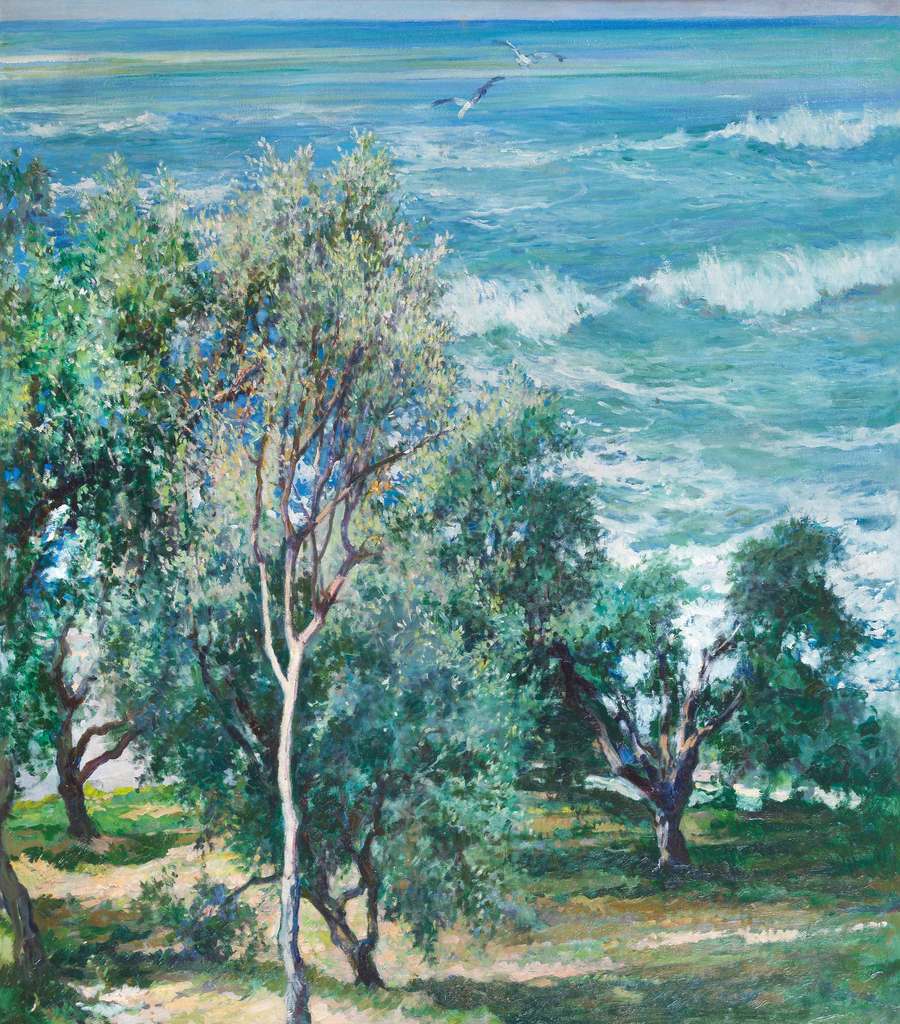
Bonassola is a 1938 painting by Italian painter Antonio Discovolo (1874–1956), depicting the Ligurian coastal village where the artist had settled and worked for much of his life.
Discovolo was born in Bologna and trained at the academies of Florence and Lucca between 1891 and 1896. After moving to Rome in 1899, he came into contact with Symbolist circles and adopted the Divisionist style in the early 20th century, participating in major international exhibitions including the Venice Biennale from 1903 onwards. In the 1920s, his work came under the influence of the Novecento Italiano movement. He moved to Bonassola, in the province of La Spezia, and held five solo exhibitions at the Galleria Pesaro in Milan between 1922 and 1938. Following World War II, Discovolo devoted himself primarily to depicting the countryside of the Liguria region until his death in Bonassola in 1956.
About Antonio Discovolo
Discovolo was an internationally exhibited painter whose career spanned from the Symbolist and Divisionist movements of the early 20th century through the Novecento Italiano period. His relocation to the Ligurian coast marked a shift toward landscape subjects rooted in regional observation.
Details
- Creator: Antonio Discovolo (1874–1956)
- Year: 1938
- Location: Bonassola, La Spezia, Liguria
- Artistic movements: Divisionism, Novecento Italiano
Frequently asked questions
Who was Antonio Discovolo?
An Italian painter born in Bologna in 1874 who studied in Florence and Lucca, exhibited widely at the Venice Biennale from 1903, and came under the influence of the Novecento Italiano movement in the 1920s.
Why did Discovolo move to Bonassola?
Discovolo relocated to Bonassola in La Spezia and spent much of his later life there, making the Ligurian landscape and countryside the primary subjects of his paintings after World War II.
What artistic movements influenced this work?
The painting reflects Discovolo’s engagement with both Divisionism, which he adopted in the early 20th century, and the Novecento Italiano movement, which influenced his work from the 1920s onward.
Sources
- S1 — Gian Ferrari, Claudia, ed. Antonio Discovolo: 1874–1956. Electa, 1990. ISBN 978-88-435-3162-2.
- S2 — Bossaglia, Rossana. Il Novecento Italiano. Feltrinelli, 1979. ISBN 978-88-07-10022-2.
Spotted an error? Write to editorial@culturalheritageonline.com and we correct it the same day.


