
.jpg)
An engineer built himself a house that spins. On a hill above Verona, Villa Girasole turns on rails to face the sun, room by room.
At a glance
Villa Girasole — the “Sunflower” — is a house that rotates. The engineer Angelo Invernizzi designed it as his summer home on a hillside at Marcellise, near Verona, and had it built between 1931 and 1935. An L-shaped villa sits on a circular base and turns on rails around a central tower, so that its rooms and terraces can be swung toward the sun. A full turn takes some nine hours. It was one of the mechanical marvels of interwar Italy, filmed by the Istituto Luce in 1935, and it still stands on its hill today.
Key facts
- What it is: a rotating house, the “Girasole” (sunflower)
- Designer: Angelo Invernizzi, engineer — with Romolo Carapacchi (mechanics), Ettore Fagiuoli (architect) and Fausto Saccorotti (interiors)
- Built: designed 1929; constructed 1931–1935 (summers only)
- Plan: L-shaped, two storeys, on a circular base over 44 metres across; central tower about 42 metres tall
- Rotation: 15 carriages on three circular rails, two of them motorised; a full 360° turn takes about 9 hours 20 minutes
- Materials: concrete and fibre-cement, later clad in aluminium after the concrete cracked
- Where: Marcellise, San Martino Buon Albergo, province of Verona
History
Angelo Invernizzi was a wealthy engineer from Genoa, and Villa Girasole was his own idea: a summer house that could follow the sun like the flower it is named for. He began designing it in 1929 and built it over several summers, finishing in 1935, with the mechanical engineer Romolo Carapacchi working out the rotation, the architect Ettore Fagiuoli shaping the building, and Fausto Saccorotti decorating the interiors.
The result was less a villa than a machine for living. In December 1935 the Istituto Luce put it on cinema screens across Italy as a national curiosity — the drawings, the gears turning under the terrace, the tower swinging into a new position. The house belongs to the same interwar moment as Italy’s rationalist architecture, but it is closer in spirit to its engineering: a private experiment in living with the sun, carried through at full scale.
What you see
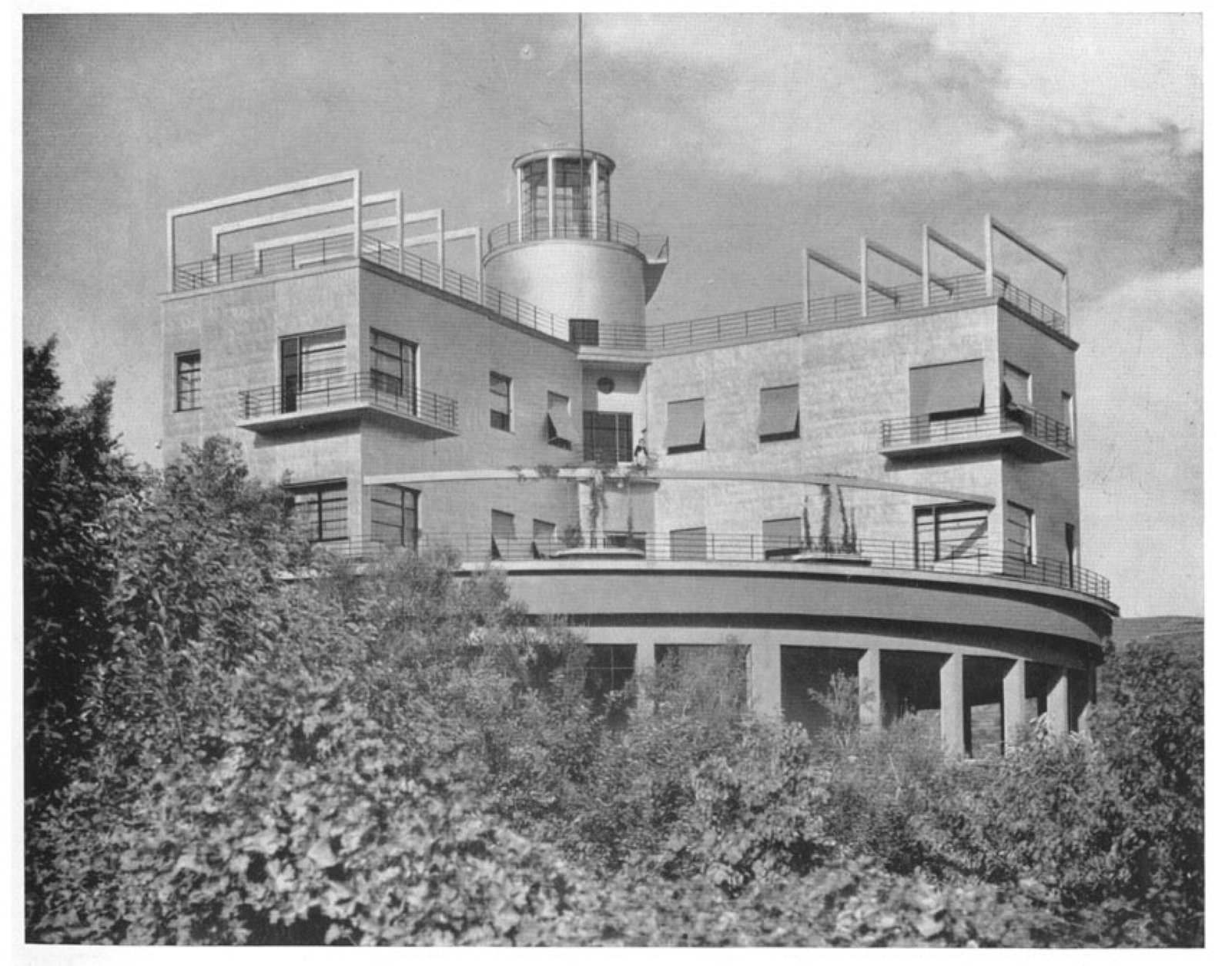
The villa reads as two things stacked. A low, curved base rests on the ground, its front opening in a run of arches; on top of it sits the mobile house — an L of two storeys, with long strip windows, cantilevered balconies and roof terraces in the clean lines of the 1930s. At the inner corner rises a cylindrical tower topped by a glazed belvedere: this is the pivot, the fixed axis the whole house turns around.
Set among vineyards on the slope above Marcellise, the white building still cuts the same modern profile it did in the 1936 photograph above. The circular track and the arcaded base give it away: this is not a villa that merely looks out over the valley, but one that can turn to meet it.
How it turns
The moving house rests on a central pivot and on fifteen carriages that run on three concentric circular rails fixed to the base. Two of the carriages are motorised, and a guide ring of rollers holds the central tower steady and stops the structure from swaying as it moves. Turning the whole villa takes very little power — the 1935 newsreel put it at under two horsepower — and the rotation is slow: about four millimetres a second, a complete circle in a little over nine hours. Invernizzi could set the house facing wherever the light was best and let it drift round with the day.
On film, 1935
The Istituto Luce filmed Villa Girasole the year it was finished. The newsreel below is Giornale Luce B0791, released 4 December 1935: the architectural drawings, the gears and rollers turning beneath the terrace, the wheels on their rails, and the tower shown in different positions as the house rotates.
Source: Archivio Storico Luce, Giornale Luce B0791 (4 December 1935) — archivioluce.com.
Practical information
- Status: a private villa, not a regular public museum.
- Seeing it: the building and its hillside setting are visible from the roads and vineyards around Marcellise.
- Setting: the Marcellise valley east of Verona, wine country in the hills of the Valpantena side.
Getting there
Marcellise is a hamlet of San Martino Buon Albergo, about ten kilometres east of Verona. It is reached by road from the Verona Est motorway exit or from San Martino Buon Albergo; the villa stands on the hillside above the village. Verona, with its airport and main railway station, is the nearest gateway.
Nearby
- Verona: the Roman arena and historic centre, about ten kilometres west.
- Valpantena: the wine hills around Marcellise, planted with vineyards and olives.
- San Martino Buon Albergo: the parent town in the plain below.
See the place
Sources
- “Villa Girasole,” English Wikipedia — Angelo Invernizzi and his collaborators, the 1929–1935 dates, the L-shaped plan on a circular base, the fifteen carriages on three tracks, the roughly nine-hour rotation, and the change from concrete to aluminium.
- Archivio Storico Luce — Giornale Luce B0791 (4 December 1935), the newsreel of the rotating house, which describes the pivot, the fifteen carriages and the motorised drive.
Find it on the map
See this place and what’s around it →Record researched and written by Stefano Vigolo for Cultural Heritage Online, 2026.
Events here — now on & upcoming
- Anniversary: Villa Girasole in the Luce Newsreel — December 4, 193504 Dec 2026See the event →
📷 Become a Cultural Heritage Online photographer
Share your photos of places: they stay published under your name as the author. The more they're seen, the more you get noticed — and soon a contest will reward the most appreciated photos.
Log in or sign up free to add a photoIs this page about you?
This page is read by travellers and heritage enthusiasts who find it on Google. Tell us how you are connected to this place and we will take it from there.