
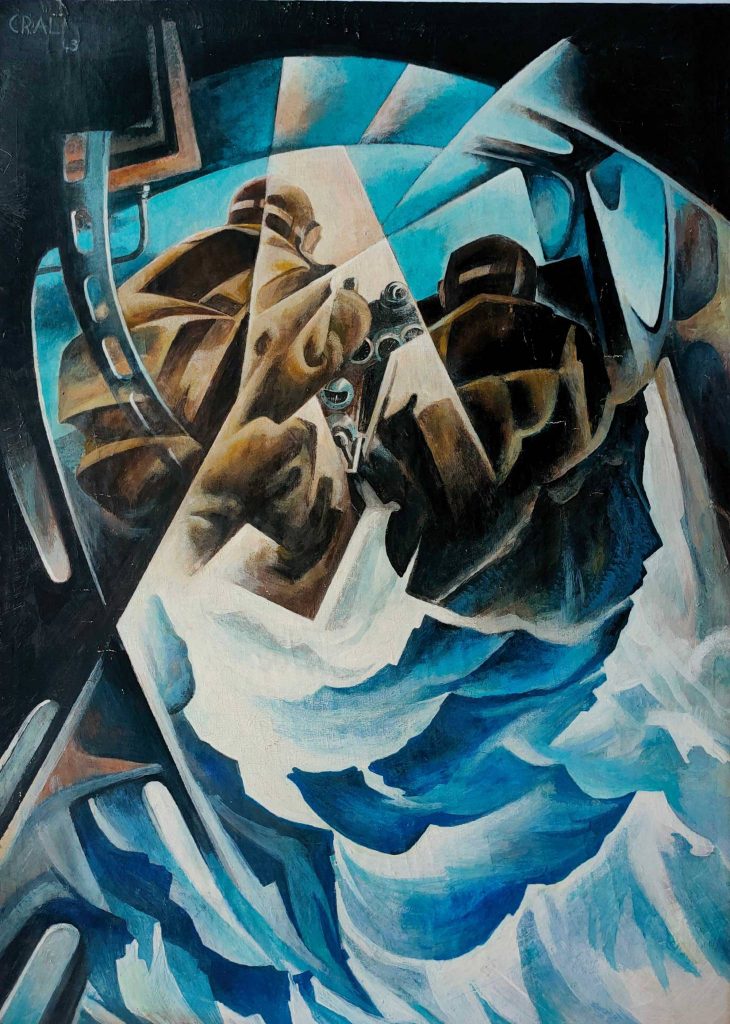
Aquile sull’Olimpo is a painting by Tullio Crali created in 1943. Crali, a Dalmatian Italian artist, joined the Futurist movement in 1929 and became known for realistic compositions exploring speed, aerial mechanisation and the mechanics of aerial warfare.
Working in the final years of Italy’s interwar period, Crali synthesised aeronautical themes with the Futurist preoccupation with dynamism and technological modernity. The title—Eagles on Olympus—invokes both classical mythology and the velocity-driven aesthetic central to Futurism. Though Crali maintained an extended career working across multiple styles, his commitment to rendering aviation and mechanised movement remained a defining aspect of his practice.
About Tullio Crali
Crali was a self-taught painter of Dalmatian Italian heritage. A late adherent to Futurism, he joined the movement in 1929 and pursued realistic representations of speed and aerial forms throughout a lengthy artistic career, while also engaging with other pictorial approaches.
Details
- Creator: Tullio Crali
- Year: 1943
- Movement: Futurism
- Medium: Painting
- Subject: Aerial imagery, speed, mechanisation
Frequently asked questions
Who was Tullio Crali?
Tullio Crali was a Dalmatian Italian painter and self-taught artist who joined the Futurist movement in 1929. He is noted for realistic paintings combining speed, aerial mechanisation and the mechanics of aerial warfare.
What is the painting about?
The work explores aerial and mechanical themes through its title, Eagles on Olympus, merging classical mythology with Futurist preoccupations with speed and technological modernity.
When was it created?
Aquile sull’Olimpo was painted in 1943, during the final years of Italy’s interwar period.
Sources
- S1 — Berghaus, Günter, ed. Futurism and the Technological Imagination. Rodopi, 2009. ISBN 978-90-420-2747-3.
- S2 — Tisdall, Caroline, and Angelo Bozzolla. Futurism. Thames and Hudson, 1977. ISBN 978-0-500-20159-6.
Spotted an error? Write to editorial@culturalheritageonline.com and we correct it the same day.


