
Curated Itinerary
Guimard’s Paris: An Art Nouveau RoadBook (1898–1913)
Travel tips from CHOUnder 26 and living in the EU? Walk in freeThe permanent collections of France’s national museums have […]
Take this route into Google Maps
From Castel Béranger to Maxim’s, Paris, in the order we curated them.
➤ Turn on the navigator in Google MapsIt opens in the Google Maps app with every stop already loaded, in the order we put them in. From there the route is yours: pick how you travel — on foot, by bike, by public transport or by car — change where you start and where you end, drag the stops into a different order, and add places of your own along the way.
Get this route — explore at your own pace
The walk and the notes are open to everyone, right here. To take the route with you — the GPX and KML tracks for your phone — you need a CHO account, and a free one is enough. We do not sell these routes: we build them ourselves and give them to the people who read us.
Create a free accountAlready have one? Log in.
This route was built with the tools we give operators.
Guides, associations and cultural operators build their own routes here: pick the stops from the archive, add your notes, and the map, the GPX and the printable version come out on their own. Your programme gets a permanent page, your events go on the city pages people read while planning — and if you sell your route as a road-book or a virtual tour, you receive 80% of the price net of tax.
See how an operator account worksBefore you go
A word from your host
Rue La Fontaine in the 16th is the street to know. Guimard lived here, built four residential buildings here, and the street gives you more concentrated Art Nouveau facades per 500 metres than anywhere else in Paris. Most visitors see only the Métro entrances. Start at rue La Fontaine instead — then take the Métro east to see what those entrances actually led people into.
Getting around
The itinerary begins in the 16th arrondissement — where Guimard lived and built his most concentrated residential work — then moves east and south by Métro to the Marais, the 1st arrondissement, and the 8th. Total on foot: approximately 4.5 km, plus two Métro legs of 25–30 minutes each. Allow a full day: 5 to 6 hours including stops, with extra time if you go inside La Samaritaine or the Maxim's museum. The 16th cluster (Castel Béranger → Hôtel Mezzara → Porte Dauphine) is completely walkable and takes about 90 minutes. Public transport: Métro lines 2 and 12 serve the main transitions.
Step by step
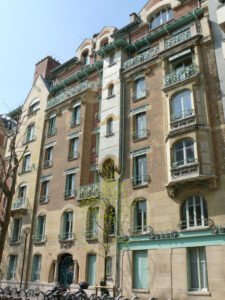
Castel Béranger
Cross the street to see the full facade. The entrance gate is the most intricate ironwork panel — photograph it in morning light.
The storyWhen Castel Béranger won the 1898 Concours des façades de Paris — the city's annual prize for the most beautiful new building facade — it made Guimard instantly famous. The jury awarded him first prize for a building that journalists had already nicknamed 'Maison Cocagne' (the haunted house) and that at least one tenant reportedly left in protest. The neighbourhood hated it. The city loved it. Guimard received the Métro commission the following year.
Insider tipThe building has a cobbled internal courtyard: if the street door is unlocked, walk in and look at the tiles and ironwork above the archway. The original interior fittings — designed by Guimard — are mostly gone, but the staircase ironwork is intact. Also look at numbers 17, 19, 21 and 60 on rue La Fontaine: further Guimard facades on the same street.
A fitting stopCafé de la Fontaine at 13 rue La Fontaine for coffee before you start. The patisserie at the corner of rue Gros has good croissants early.

Hôtel Mezzara, Paris – Virtual Tour 360°
Private residence, exterior only. Walk the full length of rue La Fontaine before continuing — at least four other Guimard buildings are on this single street.
The storyPaul Mezzara was a textile entrepreneur who made his fortune in the Paris lace industry. In 1910, he commissioned Guimard to build him a private town house on the street where Guimard himself lived. The result was one of the last great residential commissions of the Art Nouveau period — and one of the most restrained. By 1914, Mezzara had sold the house; the fashion for organic ornament had already passed. The building was later a girls' boarding school, ceded to the French state in 1956, and is today destined to become the future Musée Guimard.
Insider tipThe facade on rue La Fontaine is private and cannot be entered, but the full elevation is visible from the street. Unlike Castel Béranger, Mezzara is quieter: the ornament concentrated on the upper window surrounds and roofline. The contrast shows how Guimard's vocabulary modulated over the decade between the two buildings.
A fitting stopBoulangerie at 55 rue La Fontaine and a café-tabac at the corner with rue Ribera. Stock up before the walk to Porte Dauphine.
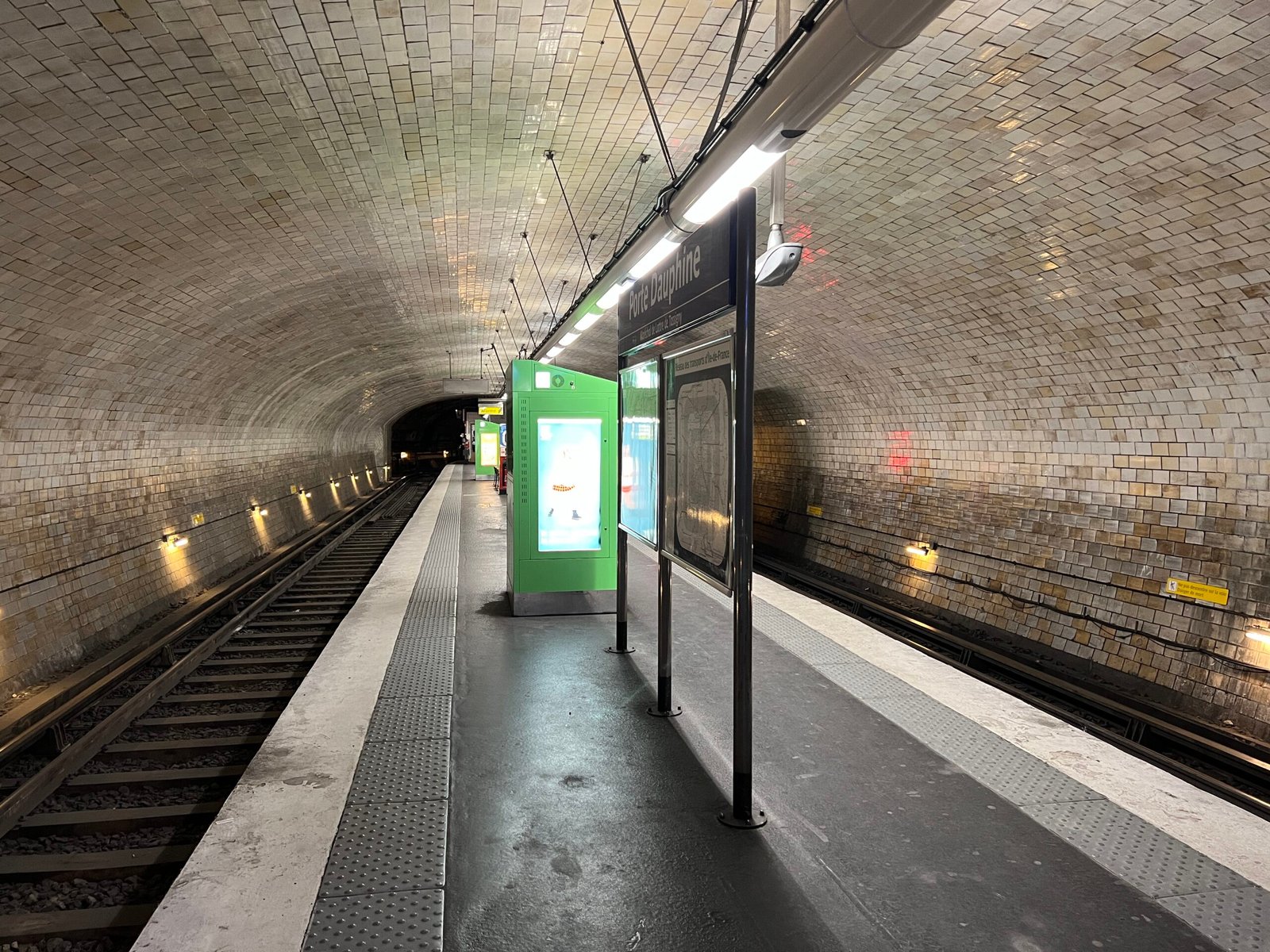
Porte Dauphine Métro Entrance — Guimard Édicule
Take Métro line 2 east from Porte Dauphine toward Nation, change at Charles de Gaulle–Étoile for line 12 north to Abbesses. About 25 minutes.
The storyThe Paris Métro opened in July 1900, built for the Exposition Universelle. Guimard was commissioned to design a system of cast-iron édicules — covered pavilions for the station entrances — of which Porte Dauphine and Abbesses are the only two surviving complete examples. The design was nicknamed 'style nouille' (noodle style) by critics. It is now the visual shorthand for Paris itself.
Insider tipPorte Dauphine has a full glass canopy — the most intact of all Guimard Métro structures. Stand at the top of the stairs and look down into the green ironwork. The originals were made by the Val d'Osne foundry from Guimard's drawings. When the Métro modernised in the 1960s, most were demolished; Porte Dauphine was saved because it was on the outer edge of the network and was deemed less obstructive to pedestrian flow.
A fitting stopCafés on Boulevard Maillot adjacent to the station. Or sit on a bench at the Bois de Boulogne entrance — the park is directly adjacent.

Abbesses Métro Entrance — Guimard Édicule
Take the Art Nouveau elevator down, not the stairs — look up at the tiled tube as you descend. Then take M12 south to Concorde, then M1 east to Saint-Paul.
The storyThe Abbesses édicule is not where Guimard designed it to be. The original covered structure was built for Hôtel de Ville station in 1900. When Hôtel de Ville was modernised in 1974, the édicule was carefully dismantled, transported to Montmartre, and re-erected at Abbesses. This transfer is the story of how Paris decided it valued Guimard after decades of regarding his Métro entrances as an embarrassment.
Insider tipTake the elevator down and look up as you descend through the ceramic-tiled tube — hand-laid in off-white with mustard-green detailing, an intact example of the original Métro interior design. At street level, step back and photograph the édicule from the south side of the Place des Abbesses: the structure with Sacré-Coeur on the hill behind is one of the canonical Paris photographs.
A fitting stopLe Sancerre at 35 rue des Abbesses is a classic neighbourhood bistro, good for lunch if you are here midday. Several cafés ring the Place des Abbesses.
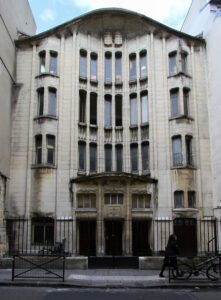
Guimard Synagogue — Agoudas Hakehilos, rue Pavée
Walk west on rue Saint-Antoine, then along rue de Rivoli to La Samaritaine on the quai. Or detour via rue des Rosiers through the Marais Jewish quarter.
The storyGuimard designed the Agoudas Hakehilos synagogue in 1913, the same year he married the American Jewish painter Adeline Oppenheim. The building is on a street under eight metres wide in the Marais, and the facade works within a compressed vertical format, concentrating the organic ornamental vocabulary into a narrow column of curves. It is one of the most unusual religious buildings in Paris, and one of the most easily missed.
Insider tipThe synagogue is active and closes on Saturdays. The exterior on rue Pavée is the primary sight. A plaque on the facade records that the building survived the Second World War: the Gestapo entered in 1942, but the community had hidden the Torah scrolls and some interior fittings. The building itself was not destroyed.
A fitting stopRue des Rosiers, the main street of the historic Jewish quarter, is a two-minute walk west. L'As du Fallafel at number 34 is legendary. Boulangerie Murciano at number 15 has a particularly good babka.
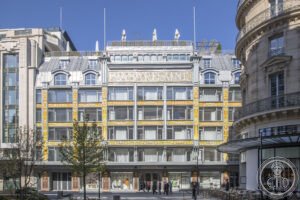
La Samaritaine
Go inside — the restored atrium is free to enter. Then walk north through the Tuileries garden to Place de la Concorde and up rue Royale to Maxim's.
The storyLa Samaritaine was founded in 1870 by Ernest Cognacq, who said his goal was to sell 'everything to everyone.' Architect Frantz Jourdain designed the main building facing the Seine between 1905 and 1910. La Samaritaine was closed in 2005 for safety reasons and reopened in June 2021 after a 16-year renovation by SANAA architects. The peacock-motif iron balconies and the glazed central atrium are intact.
Insider tipThe interior atrium is free to enter — it is now part of the DFS retail space. Go in through the main entrance on rue de la Monnaie and look up: the restored iron structural frame, with its Art Nouveau stencilled panels, is the best surviving commercial Art Nouveau interior in Paris. Then walk to the river terrace for a view of the Seine and the Île de la Cité directly opposite.
A fitting stopThe building has Café Lapérouse inside and Brasserie Lola on the upper floor, both pricey. For better value, walk 50 metres west to the Pont Neuf end where there are traditional neighbourhood cafés.

Maxim’s, Paris
End of route. The first-floor museum has separate entry. If budget allows, the bar puts you inside the most complete Belle Époque interior in Paris.
The storyMaxim's was founded in 1893 by Maxime Gaillard. The Art Nouveau interior was created in 1899, in time for the 1900 Exposition Universelle. By the early 1900s it had become the headquarters of Belle Époque Parisian social life — a point Franz Lehár acknowledged by setting the third act of The Merry Widow at Maxim's in 1905. The restaurant was bought by Pierre Cardin in 1981, who added a museum of Belle Époque objects and costumes on the upper floor.
Insider tipThe ground-floor restaurant is very expensive; the first-floor museum (Cardin's Belle Époque collection) has a separate entry ticket and is the better option for the heritage visitor. The Art Nouveau interior — mahogany banquettes, painted glass panels, copper murals, marouflaged ceiling — is classified as a monument historique. Visit before 17:00.
A fitting stopThis is the end of the route. If budget allows, even a drink at the Maxim's bar puts you inside the most complete Belle Époque interior in Paris. Otherwise, there are brasseries on Place de la Concorde a few minutes south.
Download for tour navigation
🔒 The walk and the notes are open to everyone on this page. The files to take with you — the stop list as a PDF, and the GPX and KML tracks for your phone — come with a CHO account, and the free one includes them.
Walk it with the navigator on
It opens in the Google Maps app with every stop already loaded, in the order we put them in. From there the route is yours: pick how you travel — on foot, by bike, by public transport or by car — change where you start and where you end, drag the stops into a different order, and add places of your own along the way.