
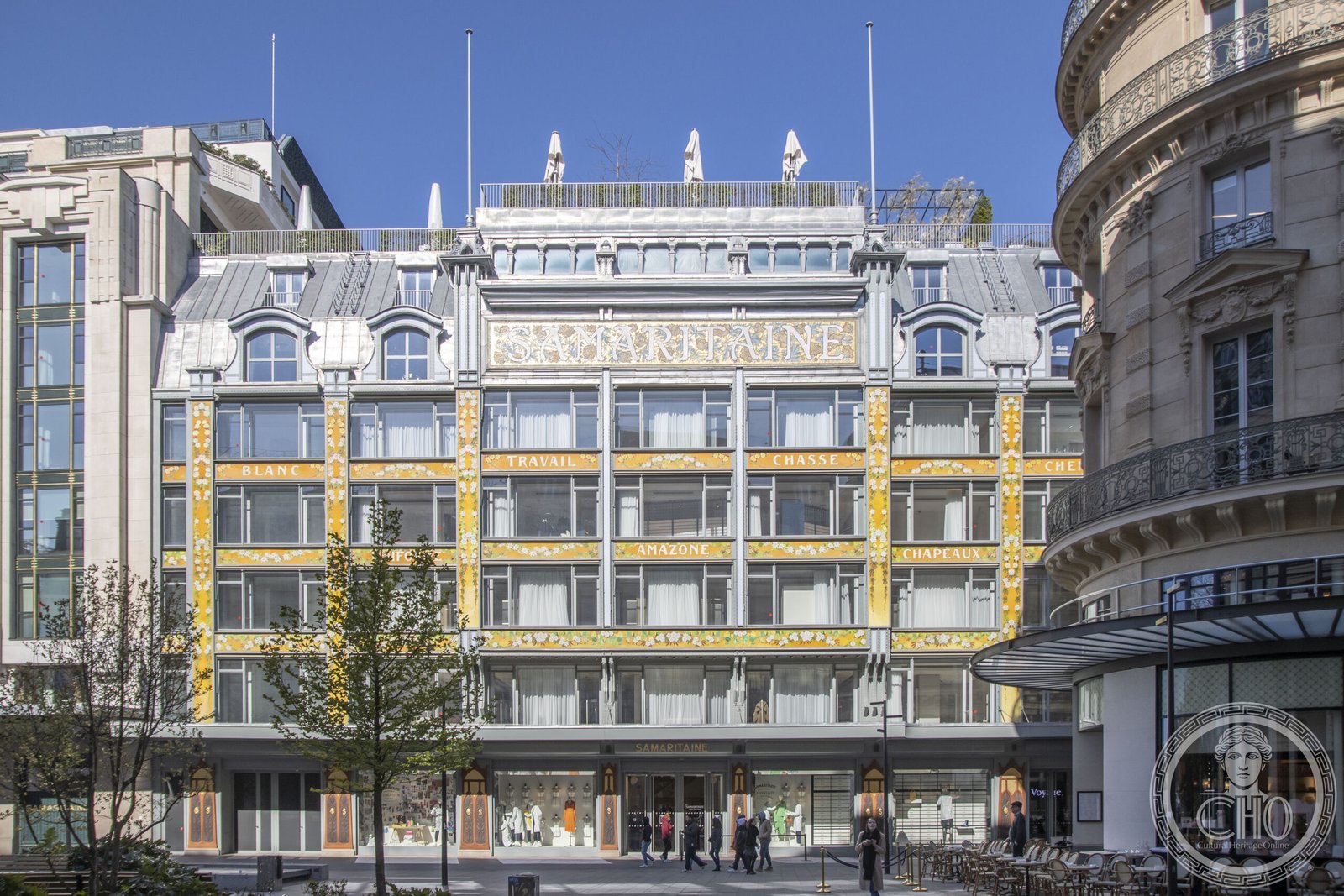
La Samaritaine is one of Paris’s most architecturally celebrated department stores, occupying a prime position on the right bank of the Seine near the Pont Neuf. Founded in 1870 by Ernest Cognacq, it grew through successive building campaigns to encompass four interconnected structures displaying both Art Nouveau and Art Deco idioms at their most lavish. The most famous facade — a sweeping Art Deco composition completed by Henri Sauvage in 1928 — remains an iconic image of interwar Paris. Closed for safety reasons in 2005 and reopened after a 16-year, €750 million restoration in 2021, it is today a luxury retail complex owned by LVMH and a testament to Paris’s capacity to reinvent its grandest historic buildings.
At a glance
- Style
- Art Nouveau (1910) and Art Deco (1928)
- Founded
- 1870
- Principal architects
- Frantz Jourdain; Henri Sauvage
- Location
- 19 Rue de la Monnaie, 1st arrondissement, Paris, France
- Floor area
- 48,000 m²
- Current owner
- LVMH (via Groupe Bon Marché)
- Reopened
- 2021 (after €750 million restoration)
- Coordinates
- 48.8589° N, 2.3421° E
Overview
Stretching between Rue de Rivoli and the Seine, La Samaritaine is far more than a department store: it is an architectural anthology of Paris’s commercial grandeur from the Belle Époque through the interwar years. Founder Ernest Cognacq turned a small dry-goods stall into one of the city’s four great grands magasins over six decades of expansion. The complex’s defining image is the stepped Art Deco facade facing the Seine, designed by Henri Sauvage and Frantz Jourdain between 1926 and 1928, adorned with geometric reliefs and monumental lettering that made it a postcard fixture. After closure, restoration, and LVMH’s transformation, the store reopened in 2021 combining luxury retail, a hotel, social housing and a crèche in one block.
History
Ernest Cognacq opened a modest shop on the corner of Rue du Pont-Neuf and Rue de la Monnaie in 1870, naming it after the old Samaritaine water pump that had stood on the Pont Neuf until 1813. Architect Frantz Jourdain redesigned the interior in 1891 and completed a lavish Art Nouveau building (Magasin 2) in 1910, with its famous enamelled floral ironwork and glass roof. Expansion toward the Seine in 1926–1928 produced the Art Deco Magasin 2 riverside wing with Sauvage. Further additions in 1930 and 1932 completed the four-building complex. Trading continued until June 2005 when authorities ordered closure over safety standards. LVMH acquired full ownership and entrusted the restoration to Samaritaine Paris Pont-Neuf, reopening the site in June 2021.
Architecture & Design
La Samaritaine is a study in contrasts across its four buildings. Jourdain’s 1910 Magasin 2 embodies Art Nouveau at its most exuberant: a wrought-iron armature filled with ceramic peacock-feather panels, a glazed atrium roof flooding the interior with light, and sinuous organic ornament on every surface. The 1928 riverside wing, co-designed by Jourdain and Sauvage, pivots decisively toward Art Deco — its boldly stepped roofline, geometric low-relief sculpture and chunky block lettering spelling out “SAMARITAINE” across the facade became the complex’s visual signature. The 2021 restoration by SANAA architects added an undulating glass and printed-frit facade on Rue de Rivoli that fuses contemporary design with the historic context, a move praised and debated in equal measure.
Cultural significance
In its heyday La Samaritaine was not merely a shop but a social institution — a place where Parisians of every class could experience the spectacle of modernity. The store’s 1970s advertising slogan “On trouve tout à la Samaritaine” (“You can find everything at La Samaritaine”) entered the French language as shorthand for completeness. Cognacq and his wife Marie-Louise Jaÿ used the fortune it generated to create the Musée Cognacq-Jay, bequeathing their collection of 18th-century art to the city of Paris. The building’s preservation and reinvention under LVMH has reignited debate about heritage, luxury capital, and the social fabric of central Paris, where the store now also provides 96 social-housing units.
Visiting today
La Samaritaine is open Monday to Saturday 10:00–20:00 and Sunday 11:00–19:00. The ground floor and public atrium areas are accessible without a purchase. The landmark Art Nouveau interior of the historic Magasin 2, including its restored peacock-panel atrium, can be viewed during shopping hours. The rooftop terrace of the Cheval Blanc hotel — located within the complex — offers exceptional views of the Seine and Notre-Dame, accessible to hotel and restaurant guests.
Getting there
La Samaritaine is located at 9 Rue de la Monnaie in the 1st arrondissement. The nearest metro station is Pont Neuf (line 7), a two-minute walk. Châtelet–Les Halles (lines 1, 4, 7, 11, 14 and RER A/B/D) is a five-minute walk. Bus lines 67, 69, 72, 74 and 76 stop nearby. The Vélib’ bike-share network has stations along Rue de Rivoli and by the Pont Neuf. The store is not recommended for car access; the nearest paid parking is at Châtelet.
Sources & resources
Find it on the map
See this place and what’s around it →Record researched and written by Luigi De Marchi for Cultural Heritage Online, 2026.
📷 Become a Cultural Heritage Online photographer
Share your photos of places: they stay published under your name as the author. The more they're seen, the more you get noticed — and soon a contest will reward the most appreciated photos.
Log in or sign up free to add a photoIs this page about you?
This page is read by travellers and heritage enthusiasts who find it on Google. Tell us how you are connected to this place and we will take it from there.