

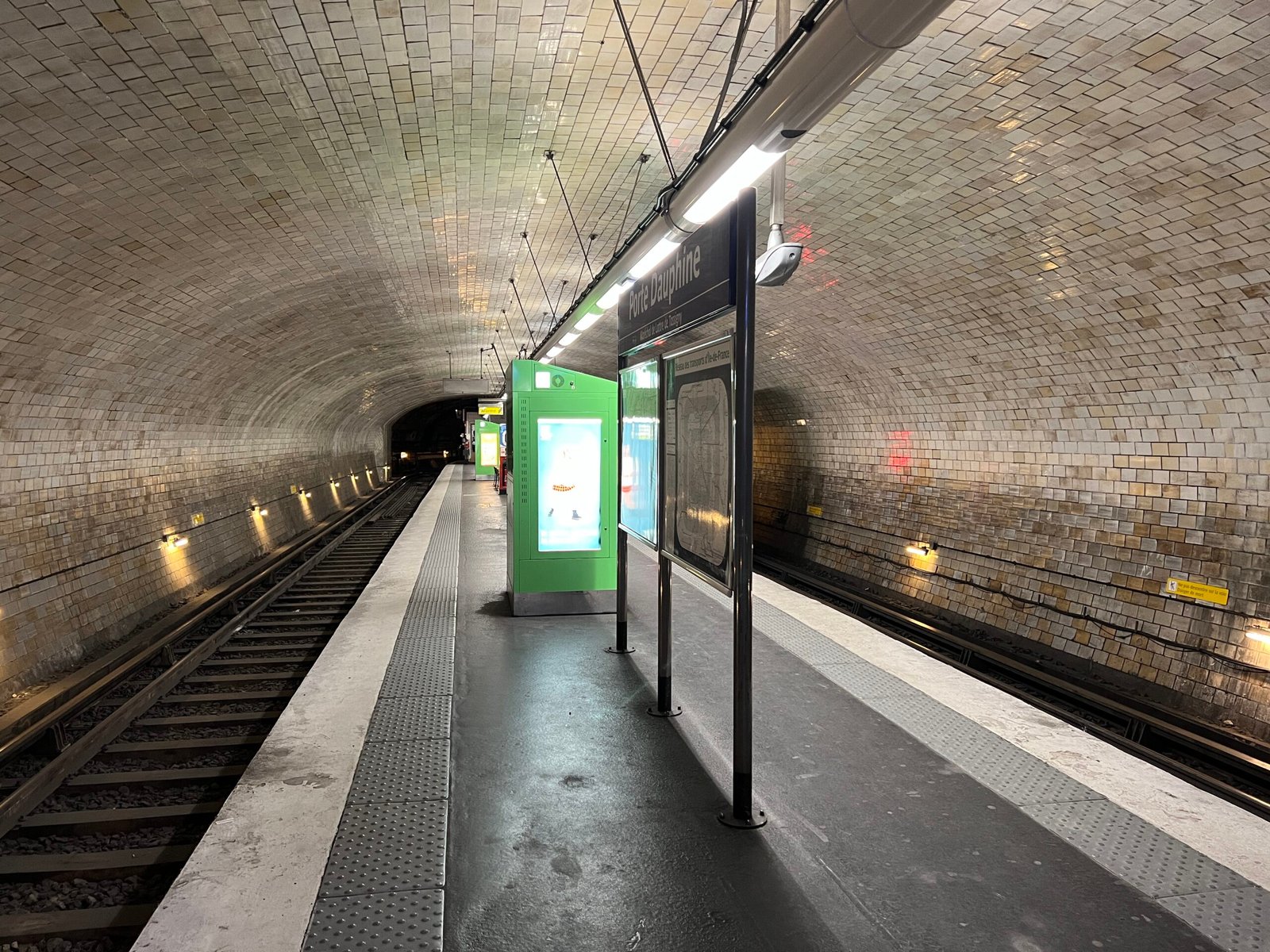
The only one of Guimard’s glass-roofed Métro pavilions still standing where he built it: a cast-iron-and-glass canopy on the edge of the Bois de Boulogne, in place since 1900.
At a glance
Porte Dauphine keeps the most complete survivor of Hector Guimard’s Métro architecture: a fully roofed édicule that has never moved from its original site at the western terminus of line 2. It was built with the station, inaugurated on 12 December 1900, the year the first Métro lines opened for the Exposition Universelle. The orange-shaded glass canopy and green cast-iron framing are the reference original against which every other Guimard entrance is measured — including the one relocated to Abbesses in 1974 and the replica at Châtelet. The station sits at the edge of the Bois de Boulogne in the 16th arrondissement.
Key facts
- Built: 1900, with the station
- Architect: Hector Guimard (1867–1942)
- Station inaugurated: 12 December 1900 (Paris Métro line 2)
- Style: Art Nouveau (Style Guimard / Style Métro)
- Address: Place du Maréchal-de-Lattre-de-Tassigny / Avenue Foch, 75016 Paris, France
- GPS: 48.871389, 2.276667 — Open in Google Maps
- Status: Listed monument historique; the only surviving glass-roofed édicule on its original site
History
The first section of the Paris Métro opened in 1900, timed to the Exposition Universelle, and Guimard’s entrances gave the new network its public face. Porte Dauphine was the western terminus of line 2 Nord, set under the square at the edge of the Bois de Boulogne. Its roofed glass canopy went up with the station and has stood there ever since.
That continuity is rare. Across the twentieth century most of Guimard’s roofed édicules were taken down — transport authorities found them dated and hard to maintain — and his open entrances fared little better. Porte Dauphine survived in place to become the benchmark original: the Abbesses édicule was transplanted from Hôtel de Ville in 1974, and Châtelet received an outright replica. Only here can the canopy be read exactly where and as Guimard set it.
The entrance and the station’s Art Nouveau fabric are protected as a monument historique. The station itself is quiet by Paris standards, sitting at the city’s western gate; its corridors were refreshed under the RATP’s renovation programme in 2011, but the Guimard canopy above ground was left as the heritage piece it is.
What you see
Cast-iron stems rise and spread into a fan of amber and orange glass set in green ironwork, the roof curving over the stair like a folded wing. The cartouche reads “Métropolitain” in Guimard’s hand-drawn lettering. Every strut is cast with leaf-and-stalk forms, so the ornament and the structure are one and the same — the principle behind all his Métro work.
Because this canopy is both original and in situ, the way it meets the avenue and the green edge of the Bois feels deliberate rather than transplanted. Stand back from the square and the small glass pavilion reads as Guimard intended: a piece of the forest’s organic line surfacing at the mouth of the underground.
Practical information
- Access: A working Métro entrance, open during operating hours; free to view from the square
- Best view: From the square above ground, where the full canopy is visible
- Best light: Afternoon, with the western sun behind the Bois
- Time needed: 10–15 minutes for the entrance
- Combine with: A walk into the Bois de Boulogne, or along Avenue Foch toward the centre
Getting there
The entrance is at the western edge of the 16th arrondissement, under the Place du Maréchal-de-Lattre-de-Tassigny where Avenue Foch meets the Bois de Boulogne. You arrive at it directly on Métro line 2, of which it is the terminus, and on tramway line T3b. The RER C stop Avenue Foch is close by. From central Paris, line 2 runs the length of the Right Bank’s northern arc to reach it.
Nearby
- Bois de Boulogne, immediately to the west
- Avenue Foch, the broad axis running back toward the Arc de Triomphe
- Abbesses — the twin surviving Guimard édicule, in Montmartre
- Paris — Belle Époque, Art Nouveau & Modernism (city guide)
Sources
- Plateforme Ouverte du Patrimoine (POP) / base Mérimée — monument historique record, Ministère de la Culture
- RATP — Paris transport heritage documentation
- Musée d’Orsay — Hector Guimard collections and documentation
Find it on the map
See this place and what’s around it →Record researched and written by Luigi De Marchi for Cultural Heritage Online, 2026.
📷 Become a Cultural Heritage Online photographer
Share your photos of places: they stay published under your name as the author. The more they're seen, the more you get noticed — and soon a contest will reward the most appreciated photos.
Log in or sign up free to add a photoIs this page about you?
This page is read by travellers and heritage enthusiasts who find it on Google. Tell us how you are connected to this place and we will take it from there.