
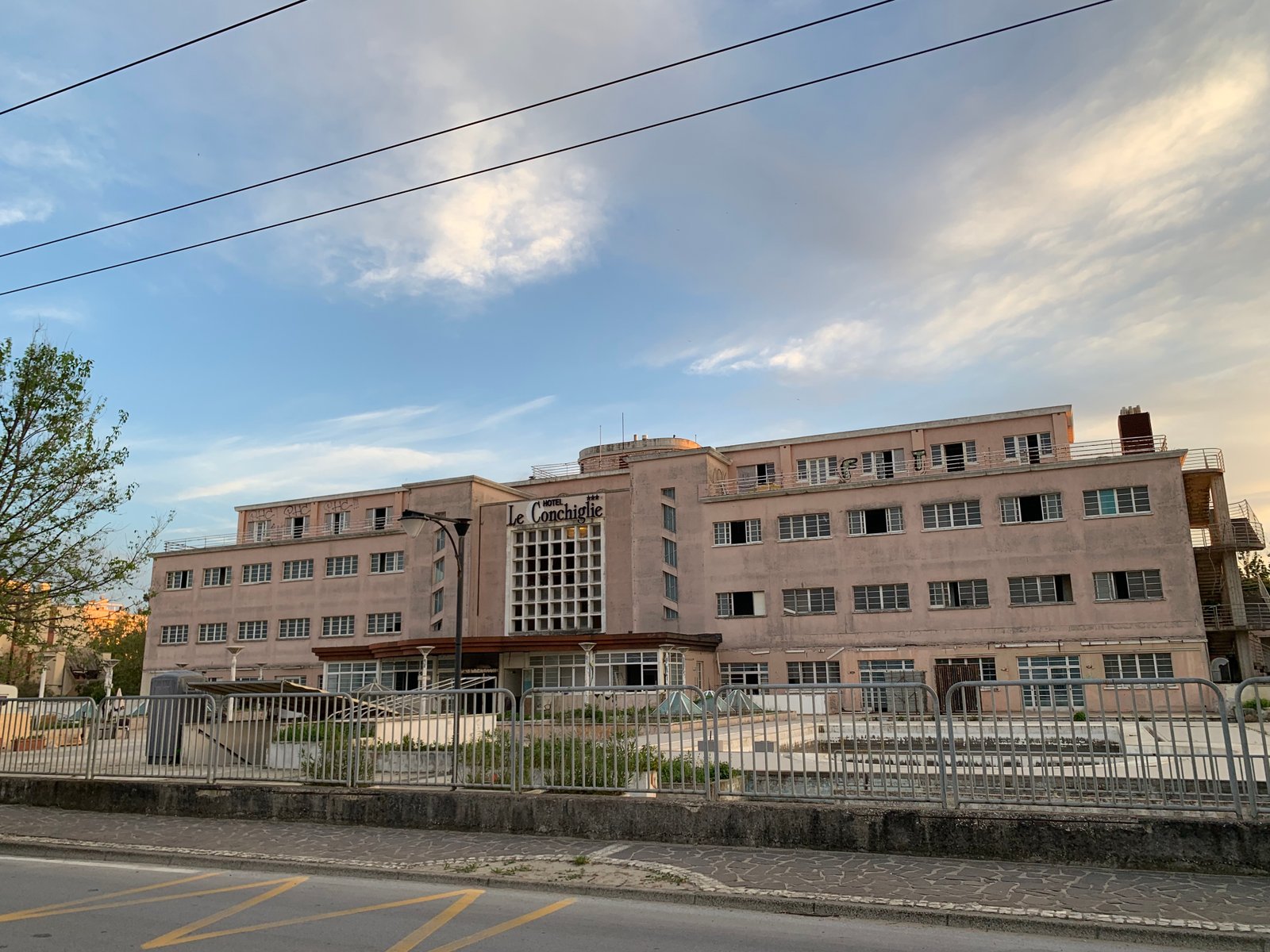
Built in 1936 along the Adriatic shore at Riccione, the Colonia Marina Dalmine was commissioned by the Societa Anonima Pro Dalmine to host the children of steelworkers from the Dalmine factory town. Designed by the Milanese architect Giovanni Greppi, the building applies the disciplined volumetry of the Italian Novecento alongside the functional clarity that defined seaside colonies of the Razionalismo years. Listed in the Italian Cultural Heritage catalogue in 2002, the complex is being converted into a luxury hotel after decades operating as Hotel Le Conchiglie.
- Address.
- Viale Gabriele D’Annunzio 227, Riccione (RN), Emilia-Romagna.
- Period.
- Built 1936, in five months.
- Architect.
- Giovanni Greppi (Milan, 1884 — Milan, 1960).
- Client.
- Societa Anonima Pro Dalmine.
- Style.
- Italian Rationalism with Novecento monumentality.
- Function.
- Originally a seaside colony for children of Dalmine steelworkers; subsequently Hotel Le Conchiglie; currently under conversion to a luxury hotel.
- Capacity / Size.
- 400 children per shift across two annual summer shifts; built volume around 23,000 cubic metres on roughly 35,573 square metres of grounds with private beach.
- Status.
- Listed in the Italian Cultural Heritage catalogue since 2002; under restoration in 2024-2025.
- Coordinates.
- 44.0232° N, 12.6322° E.
Visit on the map
Viale Gabriele D’Annunzio 227, Riccione (RN) · 44.0232° N, 12.6322° E
Download for your navigator
A single waypoint, ready for GPS apps, navigators, and contacts.
Story
The Colonia Marina Dalmine traces its origin to a precise act of paternalistic industry. In 1935 the Societa Anonima Pro Dalmine, founded the year before with the welfare of the Dalmine steelworks employees as its statutory purpose, purchased a coastal lot in Riccione for eighty thousand lire. The brief was to give the workers children a summer destination by the sea, removed from the smoke of the Bergamasco factory town. Giovanni Greppi, already the architect of the company town of Dalmine and at the height of his career, was entrusted with the project in 1936. Construction was completed in only five months, in time for the colony to open with the customary fanfare of the late fascist era. The choice of Greppi tied the seaside building back to its industrial sponsor: the same hand that had drawn the workers housing in the Lombard plain now traced the dormitories on the Adriatic.
Architecturally the complex sits at the meeting point of two strands of inter-war Italian design. Greppi was a member of the Milanese Novecento, the movement that pursued a return to classical order against international avant-gardes; yet by 1936 the rationalist vocabulary of the Adriatic colonies had become unavoidable, and the Dalmine building absorbs it without surrendering its Novecento gravity. The plan develops horizontally along the beach, with parallel pavilions of dormitories and refectories linked by long corridors, in the typological family established by the larger Novarese and Reggiana colonies of 1934 a few kilometres north. The elevations are flat, lightly framed, and stripped of decoration. Reinforced concrete carries the long spans; ribbon openings flood the interior with marine light. Where the more radical razionalisti such as Daniele Calabi or Costantino Costantini pursued ship-like curves and overt machine references, Greppi chose restraint: a calm, ordered building that read, to the children arriving from Bergamo, as solid as the factory their fathers worked in.
The colony operated through the post-war decades and was later converted into Hotel Le Conchiglie, which preserved the building’s volumetry while adapting interior partitions to private accommodation. Listing in the national Cultural Heritage catalogue in 2002 formalised the building’s status as architectural patrimony, though physical maintenance remained limited in the years that followed. In 2023 a private investor group purchased the property and announced a full restoration as a luxury hotel, with reopening targeted for May 2025. The intervention preserves the original silhouette along Viale D’Annunzio and the connection to the private beach. The Dalmine thus joins a narrow group of Adriatic seaside colonies that have survived with their architectural identity legible, against the abandonment that has consumed the Bolognese, the Novarese and the Reggiana within walking distance along the same coast.
Within the Riccione-Miramare stretch, the Dalmine still anchors the link between Bergamasco heavy industry and Adriatic welfare architecture — a piece of Lombardy parked on the sand.
Resources & References
Editorial picks across Wikipedia, photo archives, and architectural databases.
Find it on the map
See this place and what’s around it →Record researched and written by Stefano Vigolo for Cultural Heritage Online, 2026.

📷 Become a Cultural Heritage Online photographer
Share your photos of places: they stay published under your name as the author. The more they're seen, the more you get noticed — and soon a contest will reward the most appreciated photos.
Log in or sign up free to add a photoIs this page about you?
This page is read by travellers and heritage enthusiasts who find it on Google. Tell us how you are connected to this place and we will take it from there.