
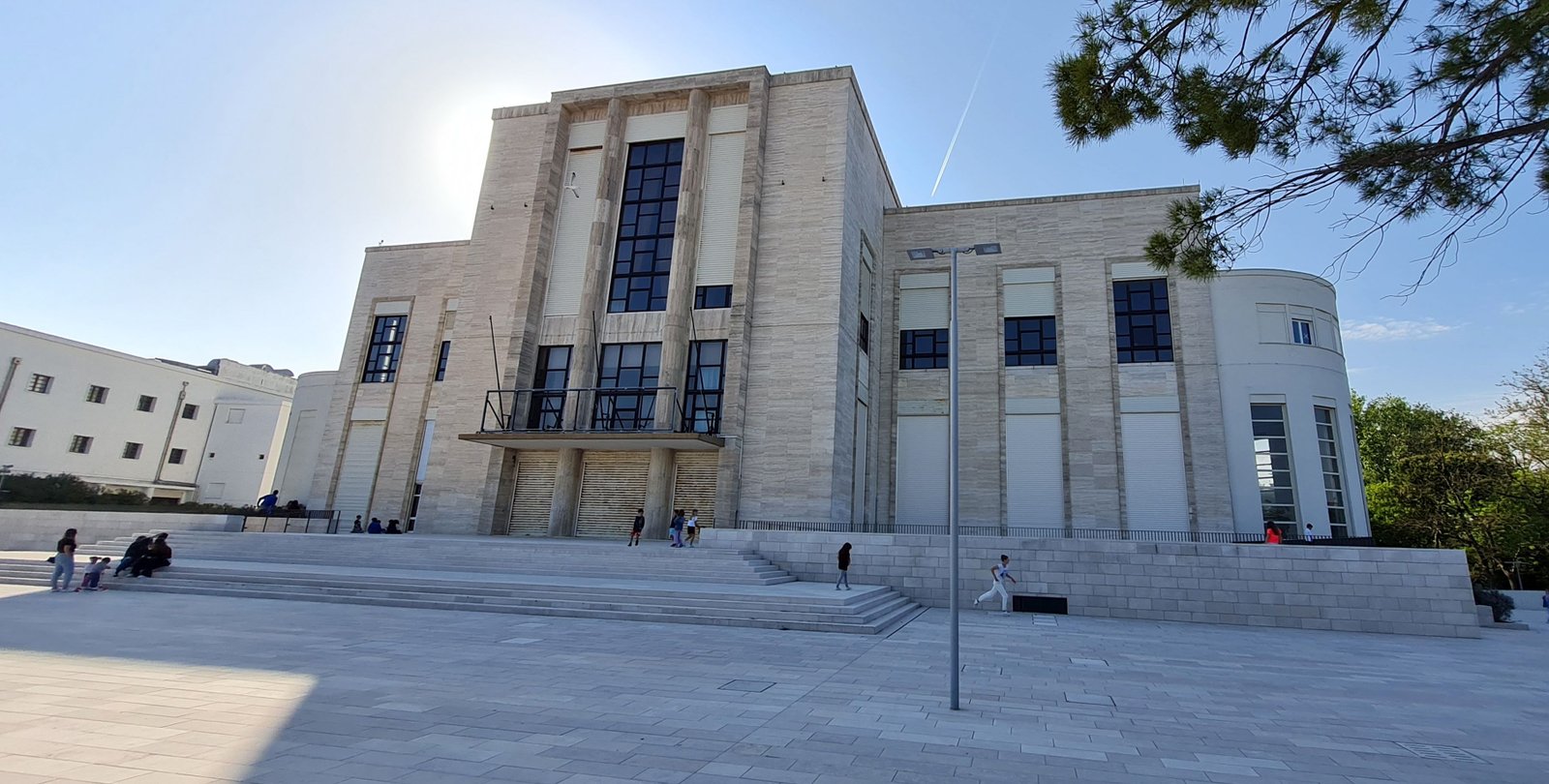
On the seaside of the Lido, between dunes and the Adriatic light, Eugenio Miozzi planted a long, porticoed slab of travertine and brick: the summer casino of Venice, built between 1936 and 1938 at the centre of a three-building rationalist plan that included the Palazzo del Cinema. Designed as the social engine of the Mostra Internazionale d’Arte Cinematografica, it remains one of the largest civic works of Italian razionalismo north of the Po, and a quietly radical break with the Lido’s earlier eclectic and Liberty hotels.
- Address
- Lungomare Guglielmo Marconi / Piazzale Casinò, 30126 Lido di Venezia (VE), Italy
- Period
- 1936–1938 (inauguration of the cinema complex: 10 August 1937; casino completed shortly after)
- Architects
- Eugenio Miozzi (1889–1979), Chief Engineer of the Municipality of Venice
- Client
- Comune di Venezia — Compagnia Italiana Grandi Alberghi (CIGA) and the Biennale di Venezia
- Style
- Italian Rationalism (Razionalismo italiano)
- Function
- Originally summer municipal casino and gaming halls; today Venice Congress Centre (Palazzo del Casinò), used for the Mostra del Cinema and conferences
- Site
- Former Austrian fort “Quattro Fontane”, reorganised by Miozzi as a symmetrical seaside ensemble with the Palazzo del Cinema
- Status
- Standing, municipal property, used annually for the Venice International Film Festival
- Coordinates
- 45.4067° N, 12.3676° E
Visit on the map
Lungomare Guglielmo Marconi, 30126 Lido di Venezia (VE) · 45.4067° N, 12.3676° E
Download for your navigator
A single waypoint, ready for GPS apps, navigators, and contacts.
Story
The commission emerged from a specific political and cultural moment. By the mid-1930s the Mostra Internazionale d’Arte Cinematografica, founded in 1932 within the Biennale, had outgrown its improvised setting on the terrace of the Hotel Excelsior. The Comune di Venezia wanted a permanent stage that could match the new ambitions of the festival and, at the same time, finally regulate the seafront on the site of the dismantled Austrian fort known as Quattro Fontane. Eugenio Miozzi, head of the Public Works Department of Venice since 1931, drew the masterplan and signed the architectural project. He conceived a symmetrical three-building ensemble facing the Adriatic: the Casinò in the centre, the Palazzo del Cinema by Luigi Quagliata on the left, and a mirror block on the right that was planned for ice skating but never realised. Work on the casino proceeded between 1936 and 1938, in parallel with the cinema, and the complex was inaugurated on 10 August 1937.
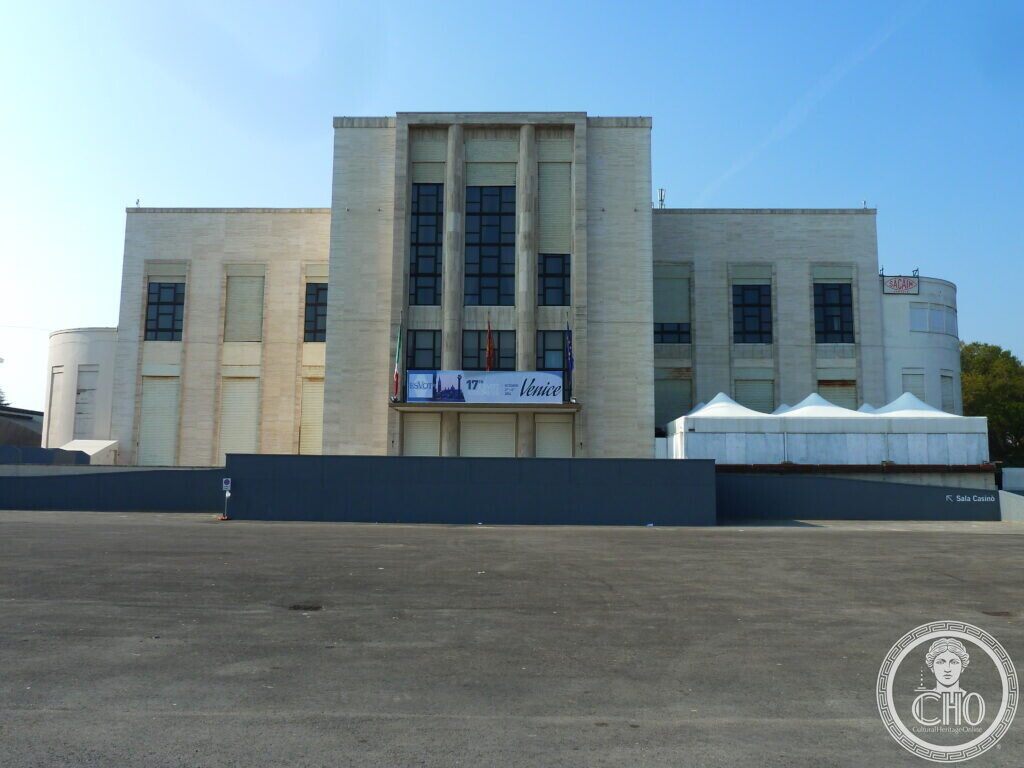
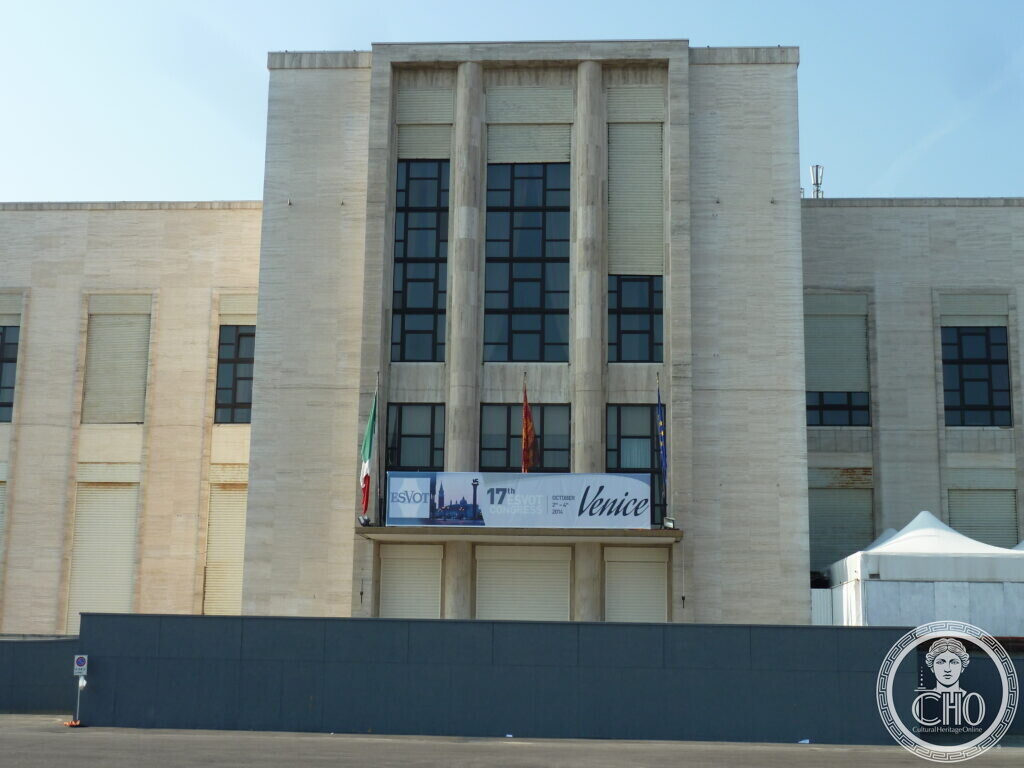
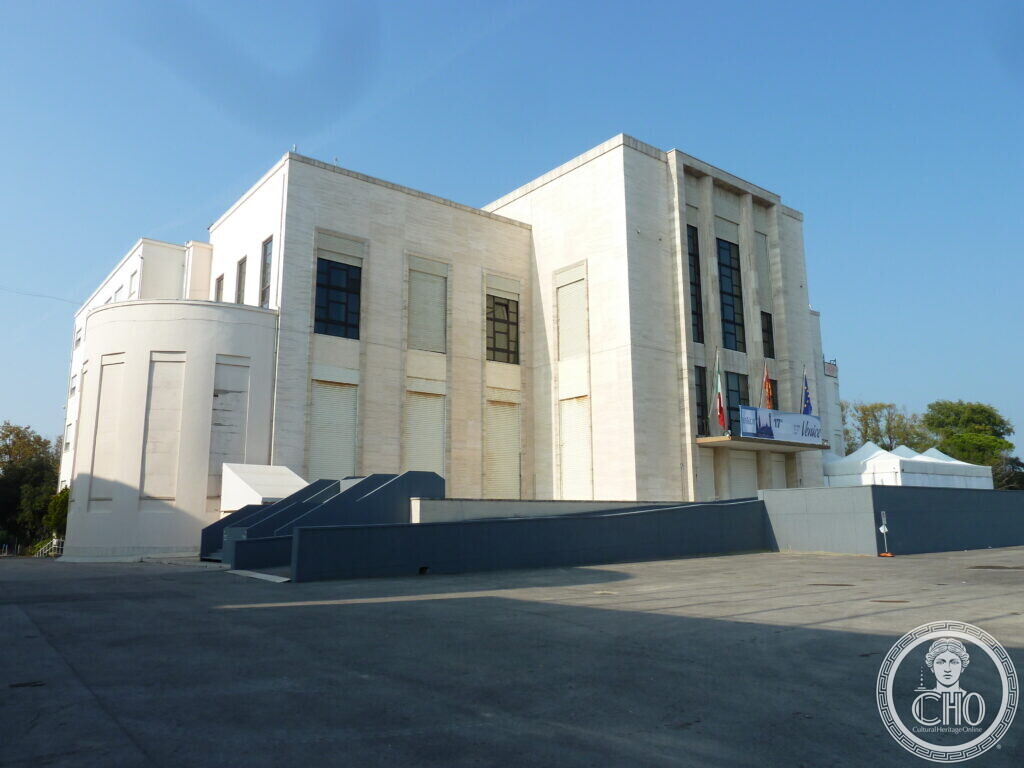
Architecturally the Palazzo del Casinò is a textbook exercise in restrained Italian rationalism. The plan unfolds as a long horizontal volume, articulated by a deep ground-floor portico that runs almost the full length of the seaside elevation. Travertine cladding wraps the lower order, while the upper storey is faced in a calmer plaster surface punctuated by regular bands of square and rectangular windows. The geometry is dominated by orthogonal lines: no curves, no historicist quotation, no overt monumental rhetoric of the kind common in regime-era public buildings of the same years. Inside, the original distribution organised gaming rooms, restaurant, dance hall and service spaces around generous foyers and double-height circulation, with the festival auditorium hosted in the adjacent Palazzo del Cinema. The building belongs to the same rationalist family as the Casa del Fascio in Como or the Casa Rustici in Milan, but applies their language to a leisure programme rather than to political or domestic life, which makes it a relatively rare example of seaside civic modernism in Italy.
The reception was mixed from the start. Local commentators welcomed the new amenities but criticised the scale and the abrupt contrast with the Liberty and eclectic hotels nearby, in particular the Hotel des Bains and the Excelsior. After the war the casino lost much of its original gaming role to the winter venue at Ca’ Vendramin Calergi on the Grand Canal, and the Lido building was progressively reassigned to congress and festival use. It now operates as the Venice Congress Centre and hosts, every September, the official screenings, press conferences and red-carpet arrivals of the Mostra del Cinema, alongside the modern Sala Grande added to the Palazzo del Cinema in 1991. The complex is municipally owned and protected as part of the seafront ensemble; restoration campaigns in the 2000s and 2010s have stabilised the travertine cladding and reopened parts of the portico to the public outside festival season.
Resources & References
Editorial picks across Wikipedia, photo archives, and architectural databases.
More views
Photographs by Stefano Vigolo, 2014.
Find it on the map
See this place and what’s around it →Record researched and written by Stefano Vigolo for Cultural Heritage Online, 2026.

📷 Become a Cultural Heritage Online photographer
Share your photos of places: they stay published under your name as the author. The more they're seen, the more you get noticed — and soon a contest will reward the most appreciated photos.
Log in or sign up free to add a photoIs this page about you?
This page is read by travellers and heritage enthusiasts who find it on Google. Tell us how you are connected to this place and we will take it from there.