An advertisement says what its owner wants people to hear. A newspaper article says what an independent person, with nothing to gain either way, decided was worth telling. Readers can feel the difference before they could explain it: the same sentence, “the oldest working watermill in the valley”, lands quite differently depending on whether the owner wrote it about themselves or a visiting journalist wrote it after actually going to look. One is a claim. The other is a finding.
Why one persuades and the other doesn’t
This is not a modern trick of marketing psychology; it is closer to something people have always understood instinctively. A recommendation from a person with nothing to gain carries weight a self-description never can, for the simple reason that self-description is expected to be flattering, and independent description is not. A local chamber of commerce letter praising a business is read differently from that same business’s own brochure, even when both say roughly the same thing, because one of them had a reason to say it and the other did not.
Search engines and, increasingly, AI assistants work on a version of the same principle. What a place says about itself carries some weight. What an independent, credible source says about that place carries more. This is not a technical quirk to be gamed — it is the same trust logic readers have always used, applied to how machines now decide what to recommend.
The story only you can tell
Every heritage place carries at least one detail that belongs to nobody else: the specific family that ran it for four generations, the flood it survived, the craft technique a single remaining artisan still practises there, the year it nearly closed and the person who refused to let that happen. Generic advertising tends to erase exactly this kind of detail, because advertising is built to be repeatable across many clients — the same five adjectives, the same call to visit, regardless of what actually happened in that specific building. A story does the opposite. It cannot be copied onto the business next door, because the business next door does not have it.
This is worth more than an advert not as a matter of taste, but as a matter of fact: unrepeatable detail is what makes a place memorable enough to mention to someone else afterward, and forgettable adjectives are not.
What earning coverage actually looks like
Earning editorial coverage is less mysterious than it sounds, and it is not reserved for famous places. It usually comes down to being specific where advertising tends to be vague: a real date instead of “for generations”, a named person instead of “our dedicated team”, a detail that could be checked rather than a claim that could not. An editor — human or, increasingly, an AI system reading a page — is looking for exactly this kind of verifiable specificity, because it is what makes a piece worth publishing or citing in the first place.
Cultural Heritage Online’s magazine and place listings work from the same principle: every entry is built from facts that can be checked against a source, not from a business’s own description of itself, because that is what keeps an editorial catalogue distinct from an advertising one — and it is also, as it happens, what independent readers and AI systems alike find worth trusting.
Frequently Asked Questions
Does this mean advertising never works?
No — advertising has its place. The point is narrower: a place’s own story, told with real detail and verified by someone independent, does something an advert cannot, which is earn trust rather than simply ask for it.
What if our history feels ordinary, not remarkable?
Almost no history is truly ordinary once the specific details come out — a name, a date, a decision someone made under pressure. The goal is specificity, not grandeur.
Who decides whether a story is worth telling?
An independent editor, working from facts that can be checked — which is also, increasingly, how AI systems assess what to cite. Self-description alone rarely meets that bar; verified detail usually does.
Does telling our story cost anything?
A basic listing on Cultural Heritage Online is free and carries no obligation. Editorial features are a separate, clearly labelled option for places that want more than a listing.
Where to start
Cultural Heritage Online lists heritage places, tours and cultural associations across Europe free of charge. If your place has a story worth telling properly, the organiser page explains what is included, or you can simply write to the editorial team and tell us what makes it different.
Sources
- Cultural Heritage Online, About — growth and readership figures
- Cultural Heritage Online, Press page
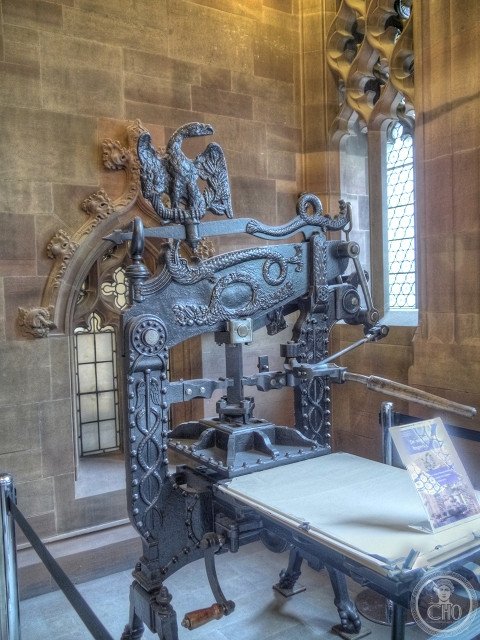
- Photo: David Dixon, Columbian Printing Press, John Rylands Library, via Wikimedia Commons, CC BY-SA 2.0