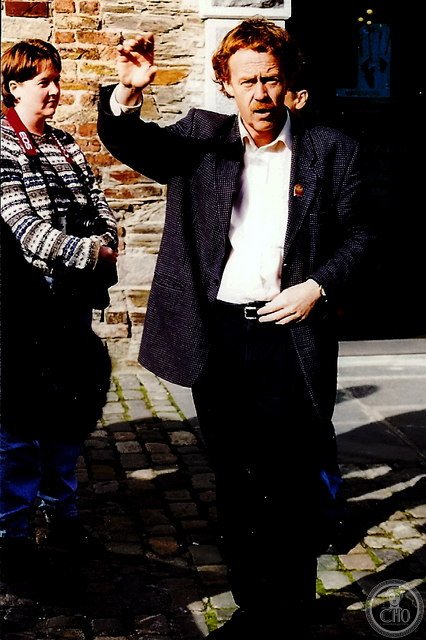
Every town in Europe has a version of the same person: the guide who knows the streets better than the map does, recommended by one visitor to the next in the way that matters most, which is unprompted. Someone asks their hotel receptionist who to walk with, or a friend who visited last year says “find the fellow who does the old town, ask for him by name”. This is the oldest form of marketing there is, and it still works exactly as well as it always did. It also has one limit that has never changed: it only reaches people who are already close enough, in person or in a conversation, to hear it.
The oldest marketing channel in Europe
Word of mouth is not being replaced by anything in this article. It is being extended. The recommendation itself — trustworthy because it comes from someone with no reason to lie — is the same mechanism that makes a good online listing work, and understanding one makes the other easier to trust rather than harder.
European Heritage Days and the walks that already exist
The scale of organised heritage walking in Europe is easy to underestimate from any single town. What began in France in 1984 as a single open-doors day for historic monuments became, from 1991, a joint programme of the Council of Europe and the European Union — European Heritage Days — now run across virtually every country that has signed the European Cultural Convention. Passeggiate del Patrimonio, Journées du Patrimoine, Tage des offenen Denkmals: different names for the same underlying idea, that a guided walk through a place’s history is one of the most effective ways anyone has found to make heritage matter to people who did not grow up with it.
Associations that organise these walks are, in other words, part of a genuinely European tradition already, whether or not they think of themselves that way. The guide in Waterford, the volunteer association running a Passeggiata in a small Italian hill town, the group leading a Denkmaltag walk through a German industrial quarter — all doing a recognisably similar thing, for a recognisably similar reason.
What changes when word of mouth goes online
The trust mechanism does not change when a recommendation moves online — a stranger’s honest account of a good walk is worth exactly as much whether it was said over a coffee or read on a screen. What changes is reach. A recommendation given in person only travels as far as the conversation does. The same recommendation, made findable to someone still deciding where to go before they have even booked a train, reaches a visitor who was never going to be standing in the right hotel lobby at the right moment to hear it in person.
This is not a reason to abandon anything that already works. Word of mouth remains the more persuasive channel, conversation for conversation. It is simply no longer the only way a walk can be found by someone who would have loved it.
What a listing actually needs to say
None of this requires an association to write like a marketing department. What travels well online is exactly what travels well in person: when the walk runs, what it actually covers, and the one detail a good local guide always leads with — the story that makes this particular walk different from the one in the next town. A listing built from those plain facts does the same job as the recommendation given over a coffee, just to someone who was never going to have that coffee.
Associations that already produce a leaflet or a printed programme usually have most of this written down already. The work is rarely starting from nothing; it is making what already exists findable to someone who has not yet arrived.
Frequently Asked Questions
Is this only relevant to associations that already take part in European Heritage Days?
No — any group organising walks, talks or guided visits sits in the same tradition, whether or not it participates in the formal programme.
Does listing a walk online replace personal recommendation?
No. It reaches people that word of mouth structurally cannot: visitors deciding where to go before arriving, who have nobody local yet to ask.
Do we need a website to be found this way?
No. A listing on an existing catalogue like Cultural Heritage Online does not require an association to build or maintain anything of its own.
Is this suitable for small, volunteer-run associations?
Yes — the scale of the association does not change how the listing works; a volunteer-run Passeggiata and a large municipal heritage programme are listed the same way.
Where to start
Cultural Heritage Online lists heritage walks, tours and cultural associations across Europe free of charge, with no obligation attached. If your association organises walks or events, the organiser page explains what is included, or you can simply write to the editorial team and tell us about what you run.
Sources
- S1 — Settis, Salvatore. Italia S.p.A.: L'assalto al patrimonio culturale. Einaudi, 2002. ISBN 978-88-06-16982-4.
- S2 — Howard, Peter. Heritage: Management, Interpretation, Identity. Continuum, 2003. ISBN 978-0-8264-5898-8.
Spotted an error? Write to editorial@culturalheritageonline.com and we correct it the same day.