Ask anyone to name the capitals of Art Nouveau and you get the same short list: Brussels, where Victor Horta drew the first whiplash curve; Vienna, where the Secession broke from the academy; Paris, Nancy, Barcelona, Glasgow. Six cities carry almost the entire English-language story of the movement. The buildings tell a wider one. Between roughly 1890 and 1914 the same impulse — new materials, floral line, a break with historicism — surfaced in provincial spa towns, border cities and rebuilt fishing ports across the continent. Most of them never made the map.
What a heritage catalogue actually holds
We keep this count honestly, because it surprised us too. Cultural Heritage Online tags 185 published place cards to the Art Nouveau movement across roughly fifty cities. The city at the top of that list is not Barcelona or Vienna. It is Oradea, in western Romania, with nine cards — more than we hold for Barcelona, Paris, Brussels or Vienna.
That number does not mean Oradea has more Art Nouveau than Barcelona. It means that when a catalogue sets out to document heritage where it actually stands, rather than where the coverage already is, the weight of the movement shifts eastward and into the provinces. A dozen cities that rarely appear in an Art Nouveau round-up turn out to hold complete, coherent ensembles — often better preserved than the famous streets, precisely because fewer people came to redevelop them.
The Secession the West forgot
Hungarian Secession — Szecesszió — is the clearest blind spot. After 1900 a generation of architects gave the eastern Habsburg lands a national variant of Art Nouveau, drawing on folk motif and Zsolnay ceramic. Its monuments did not stay inside modern Hungary. After the border changes that followed the First World War, several of these cities became part of Romania and Yugoslavia, and a body of work rooted in the Hungarian Secession slipped to the margins of the standard art-historical map.
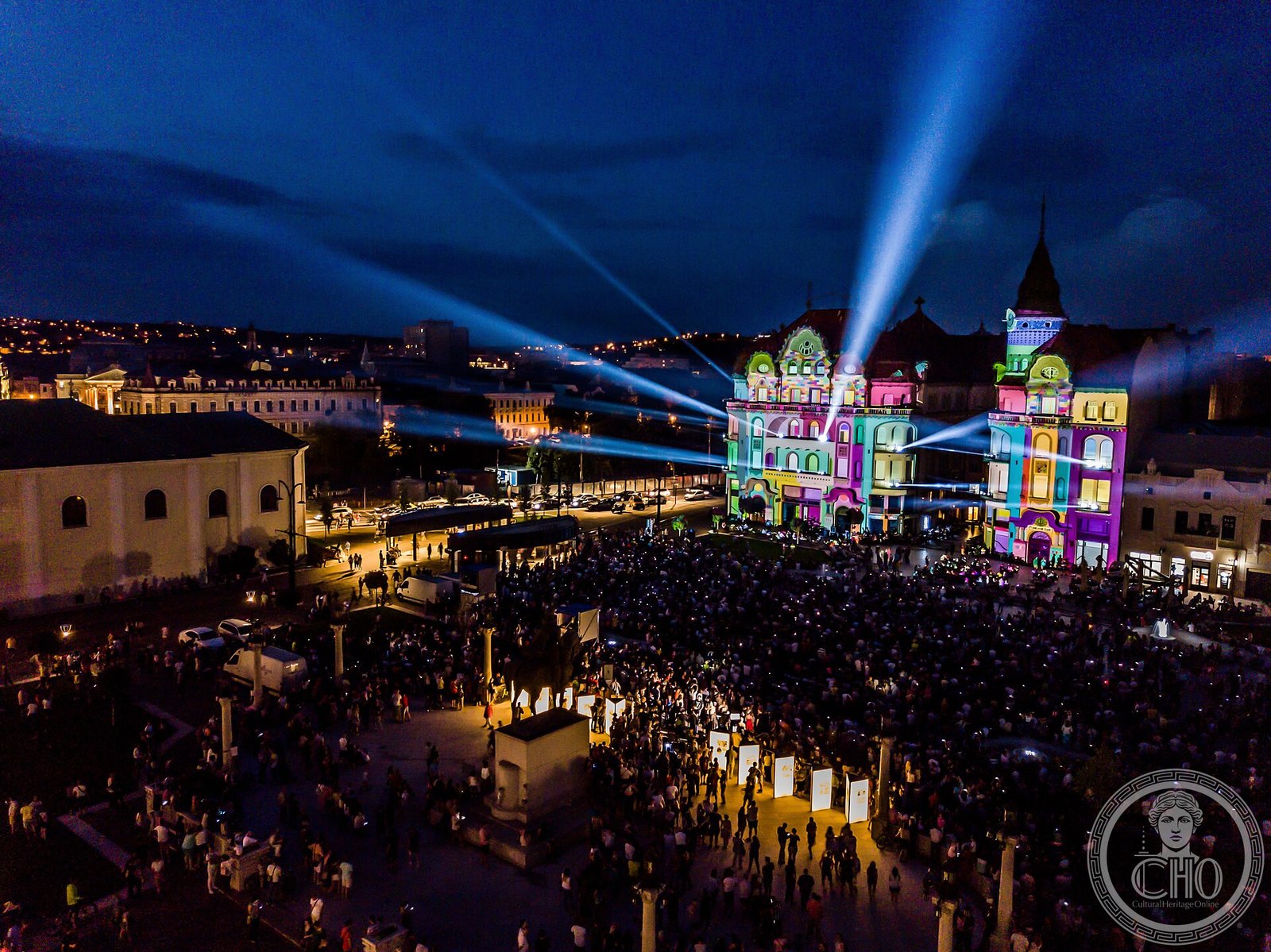
The results are extraordinary. In Subotica, now in Serbia’s Vojvodina, Marcell Komor and Dezső Jakab built a City Hall and a Synagogue that are among the boldest Secession buildings anywhere, and Ferenc Raichle built himself a palace of blue tile and heart-shaped windows. In Timișoara, the Banat capital, whole squares of Secession façades survive. In Oradea the Black Eagle Palace wraps a glass-roofed shopping arcade in a Y-shaped plan, and the Vágó brothers’ Darvas–La Roche House is a museum of the style in a single villa. Târgu Mureș answers with a Palace of Culture whose foyer is lined in stained glass and mosaic. None of these cities is on the standard itinerary.
Modernisme past Barcelona
Catalan Modernisme has the opposite problem: it is famous, but its fame stops at the Barcelona city limits. Antoni Gaudí’s own home town, Reus, holds Lluís Domènech i Montaner’s Institut Pere Mata and the Casa Navàs, one of the few Modernista houses to keep its original interior intact. The style travelled further than Catalonia. In Cartagena, a mining boom paid for a dense run of Modernista façades by Víctor Beltrí. Strangest of all is Melilla, the Spanish city on the North African coast, where Enrique Nieto — who had worked in Gaudí’s Barcelona — spent a career giving a garrison town what is often described as the second-largest Modernista ensemble in Spain, after Barcelona itself. A catalogue that follows the buildings rather than the reputation finds Art Nouveau on the edge of the Sahara.
Liberty by the sea, and a town reborn from fire
Italy called the movement Liberty, and much of its best work is where the middle class went on holiday. Viareggio, on the Tuscan coast, is a seafront of bathing establishments, cafés and villas — several decorated by the ceramicist and painter Galileo Chini, who brought the palette of his kiln to the beach. Coverage tends to treat spa and seaside architecture as a lesser, decorative footnote; the buildings are anything but.
The most literal case for looking past the canon is Ålesund, in Norway. After a fire destroyed the town centre in 1904, it was rebuilt almost entirely at once in Jugendstil — turrets, towers and stone ornament rising straight out of the fjord. There is no other town like it in northern Europe, and it barely registers in the general literature of the movement.
Why the map stayed small
The pattern behind all this is not aesthetic. It is editorial. The canonical six cities were capitals, or close to them, and they were on the Grand Tour circuit before Art Nouveau even arrived. The cities that got dropped were provincial (Reus, Viareggio), on redrawn borders (Subotica, Oradea, Timișoara), behind the Iron Curtain for two generations (most of the Secession belt), or dismissed as holiday frivolity (the Italian and Adriatic coasts). None of those are reasons the buildings matter less. They are reasons nobody came to write about them.
Mapping heritage where it stands, rather than where the attention already points, is the whole point of a catalogue. The movement was never a six-city phenomenon. It was continental, and most of it is still waiting for its first serious English-language paragraph.
Where to start
Our Art Nouveau map collects these cities in one place — the famous ensembles alongside Oradea, Subotica, Melilla and Ålesund — each building linked to its full place card with sources, coordinates and access notes. Start with the Oradea guide and follow the Secession east, or trace Modernisme out of Barcelona to where it really ends.
Sources
- CHO catalogue: place cards tagged Art Nouveau, count by city (live query, 7 July 2026)
- Komor & Jakab, Subotica City Hall and Synagogue — see individual CHO place cards and cited institutional sources
- Domènech i Montaner, Institut Pere Mata and Casa Navàs, Reus — CHO place cards
- Galileo Chini in Viareggio; Enrique Nieto in Melilla; Víctor Beltrí in Cartagena — CHO place cards with sources
- Ålesund Jugendstil reconstruction after the 1904 fire — CHO place card and Jugendstilsenteret (municipal museum)