
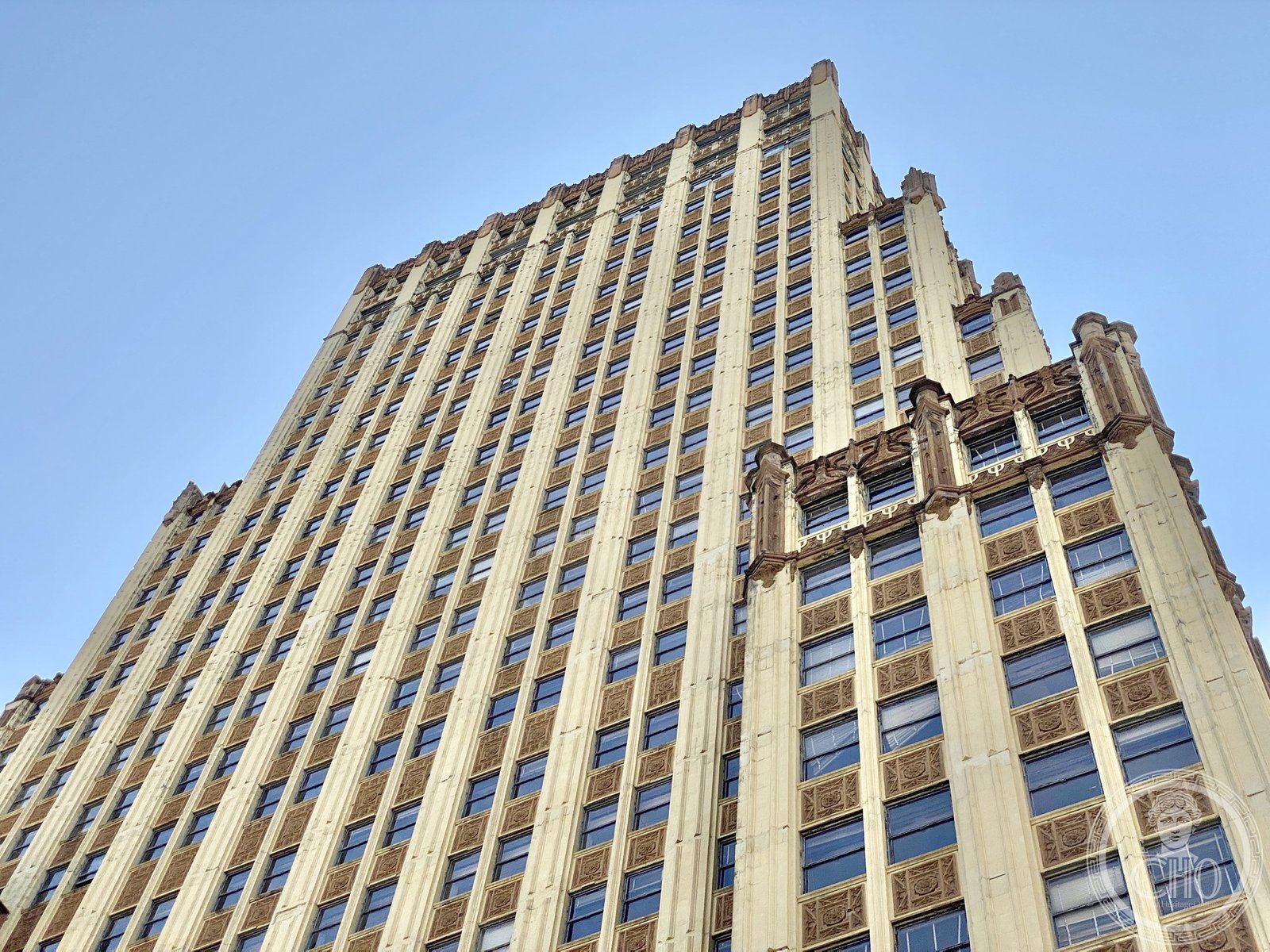
Sterick Building
Memphis’s tallest skyscraper for four decades, the Sterick Building rises at the corner of B.B. King Boulevard and Madison Avenue with a Gothic Revival crown and gargoyle-ringed parapet — a skyline landmark now vacant but intact, waiting for its second chapter.
At a glance
The Sterick Building, completed between 1928 and 1930 at the corner of what was then North Third Street (now B.B. King Boulevard) and Madison Avenue, was Memphis’s dominant skyscraper for much of the twentieth century. At 29 stories, it held the title of the city’s tallest building for decades, its Gothic Revival crown visible from miles away across the Mississippi River flatlands. The building combines the aspiration of 1920s commercial architecture — a tower designed to announce Memphis as a city of ambition and permanence — with a program of Gothic ornament at its crown that sets it apart from the more streamlined Art Deco towers of the same era. Today it is vacant and the subject of ongoing preservation discussions, its empty floors caught between the economic reality of downtown Memphis and the architectural significance of the structure.
Key facts
- Address: B.B. King Boulevard (formerly N. Third Street) at Madison Avenue, Memphis, Tennessee
- Built: 1928–1930
- Stories: 29
- Style: Gothic Revival with Art Deco interior elements
- Status: Vacant (as of 2020s); National Register of Historic Places
- Significance: Memphis’s tallest building from 1930 to the early 1970s
History
The Sterick Building was developed during Memphis’s period of postwar commercial expansion in the 1920s, when downtown Memphis was the economic center of the mid-South cotton economy. The building was named for the entity that developed it, and its construction required significant capital at a moment just before the Great Depression reshaped the economics of commercial real estate across the country. The building was completed in 1930 and immediately became both a practical address — prime office space in the heart of downtown — and a civic symbol: the skyscraper as a statement of Memphis’s aspirations for the second half of the twentieth century.
Through the mid-twentieth century the building functioned as a major office address in downtown Memphis, housing law firms, insurance companies, and the administrative apparatus of the region’s commercial life. The building held its position as Memphis’s tallest structure until the early 1970s, when the Clark Tower exceeded it. After that, the building’s relative significance gradually shifted from civic symbol to historic artifact, as new development patterns and downtown vacancy pressures changed the economics of older commercial towers.
The Sterick Building has been vacant since the early 2010s. Its future has been the subject of successive redevelopment plans, none of which have yet advanced to construction. The building remains on the National Register of Historic Places, and its listing provides a framework for potential historic tax credit financing of a rehabilitation. As of the 2020s, it is one of the most visible and contested landmarks of the downtown Memphis preservation debate.
What you see
The Sterick Building’s exterior is organized in the classical tripartite pattern of the American skyscraper — base, shaft, crown — but its crown is what makes it memorable. The upper floors are sheathed in Gothic Revival ornament: pointed arch windows, gargoyle-like projections at the parapet, carved stone tracery at the setback levels, and a decorative finial at the very top. The effect from street level is of a tower that has grown too ambitious for its base, its Gothic ambitions straining against the commercial pragmatism of the office floors below.
The lower floors are more restrained, with a commercial base typical of the era and a lobby sequence that, when the building was active, provided a formal entry experience appropriate to its status. The building’s broad Madison Avenue facade and its narrower Third Street (B.B. King Boulevard) elevation give it a distinctly asymmetrical presence at the corner, with the Gothic crown most visible from the west along Madison Avenue. The surrounding blocks of downtown Memphis, with their mix of early-twentieth-century commercial buildings and later mid-century development, provide context for reading the Sterick’s original position in the city’s urban fabric.
Practical information
- Status: Vacant; interior not accessible
- Exterior: Freely visible from B.B. King Boulevard and Madison Avenue
- Historic designation: National Register of Historic Places
- Best views: Corner of B.B. King Blvd and Madison Avenue, or from the north along B.B. King Blvd
Getting there
The Sterick Building is in the heart of downtown Memphis, at B.B. King Boulevard (formerly North Third Street) and Madison Avenue. The building is about a ten-minute walk from the Beale Street entertainment district and about five minutes from the Orpheum Theatre, Memphis’s 1928 Art Deco movie palace on South Main Street. By car, downtown Memphis is reached via I-40 (exit 1B for downtown) or I-55 (Riverside Drive to downtown). The Main Street trolley provides access along the Main Street corridor, which connects to the riverfront and Beale Street, about six blocks east of the Sterick.
Nearby
- Orpheum Theatre (1928) — Memphis’s landmark movie palace on South Main Street, with its elaborately ornamented interior, about five blocks south
- National Civil Rights Museum — at the Lorraine Motel, the site of Martin Luther King Jr.’s assassination in 1968, a short walk south in South Downtown Memphis
- Peabody Hotel (1925) — Memphis’s famous hotel on Union Avenue, in the immediate downtown neighborhood of the Sterick, home of the celebrated duck march tradition
- Mississippi Riverfront — a short walk west, with views across the river to Arkansas and the Tom Lee Park waterfront
Sources
- Wikipedia: Sterick Building
- National Register of Historic Places nomination documentation
- Memphis Landmarks Commission records
- Memphis Commercial Appeal, historical coverage
Find it on the map
See this place and what’s around it →📷 Diventa un fotografo di Cultural Heritage Online
Condividi le tue foto dei luoghi: restano pubblicate con la tua firma come autore. Più vengono viste, più ti fai conoscere — e presto un concorso premierà le foto più apprezzate.
Accedi o registrati gratis per aggiungere una fotoDo you manage this place?
This page is read by travellers and heritage enthusiasts who find it on Google. Keep it accurate — and make it work for you. Free for non-profit heritage institutions.