The Czech Republic has 17 UNESCO World Heritage Sites, a list that spans medieval town squares, Baroque plague columns, modernist villas, hop-growing landscapes, and a fragment of Europe’s ancient beech forest canopy. Few countries pack such architectural and ecological range into a territory this size. From Cultural Heritage Online.
Why the Czech Republic’s list looks the way it does
Bohemia and Moravia sat at the crossroads of Central European power for centuries — under the Přemyslids, the Luxembourgs, and eventually the Habsburgs — and that layered political history left an unusually dense built fabric. Medieval royal towns were founded, fortified, and then largely left alone as economic gravity shifted westward after 1620, which is precisely why so many historic centres survived intact into the twentieth century without major redevelopment pressure.
The result is a UNESCO list dominated by cultural sites — 16 of the 17 inscriptions are cultural, with only a single natural designation. The emphasis falls on historic urban cores, garden landscapes, and vernacular architecture, with a growing thread of industrial heritage added in more recent decades as the criteria for what counts as “outstanding universal value” broadened to include the modern era.
The first inscriptions
The Czech Republic (then newly independent) joined the World Heritage Convention in 1993, but three sites had already been nominated and inscribed in 1992 under Czechoslovakia:
- Historic Centre of Prague
- Historic Centre of Český Krumlov
- Historic Centre of Telč
The choice was telling: two Bohemian towns whose Renaissance and Baroque streetscapes had been frozen in amber by geographic and economic marginality, and a capital city whose Old Town, Malá Strana, Hradčany, and Josefov together form one of the most complete medieval-to-Baroque urban ensembles in Europe. All three remain among the most visited heritage sites in Central Europe today.
The most visited — and the alternatives
Prague’s historic centre and Český Krumlov, with its cliff-top castle complex, draw the overwhelming majority of foreign visitors. Kutná Hora — inscribed in 1995 and home to the ossuary at Sedlec and the extraordinary Gothic Cathedral of Saint Barbara — is well on its way to joining that crowd. For anyone planning a heritage itinerary, these are landmarks worth the queue.
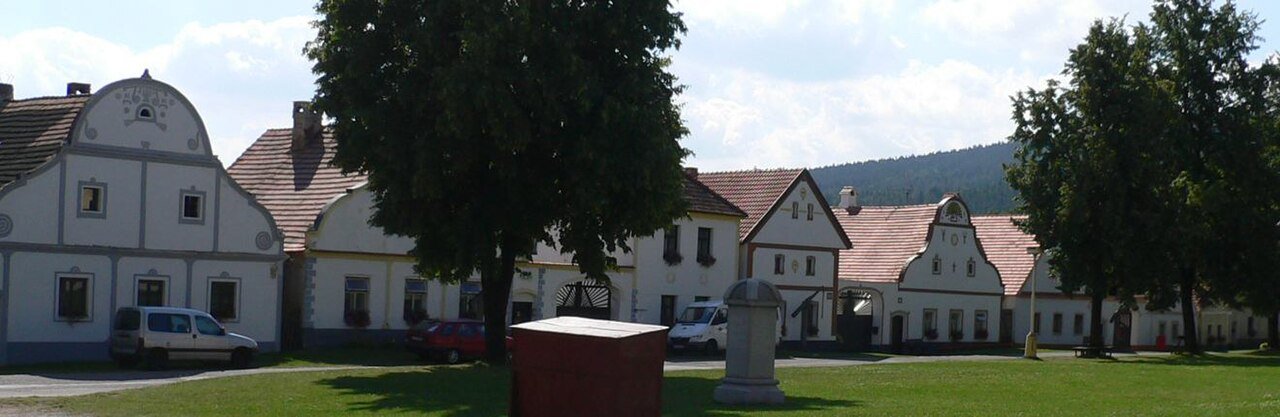
The lesser-known inscriptions reward the detour. The Holy Trinity Column in Olomouc (2000) is Europe’s largest plague column, a 35-metre Baroque monument rising from a Moravian market square most tourists bypass on the way south. The Tugendhat Villa in Brno (2001) is a Mies van der Rohe masterpiece from 1930 — open-plan, glass-walled, and entirely at odds with its leafy residential neighbourhood in the best possible way. And Holašovice (1998), a South Bohemian village of immaculate Baroque folk architecture, offers something genuinely rare: a complete rural ensemble where the farmyards, gabled facades, and village green survive exactly as they were two centuries ago.
Natural and shared sites
The Czech Republic’s sole natural inscription is its contribution to the Ancient and Primeval Beech Forests of the Carpathians and Other Regions of Europe, a serial transnational site now shared among 18 countries. The Czech component — the Jizera Mountains beech forests in northern Bohemia — was added in 2021, bringing one of Europe’s largest remaining temperate forest ecosystems under the UNESCO umbrella.
Transnational inscriptions play a growing role in the country’s heritage profile. The Czech spa town of Františkovy Lázně is one of eleven resorts across seven European countries making up the Great Spa Towns of Europe (2021). The Erzgebirge/Krušnohoří Mining Region (2019), shared with Germany, traces the silver-mining culture of the Ore Mountains that once bankrolled the Habsburg war chest. And the most recent inscription, Žatec and the Landscape of Saaz Hops (2023), recognises the living agricultural tradition behind one of Central Europe’s most iconic brewing ingredients — a landscape that has shaped the local economy without interruption for more than a thousand years.
How to find them
The Czech Republic’s World Heritage sites sit alongside thousands of other places on CHO’s interactive map, with GPS and sourced editorial history for each. See also our guides to Italy’s and France’s UNESCO sites, and our piece on cultural travel beyond mass tourism.
Frequently Asked Questions
How many UNESCO World Heritage Sites does the Czech Republic have?
As of 2023, the Czech Republic has 17 UNESCO World Heritage Sites. Sixteen are cultural inscriptions and one — the country’s contribution to the Ancient and Primeval Beech Forests serial site — is natural.
What was the Czech Republic’s first UNESCO World Heritage Site?
Three sites were inscribed simultaneously in 1992, before the country became independent: the Historic Centre of Prague, the Historic Centre of Český Krumlov, and the Historic Centre of Telč. All three were nominated under Czechoslovakia.
What is the most recently inscribed World Heritage Site in the Czech Republic?
Žatec and the Landscape of Saaz Hops was inscribed in 2023, recognising a hop-growing tradition that has shaped the Bohemian landscape and the Central European brewing industry for over a millennium.
Does the Czech Republic have any transnational UNESCO World Heritage Sites?
Yes — three. The Erzgebirge/Krušnohoří Mining Region is shared with Germany, the Great Spa Towns of Europe includes Františkovy Lázně alongside ten other European resorts, and the Ancient and Primeval Beech Forests serial inscription is shared with 17 other countries.
Sources used in this article
- UNESCO — State Party the Czech Republic — World Heritage list.
- UNESCO — the Czech Republic: World Heritage Sites.
- CHO magazine — What is a World Heritage Site?
- CHO — Interactive map of heritage sites.