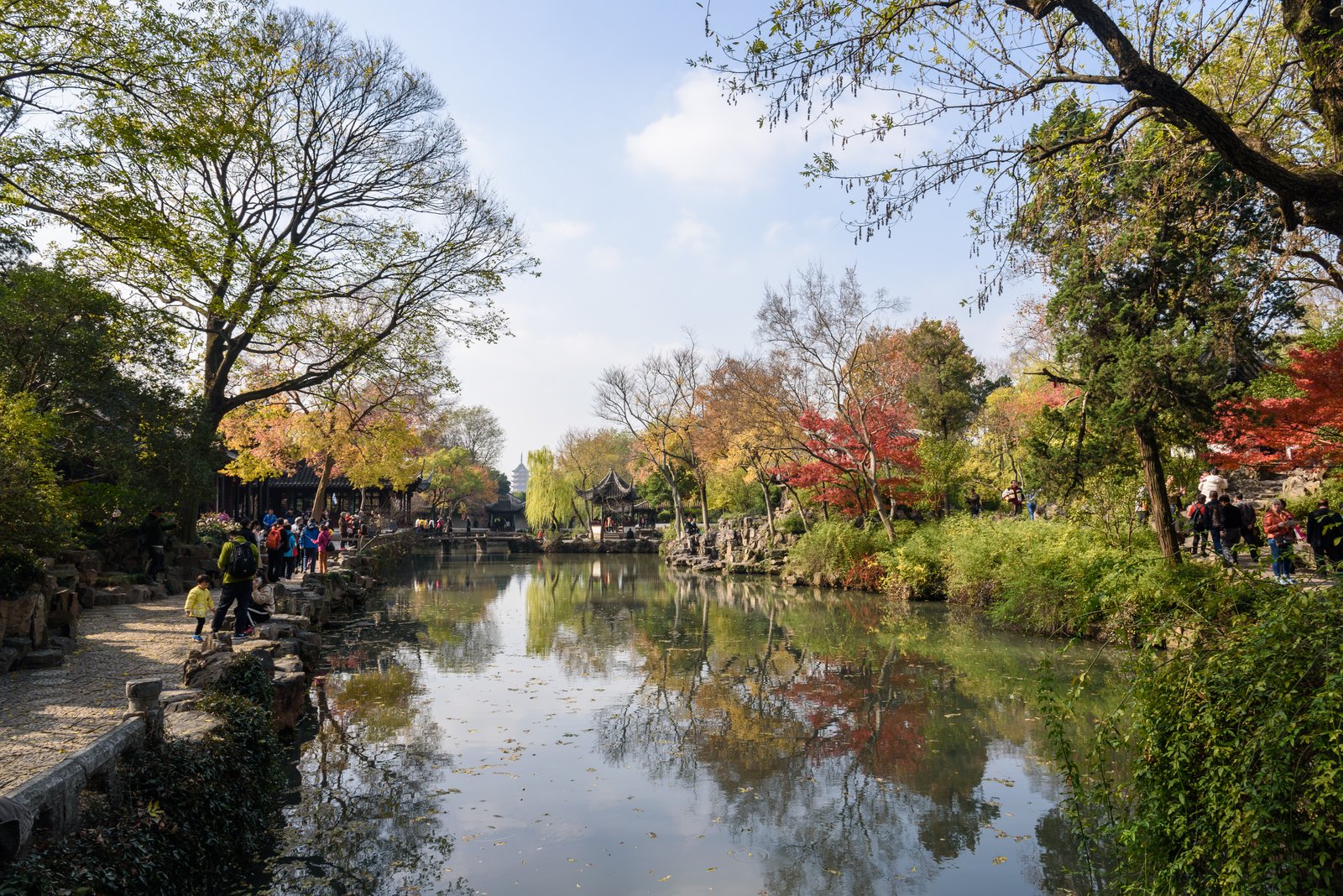
Shanghai holds no UNESCO World Heritage inscription of its own, yet two of China’s most celebrated inscriptions lie within reach of its high-speed rail stations — Suzhou’s nine classical gardens thirty minutes west, and Hangzhou’s West Lake Cultural Landscape forty minutes south-west. A third inscription, the Grand Canal, threads through both cities and can be explored during the same excursions. From Cultural Heritage Online.
Classical Gardens of Suzhou 30 min by CRH from Hongqiao
Suzhou’s classical gardens represent the most refined tradition of Chinese landscape design, spanning roughly a thousand years from the Northern Song dynasty through the late Qing (11th–19th centuries). UNESCO inscribed nine of them in two tranches — four in 1997 and five more in 2000 — under reference 813bis. The largest of the group, the Humble Administrator’s Garden, was laid out in the early sixteenth century for Wang献臣, a retired Ming official whose brief to the designer was a garden of intentional understatement. That restraint is precisely what a visitor feels stepping through the moon gate: water covers more than half the site, so pavilions appear to float rather than stand, and borrowed scenery from the distant North Temple Pagoda frames every major viewing axis. The Great Wave Pavilion, oldest of the inscribed group and dating to around 1044, generates a different sensation — moss-covered stonework and a dry moat crossed by a wooden bridge, light filtering through bamboo groves as it would have when Su Shunqin first wrote about it under the Northern Song. At peak flourishing in the mid-Ming period, Suzhou hosted as many as 200 private gardens; 69 survive in some form today.
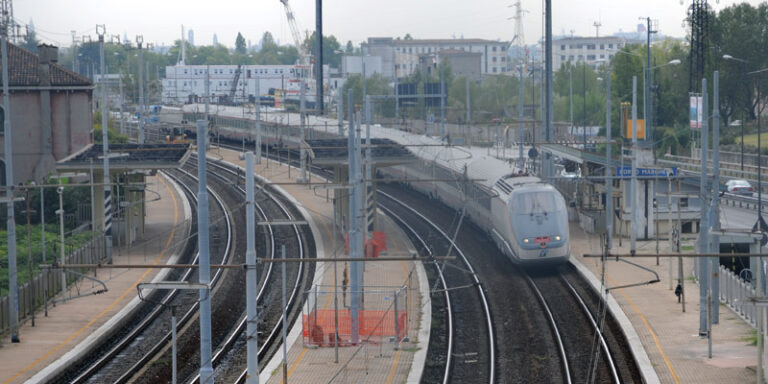
Getting there: CRH bullet trains depart Shanghai Hongqiao station for Suzhou every 15–20 minutes; journey time is around 30 minutes. Buy tickets in advance on the 12306 app or at the station. From Suzhou station, taxis and Didi reach the main gardens in 10 minutes. Allow: half a day for two or three gardens; a full day to visit four or more. Best for: travellers who want to understand the philosophical foundations of East Asian garden design and photographers seeking water reflections in soft morning light.
West Lake Cultural Landscape, Hangzhou 40 min by G-train from Hongqiao
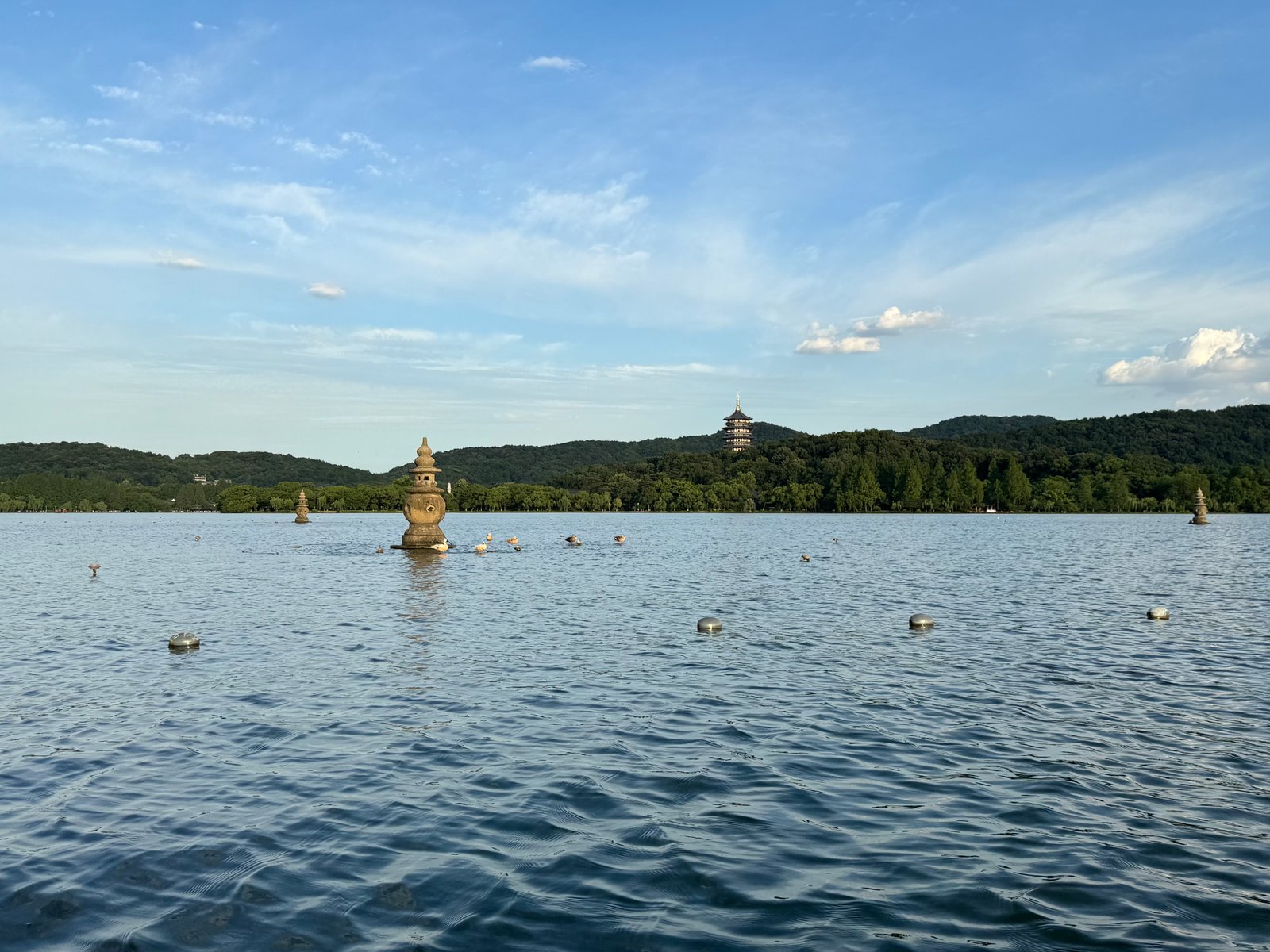
West Lake’s 6.39 square kilometres of freshwater have shaped Chinese poetry, painting, and garden theory for more than twelve centuries. UNESCO inscribed the West Lake Cultural Landscape of Hangzhou in 2011, recognising its influence on garden design across China, Korea, and Japan — the Summer Palace’s Kunming Lake in Beijing was modelled directly on it. The Tang-dynasty governor Bai Juyi dredged the silting lake in 822 and built the causeway that still carries his name; the Song-dynasty writer Su Shi (1037–1101) added a second causeway in 1089 and wrote the comparison to the beauty of Xi Shi that Chinese schoolchildren still memorise. What the visitor encounters today is not a managed period recreation but a continuously lived landscape: fishing boats anchor near the Three Pools Mirroring the Moon island at first light, the surface turns copper at dusk behind Leifeng Pagoda, and the park has admitted the public without an entrance fee since 2002. More than 30 million people visit each year, yet the morning causeways remain quiet. The lake featured on Chinese currency issued in 1979 and again on the 2005 renminbi series.
Getting there: G-trains from Shanghai Hongqiao reach Hangzhou East station in approximately 40 minutes; services run frequently throughout the day. From Hangzhou East, taxi or metro Line 1 to Longxiangqiao station deposits you at the lake’s eastern shore. Allow: half a day for the causeways, major viewpoints, and Leifeng Pagoda; a full day if adding the China National Silk Museum nearby. Best for: visitors who want a living cultural landscape rather than an enclosed monument, and those combining heritage with Hangzhou’s tea-culture district.
Grand Canal — Suzhou and Hangzhou Sections Accessible from both excursions above
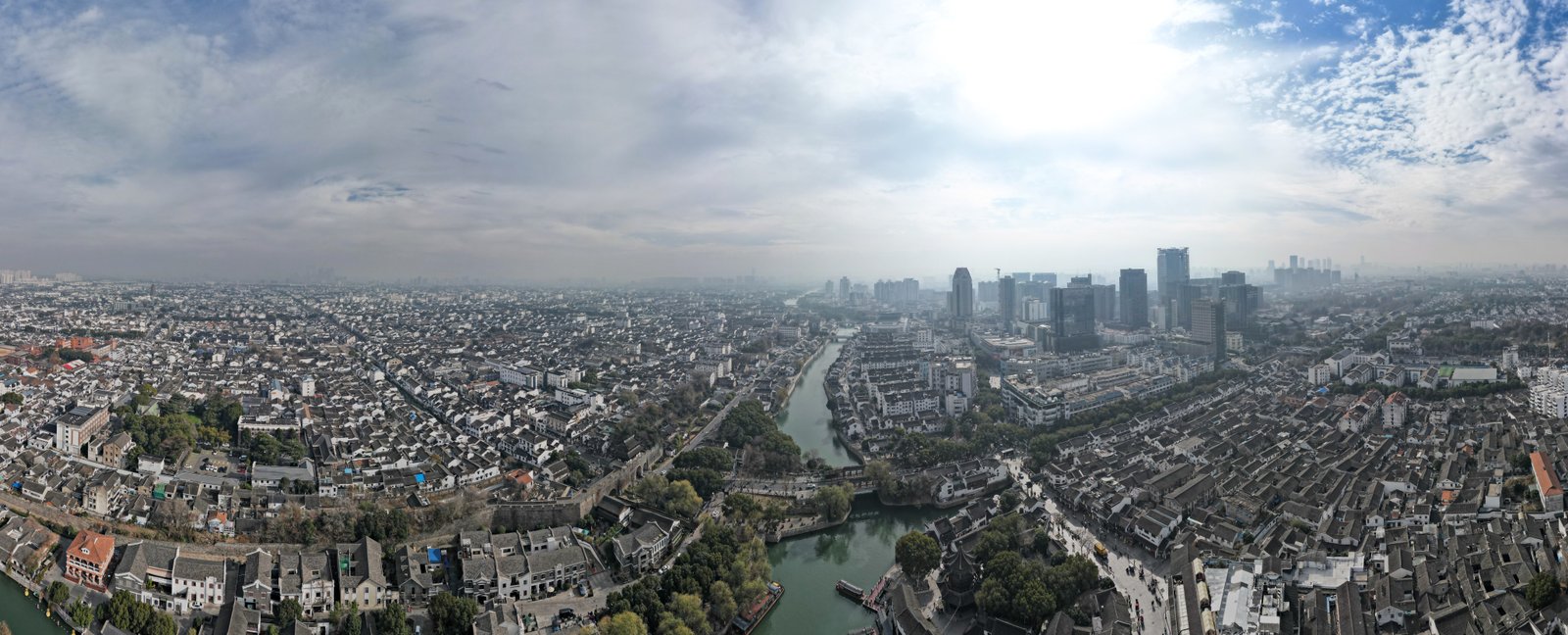
The Grand Canal is the longest and oldest artificial waterway in the world, stretching 1,776 kilometres from Beijing to Hangzhou. UNESCO inscribed it in June 2014. Its oldest sections date to the fifth century BC, but the route familiar on modern maps was unified and extended by Emperor Yang of the Sui dynasty between 604 and 609 CE — an infrastructure project that consumed vast human labour and helped destabilise the dynasty that ordered it. During the Tang and Song periods, more than 8,000 boats carrying up to 360,000 metric tons of grain moved along the canal annually, making it the circulatory system of imperial China for over a millennium. The Jiangnan section — the southern reach that connects Hangzhou north through Suzhou, Wuxi, and Changzhou — is the stretch visitors see from Shanghai. In Suzhou, the canal curves along the old city’s western wall; whitewashed merchant houses still line the banks, and traditional arched stone bridges cross the water at intervals short enough to walk between. In Hangzhou, the southern terminus begins a few kilometres from West Lake. Both cities offer short boat tours on the canal itself. No separate journey is required — the canal is woven into both cities explored above.
Getting there: No additional travel is needed. The Suzhou section is a 10-minute taxi ride from the classical gardens; the Hangzhou section sits near the city centre, a short taxi or metro ride from West Lake. Allow: 1–2 hours for a bankside walk or a 45-minute boat tour in either city. Best for: travellers who want to contextualise China’s imperial logistics network, and those adding a water-level perspective to the gardens or lake already visited.
Frequently Asked Questions
How many UNESCO World Heritage Sites are near Shanghai?
Three UNESCO inscriptions are reachable from Shanghai in under an hour by high-speed rail: the Classical Gardens of Suzhou (inscribed 1997 and 2000), the West Lake Cultural Landscape of Hangzhou (inscribed 2011), and the Grand Canal (inscribed 2014). The Grand Canal passes through both Suzhou and Hangzhou, so it is accessible during either excursion without additional travel.
Which UNESCO site is closest to Shanghai?
The Classical Gardens of Suzhou are the closest, roughly 100 kilometres west of central Shanghai and approximately 30 minutes from Shanghai Hongqiao station by CRH bullet train. Trains run every 15 to 20 minutes, making a same-day return visit straightforward.
Do foreign visitors need a visa to travel to Suzhou and Hangzhou from Shanghai?
China’s 144-hour visa-free transit policy applies to nationals of many countries entering through Shanghai Pudong or Hongqiao airports, and it covers travel within a designated zone that includes Suzhou and Hangzhou. Visitors should verify their country’s eligibility and the current policy conditions before travel, as rules can change. Separate visas are required for those whose nationality is not covered by the transit exemption.
What is the best season to visit West Lake and Suzhou’s gardens?
Spring (March to May) brings lotus buds to Suzhou and soft mist over West Lake, the combination most celebrated in classical Chinese poetry and painting. Autumn (October to November) offers clear skies and autumn foliage — the Suzhou gardens are particularly photogenic with red maples reflected in the pools. Summer is hot and very crowded; winter is quieter but some garden features are dormant. The IC transport card (available at Shanghai metro stations) streamlines payment on trains and urban transit throughout both cities.
Sources
- S1 — Keswick, Maggie. The Chinese Garden: History, Art and Architecture. Harvard University Press, 2003. ISBN 978-0-674-01086-4.
- S2 — Henrietta, Harrison. The Man Awakened from Dreams: One Man's Life in a North China Village. Stanford University Press, 2005. ISBN 978-0-8047-5069-1.
Spotted an error? Write to editorial@culturalheritageonline.com and we correct it the same day.