Greece has 20 UNESCO World Heritage Sites, spanning Bronze Age palace complexes, classical sanctuaries, Byzantine monasteries perched on stone pillars, and mountain landscapes of cobbled paths and slate-roofed villages. The list is almost entirely cultural yet reaches from the Aegean islands to the northern Pindus mountains, from prehistoric Crete to the threshold of the modern world. From Cultural Heritage Online.
Why Greece’s list looks the way it does
Greece’s UNESCO portfolio reflects a country whose territory has been a continuous stage for human settlement since at least the second millennium BC. Eighteen of the twenty inscriptions are classified as cultural, with two mixed designations acknowledging that certain sites cannot be separated from their physical setting. The near-absence of purely natural sites is not an accident: for most of Greece’s terrain, the human layer is so deep that even the landscape category folds in monuments and sacred histories.
The list is also strikingly diverse in period. Minoan palatial centres, Archaic temples, classical sanctuaries, Hellenistic cities, Roman colonies, Byzantine monasteries, and Ottoman-era vernacular architecture all appear. What ties them together is the density of inscription and reuse — places that were sacred or strategic in one era were invariably built over, adapted, or venerated in the next.
The first inscriptions
Greece entered the World Heritage List in 1986 with a single inscription, and expanded quickly in the years that followed. The founding group established the range that would define the list: ancient sanctuary, sacred island, healing centre, and the symbol of classical civilisation itself.
- Temple of Apollo Epicurius at Bassae (1986) — a fifth-century BC Doric and Ionic temple in the Arcadian mountains, one of the best-preserved in Greece
- Archaeological Site of Delphi (1987) — the pan-Hellenic sanctuary of Apollo and the oracle at the foot of Mount Parnassus
- Acropolis, Athens (1987) — the hilltop complex of the Parthenon, Erechtheion, and Propylaea that defined classical architecture for the Western world
- Sanctuary of Asklepios at Epidaurus (1988) — ancient healing sanctuary whose theatre, with its near-perfect acoustics, still hosts performances
- Delos (1990) — uninhabited sacred island regarded in antiquity as the birthplace of Apollo and Artemis, now one of the most important archaeological sites in the Aegean
The most visited — and the alternatives
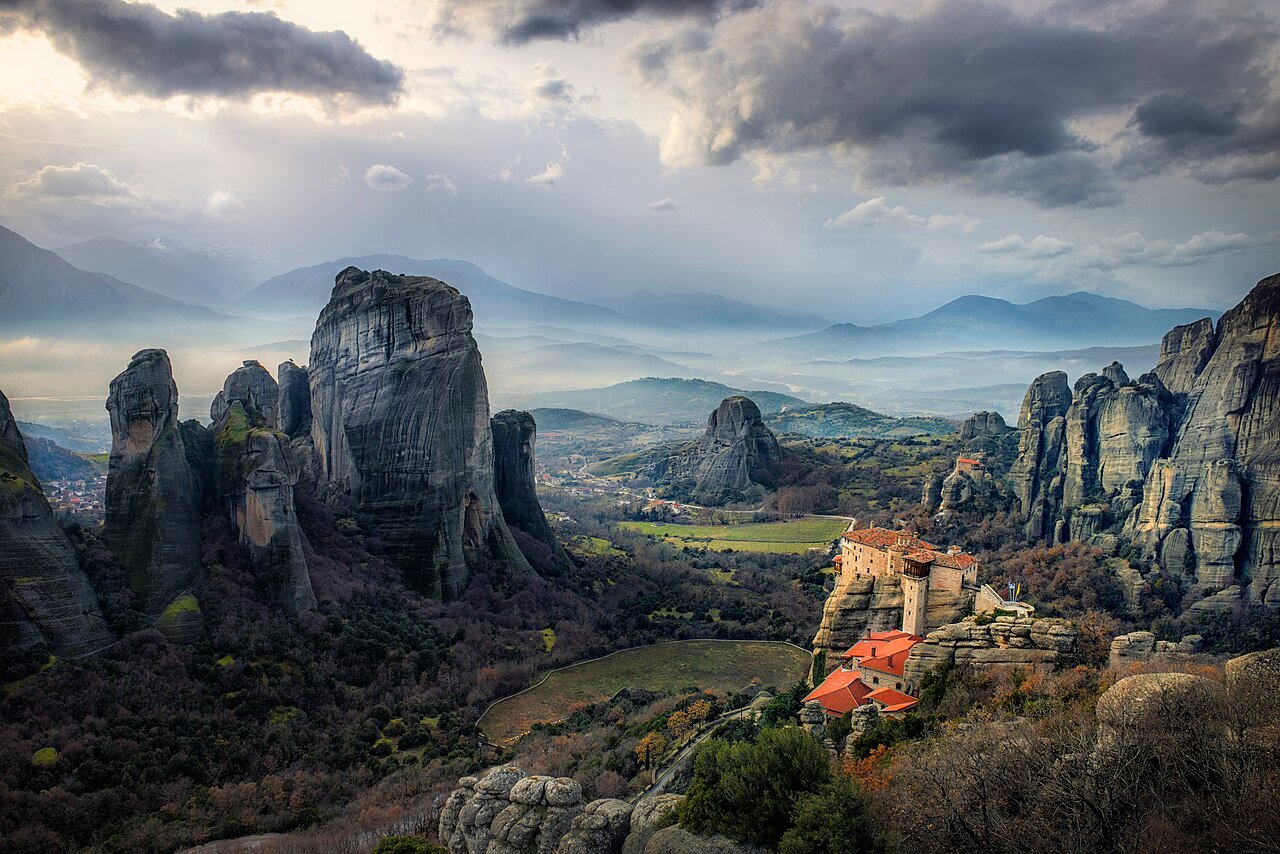
The Acropolis of Athens draws more visitors than any other site on the Greek list, followed by Delphi and Meteora. The monasteries of Meteora, built on and into towering sandstone columns in Thessaly, combine geological drama with late Byzantine frescoes and monastic life that continues today. The Archaeological Site of Olympia, inscribed in 1989, carries its own gravitational pull as the birthplace of the ancient Games.
Beyond those icons, the list holds sites that reward deliberate travel. The Archaeological Site of Philippi (2016) is a Roman city in northern Macedonia with early Christian basilicas and an octagonal church, tracing the moment when Christianity moved from Asia Minor into Europe. The Zagori Cultural Landscape (2023) covers stone-built villages in the Pindus mountains connected by arched packhorse bridges and cobblestone paths — a vernacular architectural tradition that survived intact into the modern era. The Old Town of Corfu (2007) preserves a layered Venetian, French, and British colonial townscape around a fortified harbour.
Natural and shared sites
Greece’s two mixed inscriptions are its closest equivalents to a natural heritage list. Meteora was designated partly for its extraordinary sandstone pillars, carved by erosion over millions of years into forms that make the monasteries appear almost airborne. Mount Athos, the monastic peninsula that juts into the Aegean, holds equal weight as a natural site: its relative isolation has preserved forest cover, coastal habitats, and biodiversity that have largely disappeared elsewhere in the region.
The 2025 inscription of the Minoan Palatial Centres — six Bronze Age complexes across Crete including Knossos, Phaistos, Malia, Zakros, Kydonia, and Zominthos — is the most recent addition to the list and the first to address the Minoan civilisation as a serial transnational entity of its own kind. Greece does not yet participate in major multinational serial inscriptions of the kind that link Roman frontiers or Baroque churches across several countries, but the Minoan inscription moves the list in that direction by treating Crete’s palace culture as an integrated system rather than a collection of individual sites.
How to find them
Greece’s World Heritage sites sit alongside thousands of other places on CHO’s interactive map, with GPS and sourced editorial history for each. See also our guides to Italy’s and France’s UNESCO sites, and our piece on cultural travel beyond mass tourism.
Frequently Asked Questions
How many UNESCO World Heritage Sites does Greece have?
As of 2025, Greece has 20 UNESCO World Heritage Sites. Eighteen are classified as cultural and two — Meteora and Mount Athos — hold mixed status, recognising both their outstanding natural settings and their significance as living cultural and religious landscapes.
What was Greece’s first UNESCO World Heritage Site?
Greece’s first inscription was the Temple of Apollo Epicurius at Bassae, added to the World Heritage List in 1986. Built in the fifth century BC in the Arcadian mountains, it remains one of the best-preserved ancient Greek temples and was notable even in antiquity for combining Doric, Ionic, and Corinthian orders in a single structure.
What is Greece’s most recently inscribed UNESCO site?
The Minoan Palatial Centres were inscribed in 2025, making them the newest addition to Greece’s World Heritage List. The serial inscription covers six major Bronze Age palace complexes across Crete — including Knossos, Phaistos, Malia, and Zakros — and represents the first UNESCO recognition of Minoan civilisation as a unified cultural phenomenon.
Does Greece have any natural UNESCO World Heritage Sites?
Greece has no purely natural World Heritage Sites, but two inscriptions carry mixed status. Meteora is recognised for its dramatic sandstone columns alongside the Byzantine monasteries built on them, while Mount Athos holds value both as a monastic autonomous community and as a relatively undisturbed natural peninsula with significant biodiversity.
Sources used in this article
- UNESCO — State Party Greece — World Heritage list.
- UNESCO — Greece: World Heritage Sites.
- CHO magazine — What is a World Heritage Site?
- CHO — Interactive map of heritage sites.