Poland has 17 UNESCO World Heritage Sites, spanning medieval royal capitals, Neolithic mining landscapes, primeval forest, and the darkest chapter of twentieth-century history. The list moves from salt-carved cathedrals underground to timber evangelical churches built under a peace treaty, from the oldest surviving beech wilderness in Europe to a concentration camp that stands as a permanent warning. From Cultural Heritage Online.
Why Poland’s list looks the way it does
Poland’s World Heritage list is shaped by geography and by rupture. The country sits at the centre of the European plain, a crossroads where Slavic, Germanic, Jewish, and Orthodox cultures overlapped for centuries — and where twentieth-century wars erased much of what that contact produced. The inscriptions reflect both the survival and the loss: royal cities, religious buildings, and industrial landscapes that endured, alongside Auschwitz-Birkenau, inscribed in 1979 precisely because it must not be forgotten.
The 15 cultural sites outnumber the 2 natural ones, but those two natural sites anchor the list in deep ecological time. Białowieża Forest — shared with Belarus — is the last large remnant of the primeval woodland that once covered the European lowland. The Ancient and Primeval Beech Forests, expanded in 2021 to include Bieszczady National Park as part of a transnational serial property spanning 18 countries, extend that ecological story into the Carpathians.
The first inscriptions
Poland was among the earliest signatories to act on the World Heritage Convention. In 1978, the very first cycle of inscriptions, the country placed two sites on the list simultaneously — a remarkable opening statement that reflected genuine ambition and a well-prepared nomination dossier.
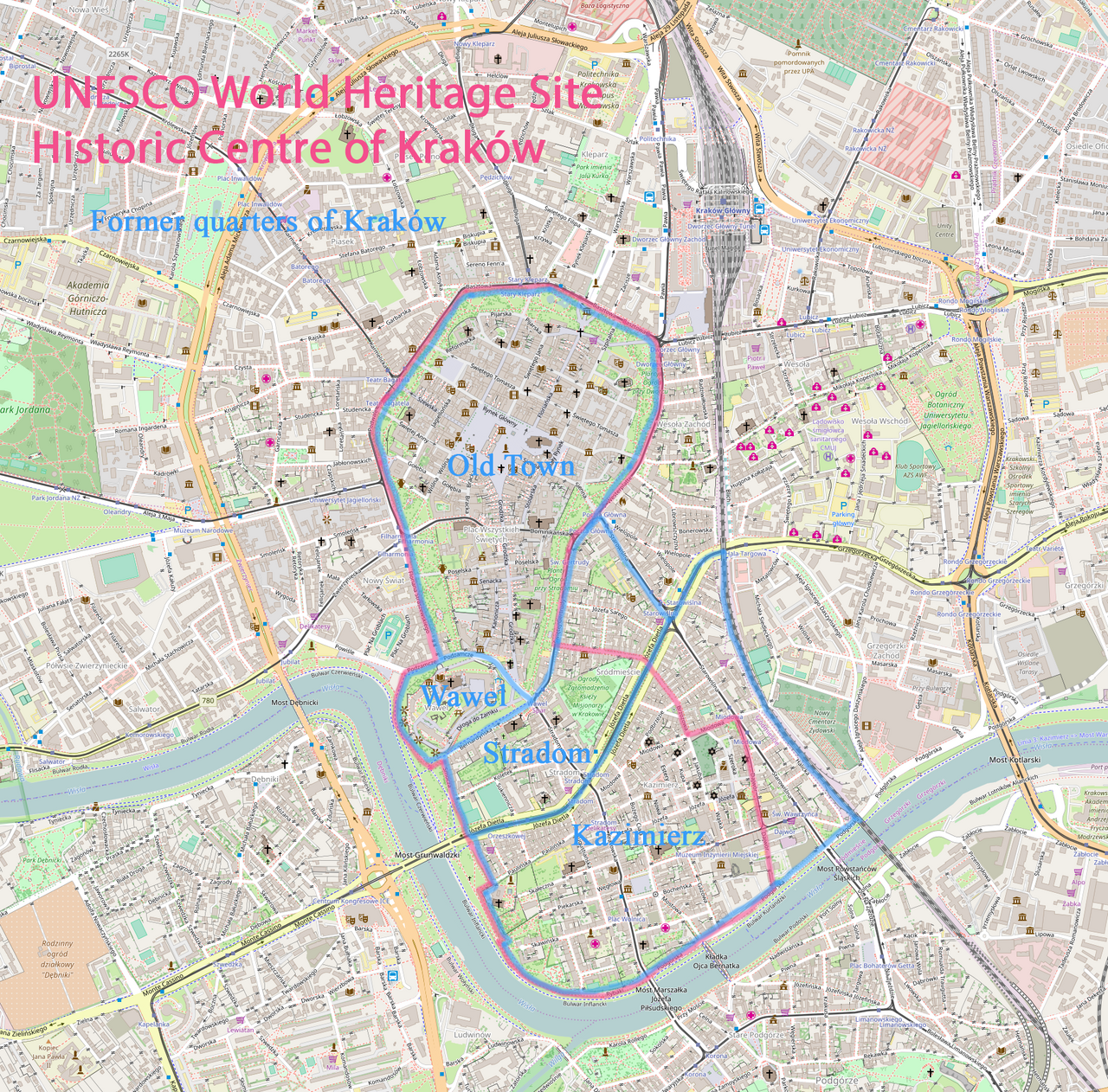
- Historic Centre of Kraków (1978) — the medieval royal capital, with Wawel Castle, Wawel Cathedral, and one of Europe’s largest surviving market squares.
- Wieliczka Salt Mine (1978) — a working mine since the thirteenth century, with underground chapels, sculptures, and chandeliers all carved from salt.
Białowieża Forest followed in 1979, and Auschwitz-Birkenau in the same year, giving Poland four inscriptions within the convention’s first two years — a density that few countries matched at the time.
The most visited — and the alternatives
Kraków draws millions of visitors each year, and Wieliczka is one of the most visited underground attractions anywhere in Europe. Warsaw’s Historic Centre — painstakingly rebuilt after near-total destruction in the Second World War — is equally well known, inscribed in 1980 as a monument to reconstruction as much as to original architecture. These three sites absorb the bulk of international heritage tourism in Poland.
The less-visited inscriptions reward the effort to seek them out. Krzemionki, inscribed in 2019, preserves a Neolithic and Bronze Age flint-mining region with more than 4,000 shafts and pits — one of the most extensive prehistoric mine complexes anywhere in the world. Tarnowskie Góry (2017) is a lead-silver-zinc mine whose nineteenth-century steam-powered drainage systems were engineering innovations of European significance. The Churches of Peace in Jawor and Świdnica (2001) are the largest timber-frame religious buildings in Europe, constructed by Silesian Lutherans under strict conditions imposed by the Peace of Westphalia in 1648 — no stone, no towers, no bells, built to last no more than a few years, yet still standing.
Natural and shared sites
Białowieża Forest straddles the Polish-Belarusian border and is jointly administered as a World Heritage property, covering the last large area of lowland primeval forest in Europe. Its old-growth stands of oak, lime, hornbeam, and spruce support populations of European bison that were reintroduced after extinction in the wild in the twentieth century. The Ancient and Primeval Beech Forests of the Carpathians and Other Regions of Europe, a serial transnational site inscribed across successive extensions since 2007, includes Poland’s Bieszczady component — added in 2021 — as part of a property now shared by 18 European countries.
Poland participates in three other transnational inscriptions. Muskauer Park / Park Mużakowski (2004) is a nineteenth-century landscape park designed by Prince Hermann von Pückler-Muskau that spans the Polish-German border along the Neisse river. The Wooden Tserkvas of the Carpathian Region (2013) — shared with Ukraine — preserves sixteen timber Greek Catholic and Orthodox churches, nine of them on the Polish side. The Centennial Hall in Wrocław (2006), though solely Polish, reflects the broader serial logic of twentieth-century reinforced-concrete modernism.
How to find them
Poland’s World Heritage sites sit alongside thousands of other places on CHO’s interactive map, with GPS and sourced editorial history for each. See also our guides to Italy’s and France’s UNESCO sites, and our piece on cultural travel beyond mass tourism.
Frequently Asked Questions
How many UNESCO World Heritage Sites does Poland have?
Poland has 17 UNESCO World Heritage Sites, comprising 15 cultural and 2 natural properties. The list includes entries inscribed from 1978 — among the first year of the World Heritage Convention — through the most recent extension in 2021.
What was Poland’s first UNESCO World Heritage Site?
Poland placed two sites on the inaugural World Heritage List in 1978: the Historic Centre of Kraków and the Wieliczka Salt Mine. Both were nominated in the very first cycle of inscriptions, making Poland one of the earliest countries to have sites recognised under the convention.
Does Poland have any natural UNESCO World Heritage Sites?
Yes — Poland has two natural World Heritage Sites. Białowieża Forest, shared with Belarus and first inscribed in 1979, is the last large area of primeval lowland forest in Europe. The Ancient and Primeval Beech Forests of the Carpathians and Other Regions of Europe, a vast transnational serial site, includes Poland’s Bieszczady National Park, added in 2021.
Which of Poland’s UNESCO sites are shared with other countries?
Poland participates in four transnational World Heritage inscriptions: Białowieża Forest (with Belarus), Muskauer Park / Park Mużakowski (with Germany), the Wooden Tserkvas of the Carpathian Region (with Ukraine), and the Ancient and Primeval Beech Forests of the Carpathians and Other Regions of Europe (with 17 other European countries).
Sources used in this article
- UNESCO — State Party Poland — World Heritage list.
- UNESCO — Poland: World Heritage Sites.
- CHO magazine — What is a World Heritage Site?
- CHO — Interactive map of heritage sites.
Sources
- S1 — Davies, Norman. Heart of Europe: The Past in Poland's Present. Oxford University Press, 2001. ISBN 978-0-19-280126-5.
- S2 — Zamoyski, Adam. The Polish Way: A Thousand-Year History of the Poles and Their Culture. John Murray, 1987. ISBN 978-0-7195-4674-7.
Spotted an error? Write to editorial@culturalheritageonline.com and we correct it the same day.