When Art Nouveau swept through Europe at the turn of the twentieth century, it arrived in Turin with particular force. The city had a reason: in 1902, the Esposizione Internazionale d’Arte Decorativa Moderna made Turin the launch platform for what Italians would call Stile Liberty — and one architect, Pietro Fenoglio, seized that moment more completely than anyone else.
Fenoglio’s Own Corner
The most direct way to understand Turinese Liberty is to stand at the corner of Corso Francia and Via Principi d’Acaja and look up. Casa Fenoglio-Lafleur, completed by Pietro Fenoglio in 1902, was the architect’s own home. That fact matters. Fenoglio was not working to a client’s hesitant brief; he was designing for himself, and the result is uninhibited. The façade breathes organic line: sinuous plasterwork curves around the windows, ironwork tendrils climb the balconies, and the whole surface reads less like masonry than like something that grew rather than was built. The corner tower resolves into a fluid silhouette that has no hard angle anywhere.
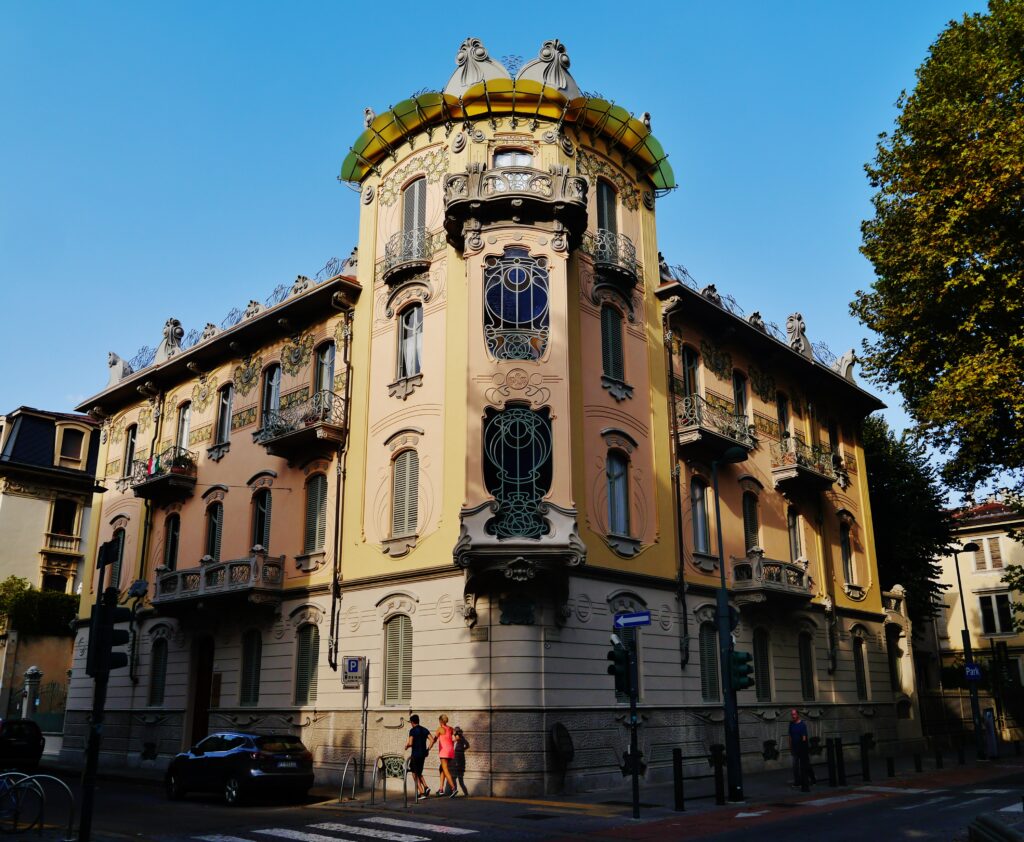
The surrounding Cit Turin district contains several other Liberty buildings from the same short burst of construction, but Casa Fenoglio-Lafleur is the anchor. Like Victor Horta’s own house in Brussels or the Casa Lleó Morera in Barcelona, it demonstrates that the movement’s most persuasive advocates built first for themselves. Turin belongs in that company without apology.
A short walk away stands Casa Florio, a rental house commissioned in 1902 by the brothers Daniele and Sereno Florio. No architect has been firmly attributed to the building, but its debt to the vocabulary that emerged from the 1902 Exposition is clear: the decorative grammar of the façade — restrained compared to Fenoglio’s exuberance, yet modern in every detail — shows how quickly that new language spread from the exposition halls into ordinary rental construction.
Villas on the Po Hill
From the city centre, tram or taxi carries you up toward the Po hill, where Turin’s Liberty ambitions expressed themselves in private villa commissions for wealthy patrons. The result is a landscape of confident private architecture.
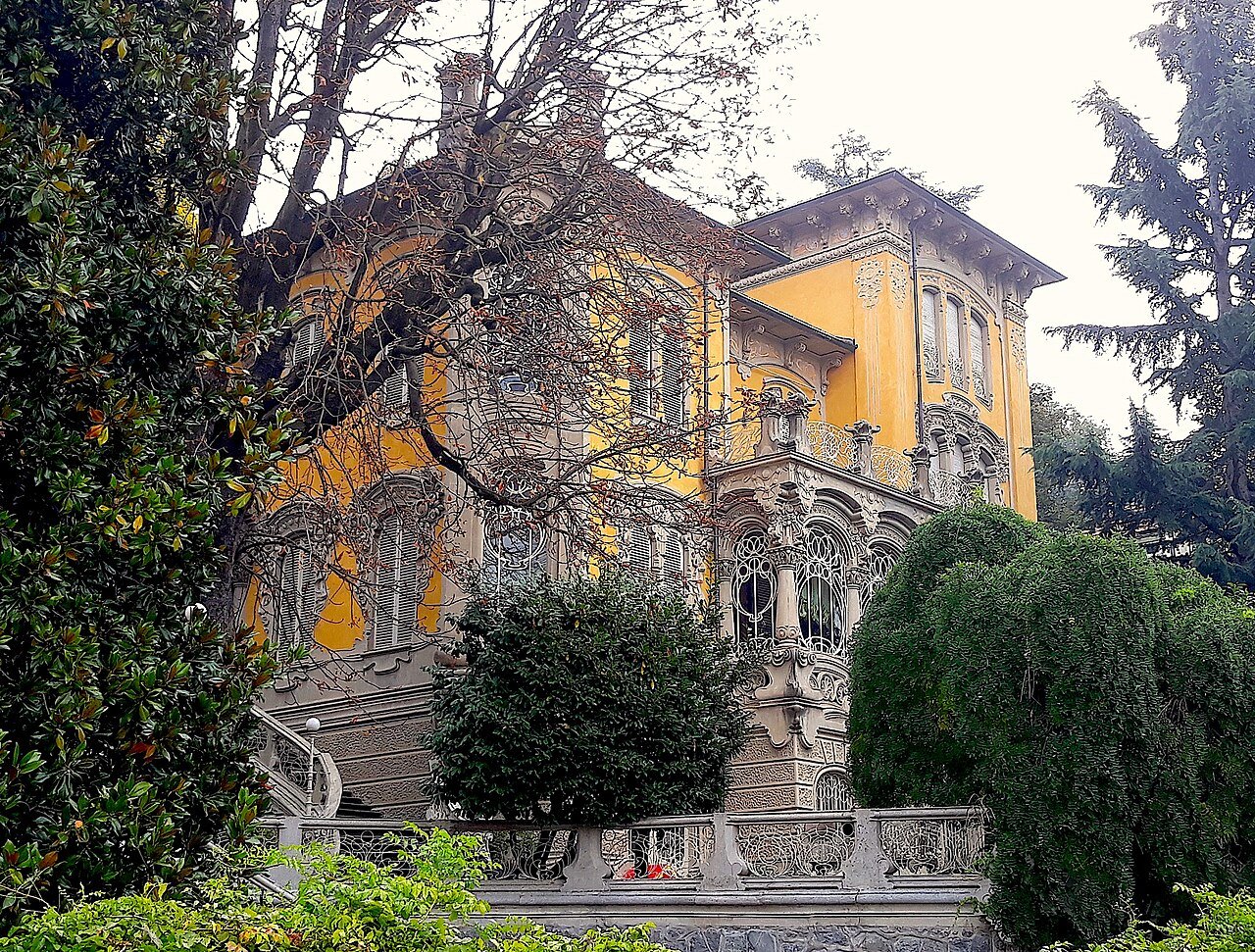
Villa Scott, designed by Pietro Fenoglio with Gottardo Gussoni in 1902, is the most theatrical of the group. Carved stone and wrought iron combine in a composition that veers toward the extravagant. The ironwork in particular deserves attention: the gates and window grilles are not ornamental additions but structural arguments, demonstrating that the Liberty architects understood metal as a plastic material rather than a rigid one. The villa later became a location for Italian cinema, and it is easy to see why directors were drawn to it — every angle offers a frame already composed. It is a private residence; the façade from the street is what the walk offers.
Nearby, Villino Raby, also by Pietro Fenoglio and dating from the early 1900s, operates on a smaller and more intimate scale. Where Villa Scott declares itself loudly, Villino Raby accumulates its effects in detail: the floral reliefs, the window surrounds, the transitions between materials. Taken together, these two buildings show Fenoglio’s range — he could work at the pitch of maximum rhetoric or at a quieter register, and he was convincing in both.
From Eclecticism to Liberty
The walk is not only about Fenoglio. Palazzo Bellia, on Via Pietro Micca and designed by Carlo Ceppi between approximately 1892 and 1898, belongs to an earlier moment. Ceppi was a Piedmontese architect of the late eclectic tradition — a tradition that drew freely on historical styles rather than breaking from them. Yet Palazzo Bellia stands at a threshold. Look at the surface treatment: the ornamental programme is still rooted in historicism, but something in the handling of mass and decoration anticipates what was about to happen.
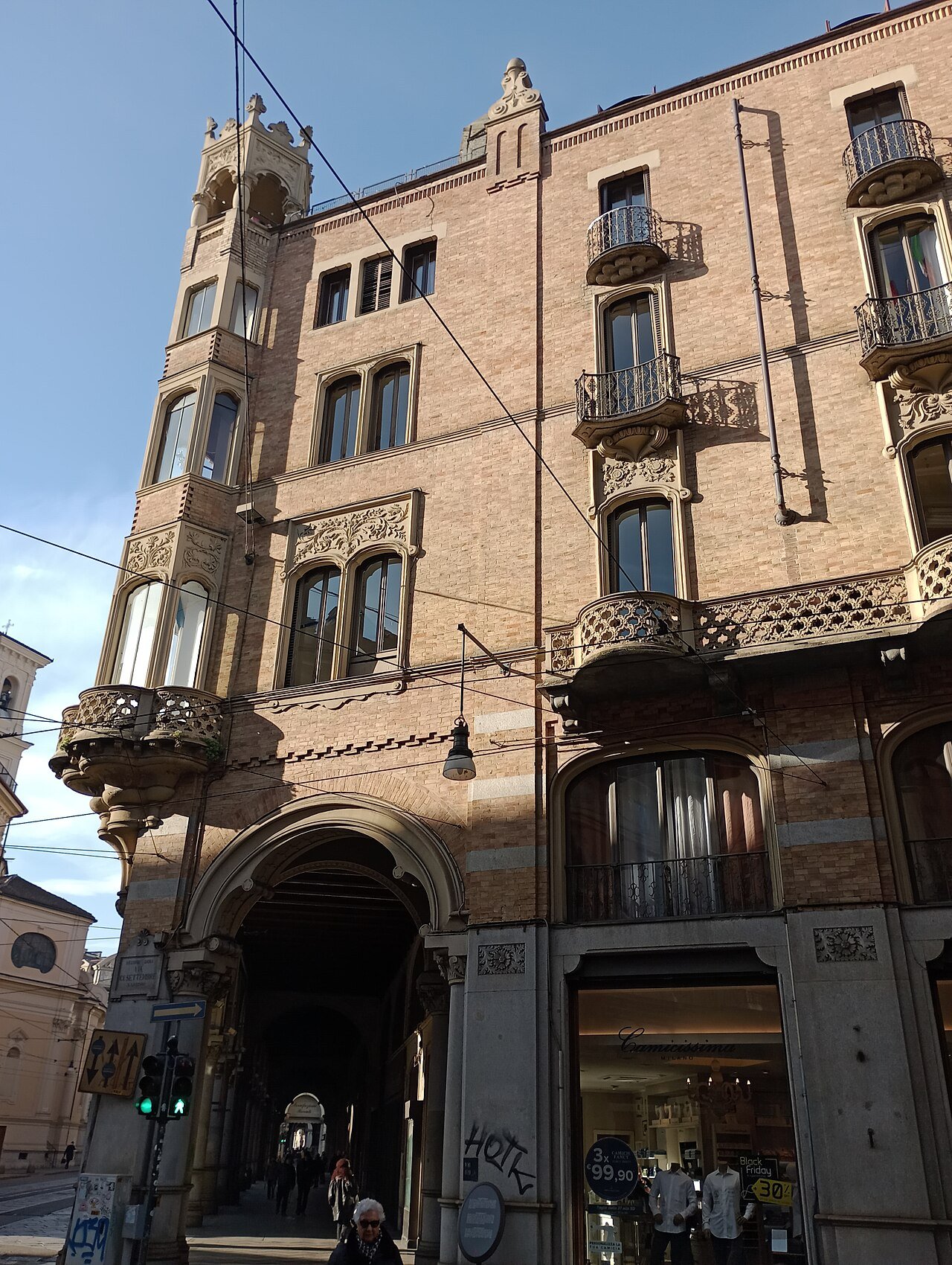
That threshold is the point. Turin’s Liberty did not arrive from nowhere. It crystallised out of decades of eclectic experimentation, and Palazzo Bellia is one of the buildings that makes the lineage visible. Placing it on the same itinerary as Fenoglio’s work is not a contrast; it is a chronology.
Why It Happened Here
The 1902 Esposizione Internazionale d’Arte Decorativa Moderna was a deliberate act of cultural positioning. Turin’s civic leadership invited the leading designers of Europe to exhibit, with a rule: no historical revivalism. Everything shown had to be new. The effect was galvanic. Italian designers arrived at the exposition confronted with the full range of what was happening in Vienna, Brussels, Paris and Glasgow — and left with a mandate to build in the same spirit.
Fenoglio was the most productive local response to that mandate. He built dozens of houses in Turin in a concentrated period of years. Then, with the same apparent decisiveness that marked his architecture, he left the profession and moved into banking. The buildings remained. Their density in certain Turin neighbourhoods — Cit Turin above all — gives the city a Liberty character that survives intact in a way that comparable districts in other Italian cities do not always match. Stile Liberty as an Italian variant of the broader Art Nouveau / Jugendstil current found its most concentrated urban expression here, in these streets, during those years.
How to Walk It
You can cover the Cit Turin cluster — Casa Fenoglio-Lafleur, Casa Florio and the surrounding streetscape — in about an hour on foot from the city centre. The corner of Corso Francia and Via Principi d’Acaja is the natural starting point. From there, a tram or short taxi ride takes you up to the Po hill for Villa Scott and Villino Raby; allow another hour to walk the hill and absorb the villas at a reasonable pace. Palazzo Bellia on Via Pietro Micca sits in the central city grid and fits naturally into either end of the route.
All five buildings are private or institutional. You are visiting façades, not interiors, so there are no entry fees or opening hours to manage. Plan for two to three hours total, more if you stop for coffee in Cit Turin. The neighbourhood has retained its residential character and is not a tourist circuit in the conventional sense — the buildings stand in ordinary streets, and that ordinariness is part of what makes the walk worthwhile.
Turin’s Liberty story connects directly to the broader European movement: the same decade that produced Fenoglio’s villas also gave the world Gaudí’s Casa Batlló in Barcelona and Victor Horta’s pioneering ironwork in Brussels.
Frequently Asked Questions
Who was Pietro Fenoglio and why is he important to Turin?
Pietro Fenoglio was Turin’s leading Liberty architect, active at the turn of the twentieth century. He designed dozens of buildings in the city during a concentrated period following the 1902 International Exposition, making Turin one of the most densely Liberty cities in Italy. After that burst of activity, he left architecture and moved into banking, leaving his buildings as his permanent contribution to the city.
What was the 1902 Turin Exposition and what did it achieve?
The Esposizione Internazionale d’Arte Decorativa Moderna, held in Turin in 1902, was an international design exhibition with a strict rule against historical revivalism. It brought together leading designers from across Europe and effectively launched Stile Liberty — the Italian variant of Art Nouveau — as a coherent movement. The exposition gave Italian architects direct exposure to the full range of contemporary European decorative design.
Can visitors enter Casa Fenoglio-Lafleur?
Casa Fenoglio-Lafleur is a private building, and access to the interior is not generally available. The walk focuses on the exterior, which is fully visible from the street at the corner of Corso Francia and Via Principi d’Acaja. The façade is detailed enough that an extended look from the pavement is genuinely rewarding.
How does Stile Liberty differ from French Art Nouveau or Catalan Modernisme?
All three are national expressions of the same broad European movement that flourished roughly between 1890 and 1910 — the rejection of historical revivalism in favour of organic, nature-derived ornament and new structural possibilities offered by iron and glass. Stile Liberty takes its name from the Liberty department store in London, which imported decorative goods in the style. The Turin buildings share the movement’s central formal vocabulary while reflecting local building materials and Piedmontese craftsmanship traditions.
Is the Po hill worth the detour for Villa Scott and Villino Raby?
For anyone seriously interested in Liberty architecture, yes. Villa Scott in particular, designed by Fenoglio with Gottardo Gussoni in 1902, is one of the most exuberant Liberty villas in Italy. The hill setting also separates these buildings from the urban density of Cit Turin, giving them a different spatial context that changes how they read. The combination of tram access and the Po hillside landscape makes the detour pleasant in practical terms as well.
What is the best starting point for a Liberty walk in Turin?
The corner of Corso Francia and Via Principi d’Acaja, where Casa Fenoglio-Lafleur stands, is the natural anchor. It is accessible by tram from the city centre and places you immediately in the Cit Turin district, which has the highest concentration of Liberty buildings. From there, the route to Palazzo Bellia and then up to the Po hill villas follows a logical geographic sequence.