
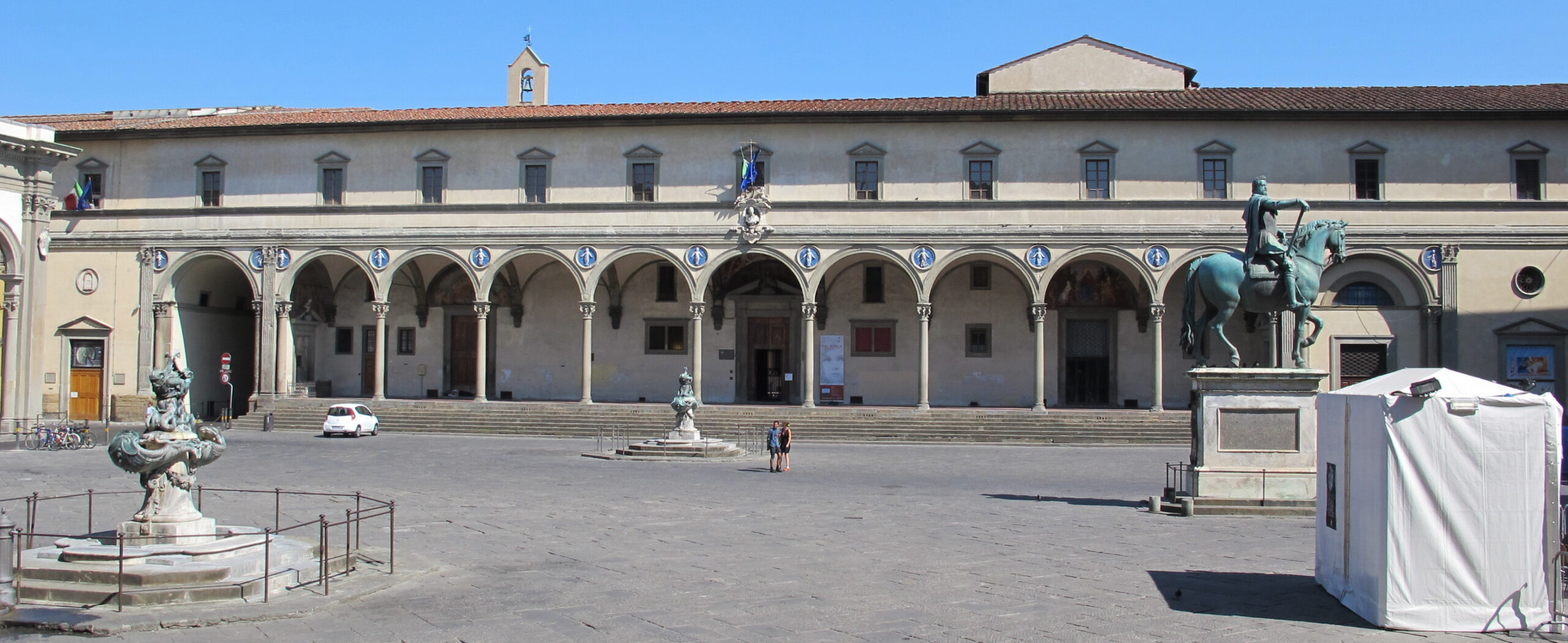
On the eastern side of Piazza della Santissima Annunziata, a slender colonnade of nine arches opens onto the square in measured intervals. Commissioned in 1419 from Filippo Brunelleschi by the Arte della Seta, the silk guild of Florence, the building was conceived as a foundling hospital for abandoned children — and is generally regarded as the first structure built in the new Renaissance manner.
- Address
- Piazza della Santissima Annunziata, 12, 50122 Firenze FI
- Period
- 1419–1445, Early Renaissance
- Architect
- Filippo Brunelleschi
- Function
- Foundling hospital operated by the Arte della Seta (Silk Guild)
- Current use
- Museo degli Innocenti; UNICEF Innocenti Research Centre; institutional seat of the Istituto degli Innocenti
- Coordinates
- 43.7761° N, 11.2609° E
- Notes
- The first infant was received on 5 February 1445, ten days after the hospital opened.
Gallery
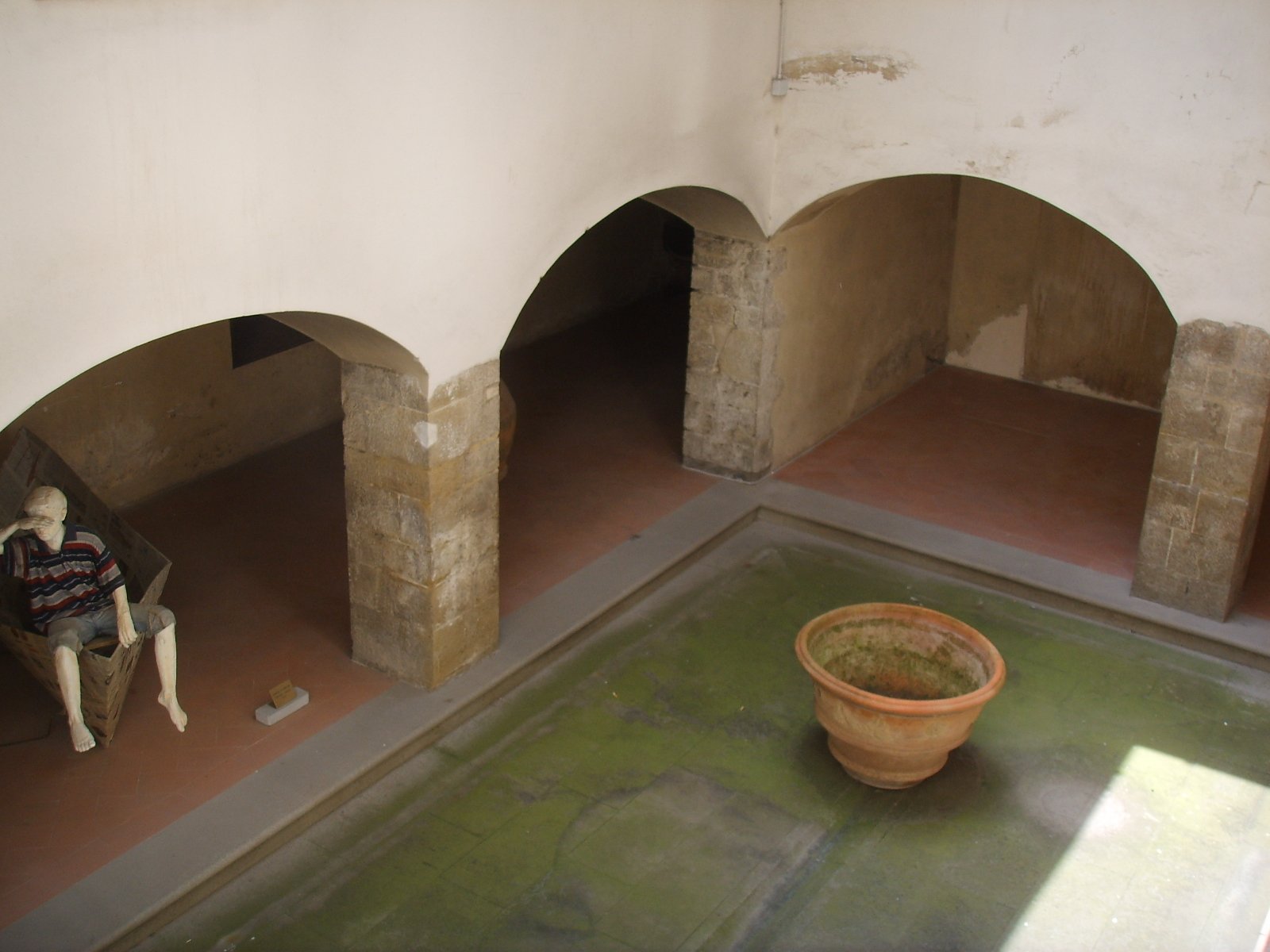
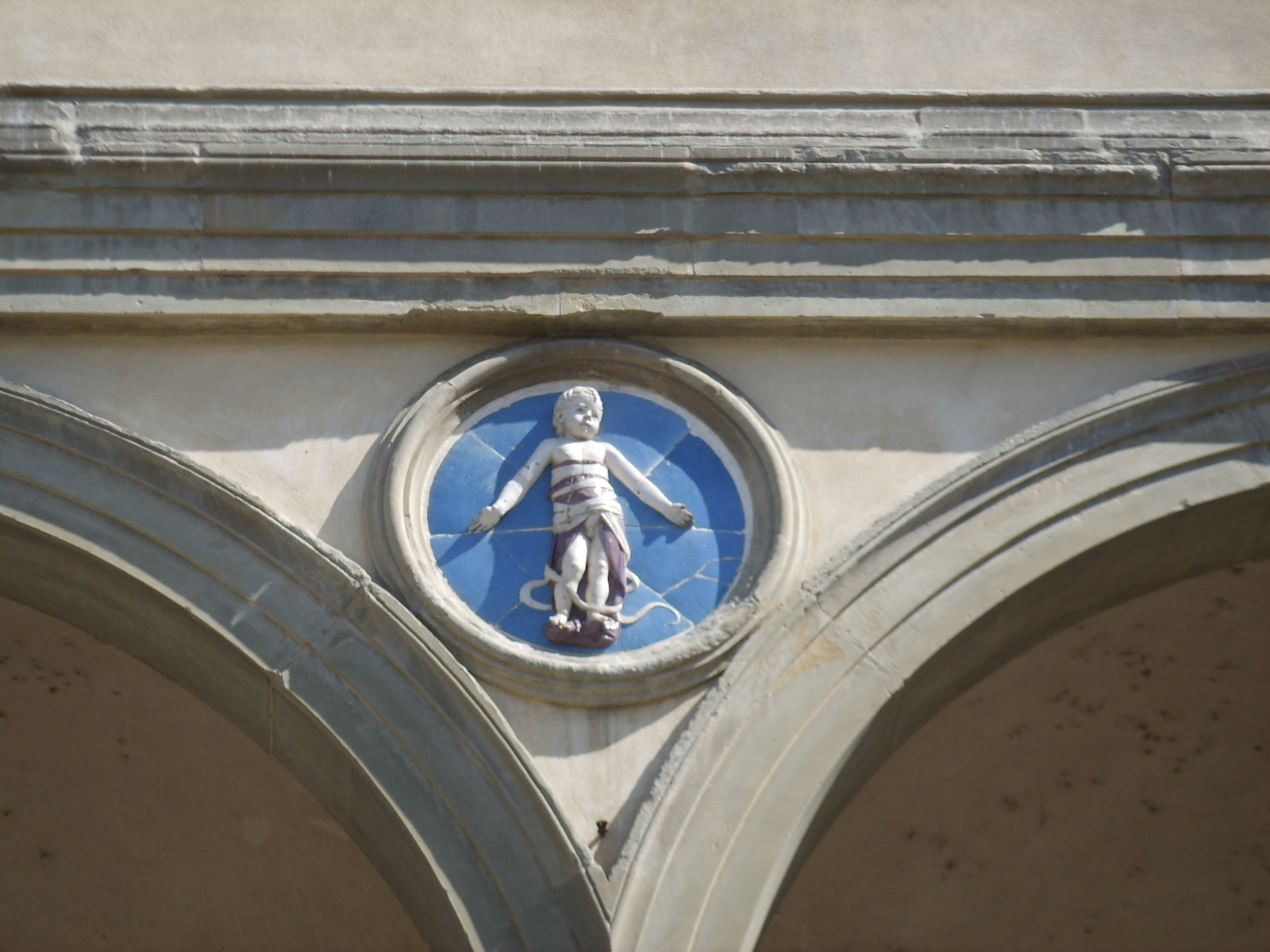
Two views of the building beyond the public facade: the principal interior courtyard, and one of the Della Robbia medallions that have become the building’s emblem.
Visit on the map
Piazza della Santissima Annunziata · 43.7761° N, 11.2609° E
Download for your navigator
A single waypoint, ready for GPS apps, navigators, and contacts.
The hospital was commissioned in 1419 by the Arte della Seta, the Florentine silk guild, which assumed responsibility for the care of abandoned children. Filippo Brunelleschi designed the building and oversaw construction during its first phase, between 1419 and 1427. Work continued under other masters after his departure, and the institution formally opened on 25 January 1445. The loggia facing the piazza — nine equal bays carried on slender Corinthian columns, with shallow pendentive vaults overhead — became the most studied element of the project, and one of the earliest applications of the classical orders to a wholly new civic typology.
Andrea della Robbia added the celebrated glazed terracotta medallions in the spandrels around 1490, replacing the blank concavities Brunelleschi had originally intended. Each tondo shows an infant in swaddling clothes against a deep blue ground, an emblem so closely identified with the institution that the American Academy of Pediatrics adopted a version of it as its insignia. Beyond the loggia, the building extended into a sequence of cloisters and wards organised around the Cortile degli Uomini and the Cortile delle Donne, separating the spaces for boys and girls and following a clear, repeatable geometry that would become a Renaissance standard for institutional architecture.
The hospital received foundlings until 1875. Since 1988 the building has also housed the UNICEF Innocenti Research Centre, and in 2016 the Museo degli Innocenti opened across three levels, presenting the institution’s history together with paintings by Domenico Ghirlandaio, Sandro Botticelli, Piero di Cosimo and members of the Della Robbia workshop. The Istituto degli Innocenti continues to operate from the same complex, six centuries after its foundation.
Resources & References
Editorial picks across Wikipedia, photo archives, and the official portal.
All photographs Wikimedia Commons (CC-BY / CC-BY-SA / Public Domain) unless otherwise stated. Editorial text Cultural Heritage Online, OASIS Tech LLC USA.
See the place
Find it on the map
See this place and what’s around it →📷 Become a Cultural Heritage Online photographer
Share your photos of places: they stay published under your name as the author. The more they're seen, the more you get noticed — and soon a contest will reward the most appreciated photos.
Log in or sign up free to add a photoIs this page about you?
This page is read by travellers and heritage enthusiasts who find it on Google. Tell us how you are connected to this place and we will take it from there.