
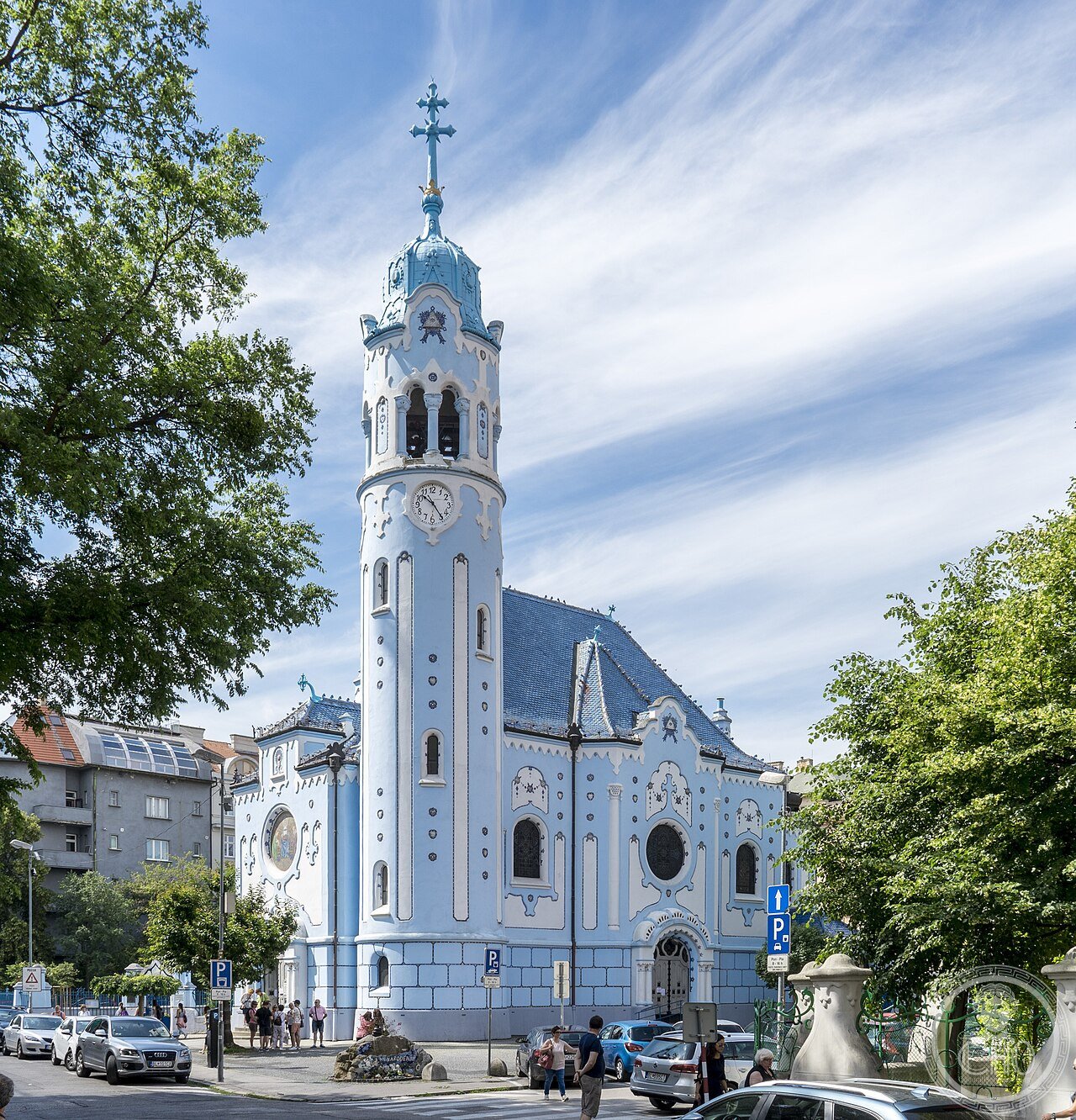
A church of cake-icing blue, from mosaic roof to pastel walls – Odon Lechner’s Hungarian Secession fantasy and the most photographed building in Slovakia.
At a glance
- Type
- Church
- Period
- 1909-1913
- Style
- Hungarian Secession (Art Nouveau)
- Location
- Bezrucova street, Bratislava, Slovakia
- Coordinates
- 48.1438, 17.1188
- Architect
- Odon Lechner
Overview
The Church of St Elisabeth, universally the Blue Church, is the late masterpiece of Odon Lechner, the Gaudi of Hungary, who fused Magyar folk ornament with Art Nouveau into a national style. Every surface – the round tower, the wave-edged gables, the majolica roof, the very mortar – is tuned in blues from powder to ultramarine, a building seemingly piped from a confectioner’s bag.
History
Built 1909-1913 as the chapel of the neighbouring Catholic grammar school in what was then Pressburg/Pozsony, the church is dedicated to St Elisabeth of Hungary, born in the city’s castle in 1207. The First World War made it Lechner’s swan song; the border changes of 1918-1920 left his Hungarian Secession landmark in the new Czechoslovakia, where it became, and remains, Bratislava’s best-loved building.
Architecture and Design
The single-nave oval interior continues the blue theme beneath a coffered ceiling, with Zsolnay ceramic details and a mosaic of the saint above the portal. The adjoining school by Lechner repeats the palette; the round campanile’s spiralling crown is the style’s purest gesture outside Budapest.
Cultural significance
The Blue Church is the icon of Bratislava and a key monument of Central Europe’s Secession – the moment national romantics built modern identities in tile and curve. It hosts a constant stream of weddings, drawn by an architecture of pure joy.
Visiting today
The interior opens around Mass times morning and evening; the exterior photographs best in low light. The old town and the Danube embankment are five minutes away.
Getting there
From the old town, walk east past the Slovak National Theatre; trams and buses along Dostojevskeho rad stop within two blocks.
Sources and resources
Find it on the map
See this place and what’s around it →Record researched and written by Luigi De Marchi for Cultural Heritage Online, 2026.
📷 Become a Cultural Heritage Online photographer
Share your photos of places: they stay published under your name as the author. The more they're seen, the more you get noticed — and soon a contest will reward the most appreciated photos.
Log in or sign up free to add a photoIs this page about you?
This page is read by travellers and heritage enthusiasts who find it on Google. Tell us how you are connected to this place and we will take it from there.