
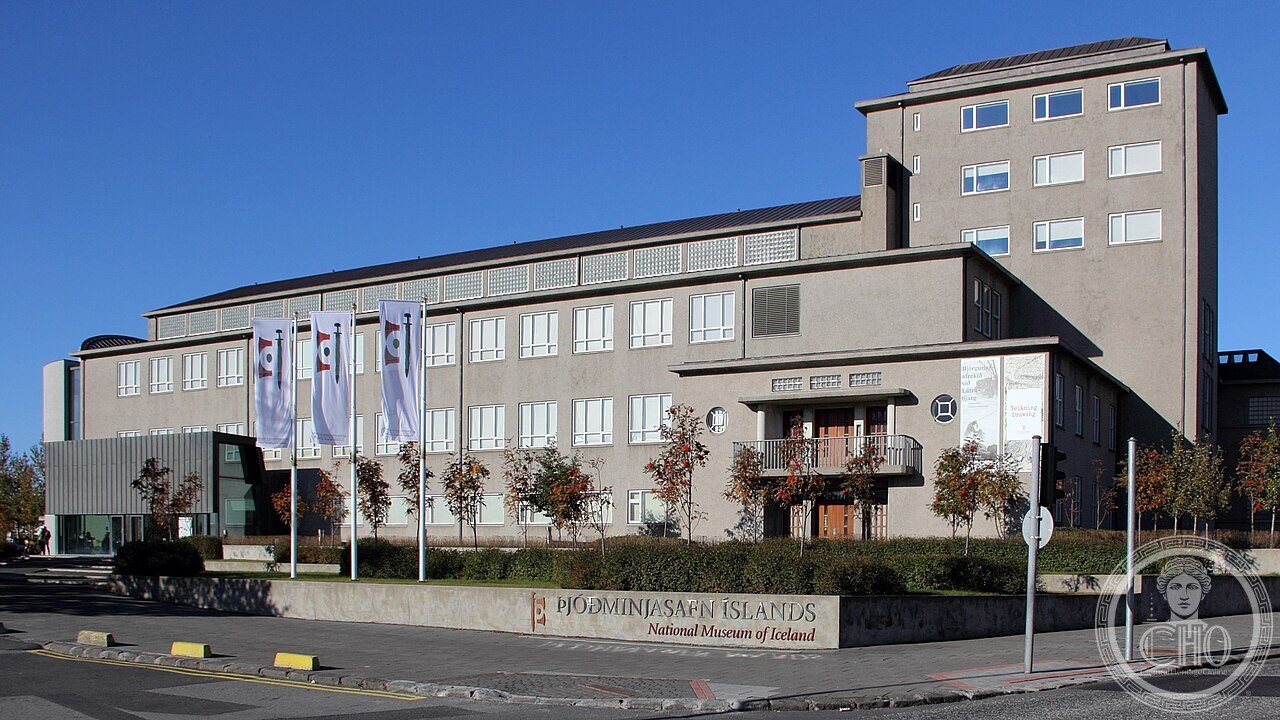
National Museum of Iceland
Iceland’s premier cultural institution, the National Museum in Reykjavik holds the world’s most comprehensive collection of Icelandic heritage — from Viking Age woodcarvings and Saga-period gold to the story of the first Norse settlers who landed on an uninhabited island at the edge of the world.
At a glance
- Type
- National museum
- Period
- Opened 1950; expanded 2004
- Style
- Nordic Functionalism
- Location
- Sudurgata 41, 101 Reykjavik, Iceland
- Coordinates
- 64.1369, -21.9518
- Architect
- Gudjon Samuelsson (original building)
Overview
The National Museum of Iceland (Thjodminjasafn Islands) houses the most comprehensive collection of Icelandic cultural heritage in existence, tracing the country’s history from the Settlement Period (874 AD) through the present day. The current building, opened in 1950 and substantially expanded in 2004, exemplifies Nordic Functionalism: a clean, light-filled structure in concrete and glass that prioritizes natural illumination and spatial clarity over decoration — a philosophy deeply aligned with Iceland’s Lutheran cultural tradition and the crystalline quality of sub-Arctic light. The museum’s permanent exhibition “The Making of a Nation” uses original artefacts, reconstructed environments, and cutting-edge audiovisual technology to tell the story of Norse settlement, the Commonwealth period, the Sagas, Reformation, and modernity. With over 2,000 objects on permanent display from a collection of some 25,000 items, it is the essential first stop for understanding Icelandic civilization.
History
The origins of the National Museum date to 1863, when the Antiquarian Society of Iceland began systematically collecting objects related to Icelandic history and folk culture. The collection was initially housed in various premises before the purpose-built museum on Sudurgata opened in 1950, designed by the prolific Icelandic architect Gudjon Samuelsson (also responsible for Hallgrimskirkja church). Iceland’s history as a collected subject is inseparable from the country’s national awakening: the 19th-century Romantic movement led the desire to preserve and celebrate the Norse heritage that proved Icelandic cultural distinctiveness from Danish rule. Iceland achieved home rule in 1904 and full independence in 1944. The museum’s 2004 expansion tripled the exhibition space, enabling the landmark “Making of a Nation” permanent display to open with state-of-the-art presentation technology.
Architecture and Design
The 1950 building by Gudjon Samuelsson follows Nordic Functionalist principles that dominated Scandinavian institutional design from the 1930s onward: rectilinear massing, load-bearing concrete construction, large windows admitting maximum northern light, and minimal surface ornament. The 2004 extension added a new entrance pavilion, a glazed atrium linking old and new wings, and contemporary gallery spaces with precision climate control for artefact preservation. The overall effect is a building that feels simultaneously simple and serious — suited to its landscape of volcanic rock and horizontal light. The museum sits within the University of Iceland campus, adjacent to the Faculty of Law and within walking distance of the Perlan geothermal museum and the Arni Magnusson Institute for Icelandic Studies (home of the Codex Regius, the primary manuscript source for the Elder Edda).
Cultural significance
The National Museum holds several objects of world-class cultural importance. The carved wooden portal door from the Valthjofsstadir church (c. 1200 AD) is among the finest surviving examples of Viking Age woodcarving, depicting the legend of a knight and a lion in a style fusing Norse and Norman Romanesque influences. The museum’s collection of gold and silver ecclesiastical objects from the 12th-14th centuries — chalices, reliquaries, and croziers — represents the finest surviving corpus of medieval Icelandic metalwork. The Viking Age archaeological finds include brooches, weights, tools, and the distinctive oval tortoise brooches that identify Norse women’s graves across the North Atlantic. The museum also holds the world’s most extensive collection of Icelandic folk costumes and domestic objects from the turf-house era. For the story of human beings settling a previously uninhabited landmass — the last such event in temperate Northern Europe — this collection is the primary physical witness.
Visiting today
The National Museum is open Tuesday to Sunday, 10:00 to 17:00, with extended hours in summer (May to September, open daily including Mondays). An entrance fee applies; discounts for students, seniors, and children. The “Making of a Nation” permanent exhibition requires approximately two hours for a thorough visit. Audio guides are available in multiple languages. The museum shop carries high-quality reproductions and academic publications. A cafe on site serves light meals. The museum is located on Sudurgata, a short walk from the Hlemmur bus terminal; buses 1, 3, 6, and 14 stop nearby.
Getting there
Keflavik International Airport (KEF) serves Reykjavik, approximately 50 km away. The Flybus and Reykjavik Excursions airport shuttles connect KEF to the BSI bus terminal in central Reykjavik in about 45 minutes. From central Reykjavik, the museum is reachable on foot (25 minutes from Laekjartorg) or by Straeto city bus (routes 1, 3, 6, 14 — alight at Sudurgata/Hringbraut). Taxis are readily available. Reykjavik is a compact city and the museum is within easy walking distance of the Old Harbour, Hallgrimskirkja, and the main hotel district.
Sources and resources
Find it on the map
See this place and what’s around it →📷 Diventa un fotografo di Cultural Heritage Online
Condividi le tue foto dei luoghi: restano pubblicate con la tua firma come autore. Più vengono viste, più ti fai conoscere — e presto un concorso premierà le foto più apprezzate.
Accedi o registrati gratis per aggiungere una fotoDo you manage this place?
This page is read by travellers and heritage enthusiasts who find it on Google. Keep it accurate — and make it work for you. Free for non-profit heritage institutions.