
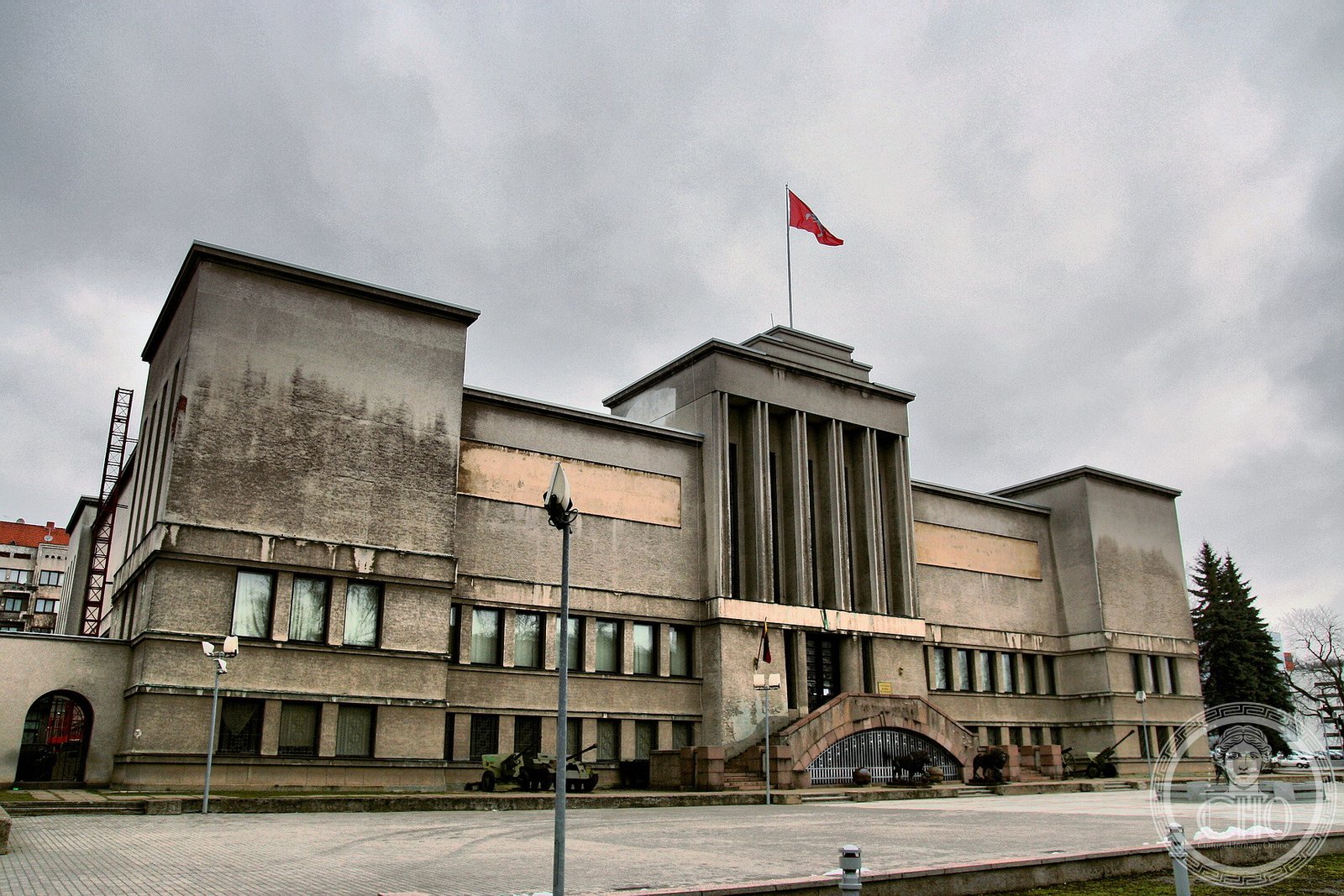
The Vytautas Magnus War Museum stands at the heart of Kaunas as the most significant monument to Lithuanian military history and national independence. Built between 1933 and 1936 to designs by architects Mykolas Songaila and Vidas Janulis, it was conceived during the period when Kaunas served as the provisional capital of independent Lithuania — Vilnius having been occupied by Poland since 1920. The building’s Neoclassical facades with Art Deco simplification were a deliberate architectural statement: Lithuania was a modern, sovereign European nation deserving an institution of European dignity and seriousness. The museum commemorates soldiers who fell in the First World War and in the Lithuanian Wars of Independence of 1918–1919, and preserves a remarkable collection of armaments, uniforms, maps, and personal effects spanning six centuries of Lithuanian military history. That it survived Soviet occupation, Nazi occupation, and a second Soviet period to be restored to its original purpose after 1990 independence gives it an added layer of historical meaning that no restoration can erase.
At a glance
- Type
- National military museum
- Period
- 1933–1936
- Style
- Neoclassical / Art Deco
- Location
- K. Donelaičio g. 64, Kaunas, Lithuania
- Coordinates
- 54.8999° N, 23.9017° E
- Architect(s)
- Mykolas Songaila, Vidas Janulis
Overview
The museum is housed in a substantial four-storey building whose primary facades face a formal garden containing the Statue of Liberty — a bronze female figure with a torch, erected in 1928 to mark ten years of Lithuanian independence — and several captured military vehicles. The permanent collection spans medieval armour and weaponry, the Napoleonic campaigns, the First World War, the Wars of Independence, and the interwar Lithuanian Army, including the armoured car used in the 1923 Klaipėda Revolt. Temporary exhibitions address more recent military history and international conflicts.
History
The museum was founded in 1921 in temporary premises as a direct response to the conclusion of the Wars of Independence. Planning for a dedicated building began in the late 1920s; construction ran from 1933 to 1936. The opening in 1936 was a major state occasion in interwar Lithuania. During Soviet occupation (1940–41 and 1944–1990) the building became a Museum of the Red Army: Soviet exhibits replaced Lithuanian ones and the Statue of Liberty was removed. After Lithuania restored independence in 1990, the building was returned to its original function and the Statue of Liberty was reconstructed in 1991, becoming a powerful symbol of renewed statehood. Comprehensive restoration followed through the 1990s and 2000s.
Architecture & Design
The building presents a sober, dignified exterior combining the symmetry and proportion of Neoclassicism with the stripped ornament characteristic of interwar European Art Deco. The main facade is organised around a central projecting bay with tall windows, flanked by symmetrical wings. Pilasters run the full height of the upper storeys, providing vertical rhythm without the fluted columns of strict classicism. The stone facing is pale limestone. Interior spaces are organised around a central hall and staircase rising through all four floors. The formal garden in front, with its central Liberty statue and flanking military hardware, extends the architectural composition into the public realm in a manner typical of interwar nationalist civic planning.
Cultural significance
The Vytautas Magnus War Museum is the primary institution of Lithuanian national military memory and one of the most visited museums in the country. The building, garden, and Statue of Liberty together constitute a site of national pilgrimage. The statue’s removal under Soviet occupation and its reconstruction in 1991 transformed it from an architectural feature into a symbol of resistance and restored sovereignty. The museum is named for Vytautas the Great, the medieval Grand Duke under whom the Grand Duchy of Lithuania reached its greatest territorial extent — a deliberate invocation of historical depth and legitimate statehood.
Visiting today
Open Tuesday to Sunday, 10:00 to 18:00 (closed Monday). Admission fees apply; discounts for students, seniors, and families. Audio guides are available in Lithuanian, English, and Russian. The garden with the Statue of Liberty and outdoor military exhibits is accessible at all hours. The museum benefits from improved signage and visitor facilities introduced during the Kaunas 2022 European Capital of Culture programme. Photography is permitted throughout.
Getting there
Located on K. Donelaičio gatvė in central Kaunas, a five-minute walk from Laisvės alėja (Freedom Avenue), the city’s main pedestrian boulevard. From Kaunas railway station, take bus or trolleybus to the city centre (approximately 15 minutes) or walk (25 minutes). From Kaunas Airport, take bus No. 29 to the city centre. Vilnius is approximately 100 km east; intercity buses and trains run frequently and take 1.5–2 hours.
Sources & resources
Find it on the map
See this place and what’s around it →Record researched and written by Luigi De Marchi for Cultural Heritage Online, 2026.
📷 Become a Cultural Heritage Online photographer
Share your photos of places: they stay published under your name as the author. The more they're seen, the more you get noticed — and soon a contest will reward the most appreciated photos.
Log in or sign up free to add a photoIs this page about you?
This page is read by travellers and heritage enthusiasts who find it on Google. Tell us how you are connected to this place and we will take it from there.