
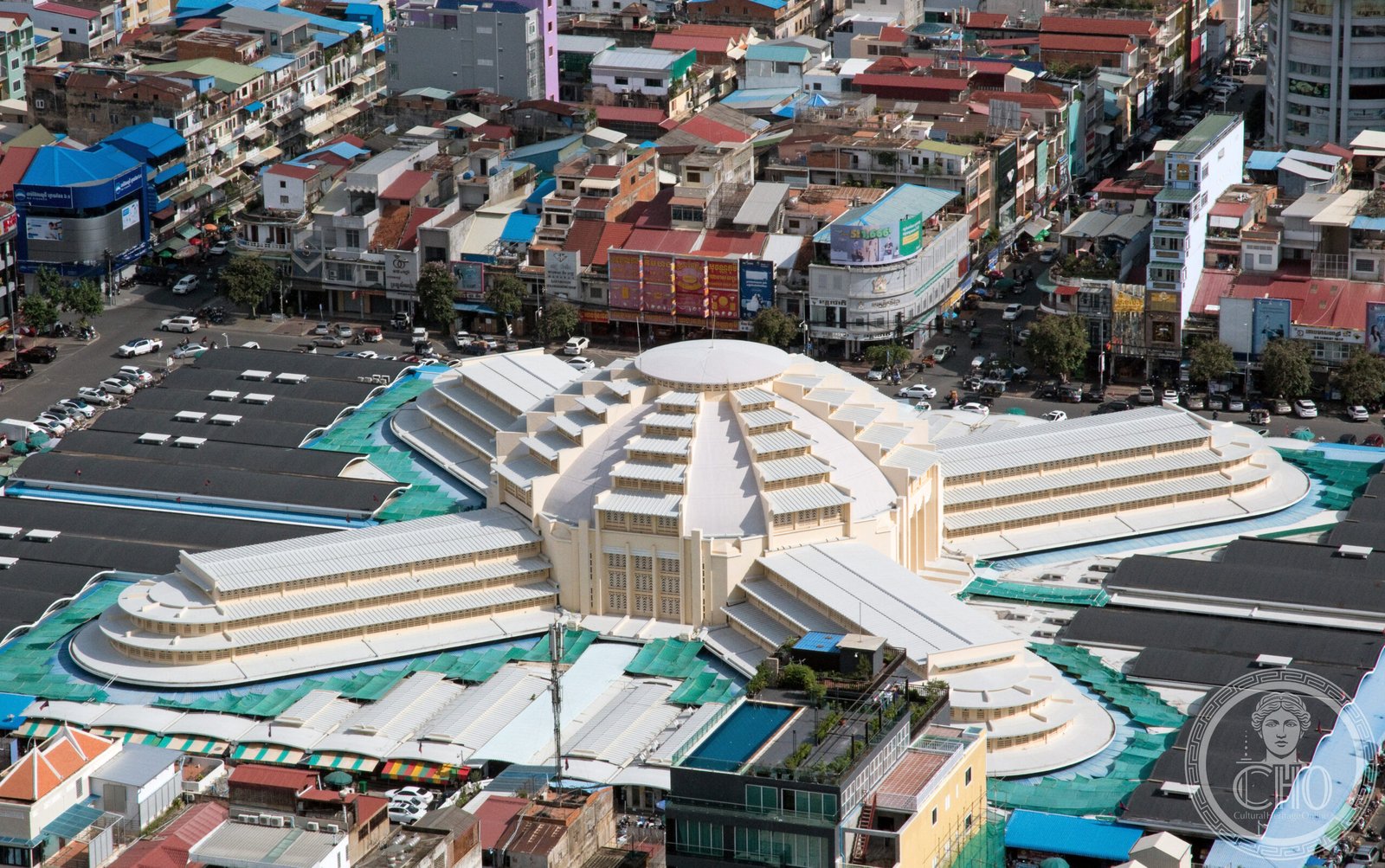
Rising from the commercial heart of Phnom Penh like a pale yellow sun, Phsar Thmei — the New Market — is among the most architecturally ambitious buildings of the French colonial period anywhere in Southeast Asia. Designed by French architect Louis Chauchon and completed in 1937, the structure consists of a vast central dome 26 metres high with four radiating wings stretching outward in a cruciform plan, the whole complex covering nearly 13,000 square metres and enclosing hundreds of market stalls selling everything from gold jewellery to dried fish. The dome itself is a feat of reinforced concrete construction that remains structurally intact nearly ninety years after completion. When Phsar Thmei opened, King Norodom Sihanouk I presided over the ceremony on 25 March 1937; it was then the largest covered market in Southeast Asia. Today it is both a functioning commercial market and one of Phnom Penh’s premier architectural landmarks, a reminder that French colonial planners occasionally produced civic buildings of genuine quality and ambition.
At a glance
- Type
- Covered market
- Period
- 1937
- Style
- Art Deco / French Colonial Moderne
- Location
- Street 128, Phnom Penh, Cambodia
- Coordinates
- 11.5696° N, 104.9254° E
- Architect(s)
- Louis Chauchon
Overview
Phsar Thmei stands at the intersection of Streets 128 and 63 in central Phnom Penh. The building’s distinctive silhouette — a high central dome above four wings radiating to the cardinal points — is visible from a considerable distance and has become one of the defining images of the Cambodian capital. Inside the central dome, jewellery merchants, money changers, and souvenir vendors occupy stalls in a circular arrangement. The four wings extend outward through roofed but open-sided corridors into a surrounding outdoor market of several city blocks.
History
The market was constructed under French colonial administration as part of Phnom Penh’s urban expansion in the 1930s. Louis Chauchon’s design replaced an earlier market on a different site; the name Phsar Thmei simply means New Market in Khmer. The official opening on 25 March 1937 was a state occasion attended by the Cambodian king and senior French colonial officials. During the Khmer Rouge period (1975–1979), all markets in Cambodia were abolished: Phsar Thmei was shuttered and used for storage. After the Vietnamese-backed liberation in 1979, it gradually reopened as commercial life resumed. A major renovation was completed in 2011, restoring the dome and replastering the facade while retaining the original structural form entirely.
Architecture & Design
Chauchon’s design is a textbook example of Art Deco civic planning adapted for a tropical climate. The central dome is a reinforced concrete hemisphere raised on a drum, with strip windows running around the base to admit light and air. The four wings are lower, roofed in shallow vaults, their sides open to allow ventilation — a crucial adaptation to Cambodia’s heat that distinguishes this building from its European Art Deco contemporaries. The overall colour scheme is pale ochre-yellow, which gives the building a warm, almost luminous quality in morning and evening light. The cruciform plan is geometrically precise and is best appreciated from aerial photographs. Decorative pilasters and horizontal mouldings provide the surface articulation characteristic of Art Deco without the more extravagant ornament of contemporary American examples.
Cultural significance
Phsar Thmei holds a central place in Phnom Penh’s collective identity as both a commercial hub and an architectural landmark. For Cambodians, the market represents both the traumatic interruption of normal life under the Khmer Rouge and the resilience of the city’s recovery. For historians of architecture, it stands as one of the finest surviving examples of Art Deco colonial civic building in Asia, comparable in ambition to contemporaneous buildings in Shanghai, Mumbai, and Casablanca. Its survival through occupation, war, and neglect is itself remarkable.
Visiting today
The market is open daily from approximately 07:00 to 17:00. Entry is free. The central dome is the main architectural attraction; the gold and silver jewellery stalls here are among the best-stocked in Phnom Penh. Morning visits offer the best light for photography of the dome interior. Visitors should be alert to the usual precautions in busy market environments. The surrounding outdoor market extends several blocks in each direction.
Getting there
Phsar Thmei is located in central Phnom Penh, easily reachable by tuk-tuk or ride-hailing app (PassApp, Grab) from anywhere in the city. The market is approximately 1.5 km north of the Royal Palace and Riverside area. From Phnom Penh International Airport, the journey by taxi takes approximately 20–30 minutes depending on traffic. There is no metro in Phnom Penh; surface transport is the only option.
Sources & resources
Find it on the map
See this place and what’s around it →Record researched and written by Luigi De Marchi for Cultural Heritage Online, 2026.
📷 Become a Cultural Heritage Online photographer
Share your photos of places: they stay published under your name as the author. The more they're seen, the more you get noticed — and soon a contest will reward the most appreciated photos.
Log in or sign up free to add a photoIs this page about you?
This page is read by travellers and heritage enthusiasts who find it on Google. Tell us how you are connected to this place and we will take it from there.