
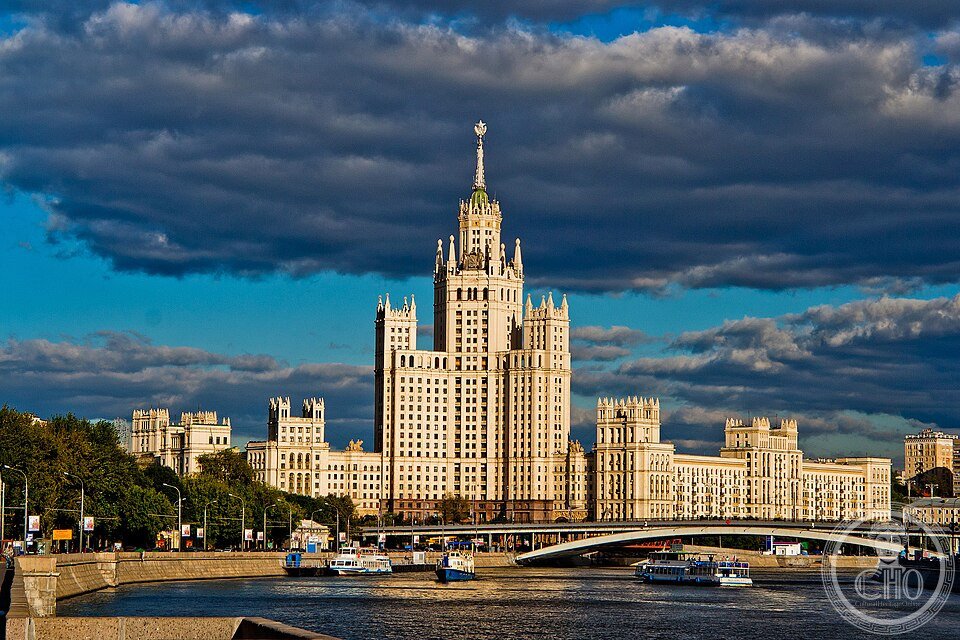
One of Moscow’s legendary Seven Sisters, the Kotelnicheskaya Embankment Building rises 176 metres from the confluence of the Moscow and Yauza rivers in a soaring wedding-cake silhouette of cream-coloured stone. Completed in 1952, it is 32 floors of Stalinist Gothic ambition: tiered setbacks, a tapering spire crowned with a red star, and a grand river-facing facade that catches the light at every hour. For nearly two decades after its inauguration it was one of the tallest residential towers in Europe. Unlike the other Sisters — mostly hotels, universities, or ministries — Kotelnicheskaya was conceived as a prestige apartment house for the Soviet cultural elite. Actors, prima ballerinas, composers, and scientists were assigned flats here by the state, making it a vertical who’s who of mid-century Soviet achievement. Today it remains fully residential, a living landmark in the Moscow skyline and one of the most photographed buildings in the city.
At a glance
- Type
- Residential skyscraper
- Period
- 1938–1952
- Style
- Stalinist Gothic / Soviet Art Deco
- Location
- Kotelnicheskaya Embankment, Moscow, Russia
- Coordinates
- 55.7442° N, 37.6441° E
- Architect(s)
- Dmitry Chechulin and Andrei Rostkovsky
Overview
The Kotelnicheskaya Embankment Building is the most romantically sited of Stalin’s Seven Sisters, occupying a promontory where the Yauza flows into the Moscow River. Its tiered silhouette, rising from a broad base through progressively narrowing wings to a spire and star, defined the Moscow skyline for a generation and still anchors the city’s eastern horizon. The building contains around 700 apartments, as well as shops, a cinema (the Illusion, one of the finest art-film cinemas in Russia), and a post office. Its combination of monumental public base and privileged residential tower above is a perfect emblem of Stalin’s urbanism: grandeur for the masses at street level, comfort for the chosen above.
History
The design was approved in 1938 as part of Stalin’s General Plan for the Reconstruction of Moscow, which called for eight high-rise dominants to anchor the city’s radial boulevards. Construction began in 1948, after the wartime pause, and the building was completed in 1952 — the year of Stalin’s final purges. As with all the Sisters, a portion of the labour force was drawn from the Gulag system: prisoners under NKVD supervision worked alongside regular construction brigades. The building’s most celebrated resident was Galina Ulanova, the Bolshoi Ballet’s greatest prima ballerina, who kept her apartment here from 1952 until her death in 1998. The comedian and actress Faina Ranevskaya — whose acerbic wit survived decades of Soviet cultural control — also lived here. Their presence turned Kotelnicheskaya into a legend beyond its architecture.
Architecture & Design
Chechulin and Rostkovsky worked within the Stalinist High Style mandate: monumental mass, Gothic verticality achieved through setbacks and spires, and classical ornamental vocabulary reinterpreted in stone and Soviet symbolism. The main tower is 32 storeys; two lateral wings of 10 and 17 storeys flank it symmetrically. The facades are clad in pale Ural limestone with deeply recessed window niches, spandrel reliefs of wheat sheaves and five-pointed stars, and corner loggia accents. The interior lobbies retain much of their original marble and mosaic decoration. The Illusion Cinema on the ground floor, opened in 1966, became a Moscow institution for screening rare foreign and archival Soviet films.
Cultural significance
Kotelnicheskaya occupies a unique place in Russian cultural memory as the building where Soviet art was literally housed. Its residents were not bureaucrats but artists — the most visible, and most controlled, stratum of Soviet society. To live here was a mark of state favour; to lose one’s apartment here was a mark of disgrace. This paradox — extraordinary beauty produced by forced labour, luxury allocated by political decree — makes the building a condensed symbol of Stalinist modernity. It appears in dozens of Russian films and novels, and its river-reflected silhouette at dusk is one of the canonical images of Moscow.
Visiting today
The building is a private residential address and is not open to the public, but its exterior and the riverfront embankment below are fully accessible. The Kotelnicheskaya Embankment promenade offers unobstructed views of the tower and its reflection. The Illusion Cinema inside the building is open to the public and screens classic and art films on a regular programme — one of the most atmospheric cinemas in Moscow. The best exterior views are from the Bolshoy Ustinsky Bridge or from the opposite Yauza bank at dusk.
Getting there
The nearest metro station is Taganskaya (Circle and Tagansko-Krasnopresnenskaya lines), approximately a 10-minute walk along the embankment. Tram lines 3 and 39 stop on Kotelnicheskaya Embankment directly below the building. From Red Square, the building is reachable on foot in about 20 minutes along Moskvoretskaya and Kotelnicheskaya embankments — a scenic riverside walk.
Sources & resources
Find it on the map
See this place and what’s around it →📷 Diventa un fotografo di Cultural Heritage Online
Condividi le tue foto dei luoghi: restano pubblicate con la tua firma come autore. Più vengono viste, più ti fai conoscere — e presto un concorso premierà le foto più apprezzate.
Accedi o registrati gratis per aggiungere una fotoDo you manage this place?
This page is read by travellers and heritage enthusiasts who find it on Google. Keep it accurate — and make it work for you. Free for non-profit heritage institutions.