
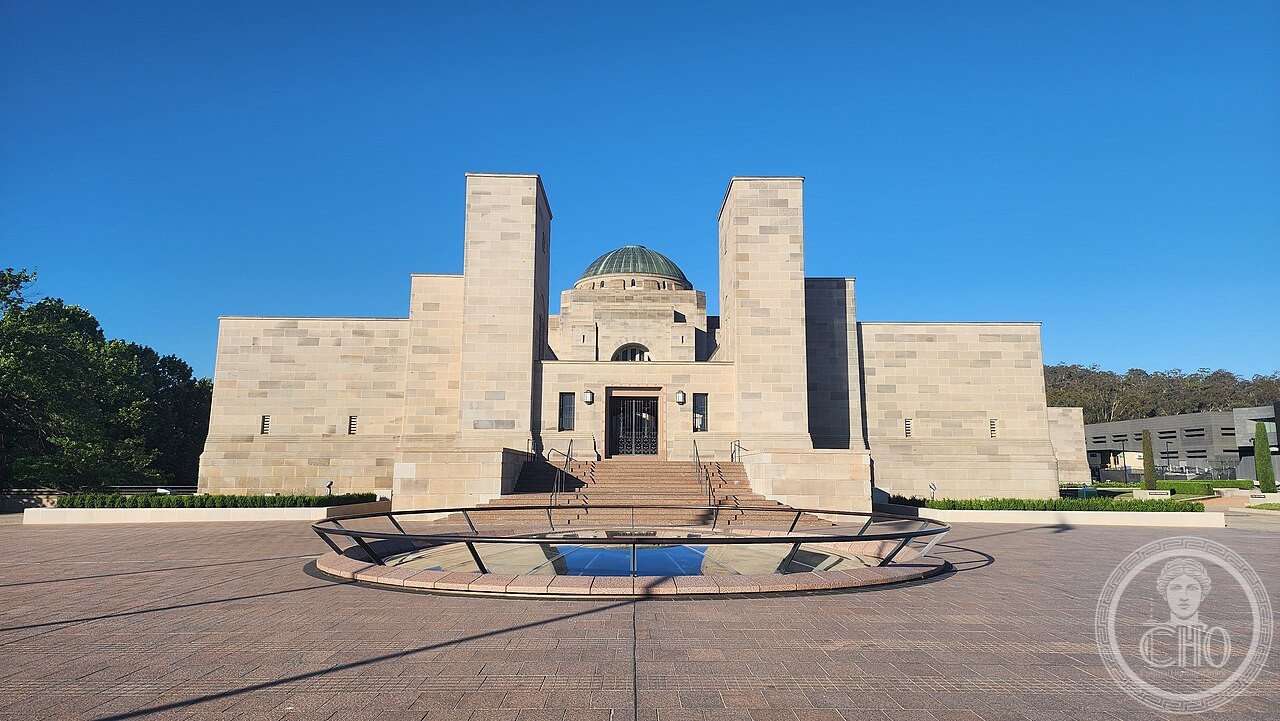
Standing at the northern terminus of Anzac Parade and aligned along a ceremonial axis with Parliament House, the Australian War Memorial is simultaneously a shrine, a national museum, and one of the most architecturally distinctive buildings in the Southern Hemisphere. Designed by Emil Sodersten and John Crust following an international competition won in 1927, the Memorial took more than a decade to complete, opening on Remembrance Day 1941 — while the Second World War it would ultimately commemorate was still being fought. The building draws on Byzantine and Egyptian monumental grammar: a domed Hall of Memory echoing the great domed churches of Constantinople, flanked by two cloistered wings whose arcade proportions recall the Hagia Sophia. Art Deco detailing softens this ancient vocabulary — the bronze doors, the mosaic floors, and the geometric ornament are unmistakably of the twentieth century. Inside, the Tomb of the Unknown Australian Soldier rests beneath the mosaic dome, and the Roll of Honour — bearing the names of more than 102,000 Australians killed in conflict — lines the covered cloisters outside. Nearly one million people visit each year, gathering in particular for the nightly Last Post ceremony held at 4:45 every afternoon.
At a glance
- Type
- War memorial, national museum and archive
- Period
- 1928–1941
- Style
- Byzantine / Art Deco Moderne
- Location
- Treloar Crescent, Campbell, Canberra, ACT, Australia
- Coordinates
- 35.2806° S, 149.1492° E
- Architect(s)
- Emil Sodersten and John Crust
Overview
The Australian War Memorial occupies fourteen hectares at the foot of Mount Ainslie, its domed silhouette forming the visual anchor of Canberra’s parliamentary triangle. The institution comprises the Memorial Building, a series of gallery wings housing one of the world’s great military history collections, a sculpture garden with more than twenty-five individual memorials, and a research centre holding over one million photographs and the largest single collection of First World War relics outside Europe. The Pool of Reflection in the forecourt, edged with rosemary for remembrance, gives the complex its characteristic quality of contemplative stillness even during peak visitation.
History
The idea of a national war memorial was first proposed by the Australian official war historian Charles Bean, who conceived it as a place where the experience of the Australian Imperial Force could be honoured and studied together. An architectural competition in 1927 was won by Emil Sodersten, who refined the design in collaboration with John Crust. The foundation stone was laid in 1929 but economic depression and political delays pushed the opening to November 1941. The Memorial immediately began collecting records and relics from the Pacific War then under way. Post-war expansions added ANZAC Hall for large aircraft and vehicles, and Denton Corker Marshall designed the modern administration wing. Heritage listing on the National Heritage List and the Commonwealth Heritage List followed in 2004.
Architecture & Design
Sodersten and Crust synthesised several historical vocabularies into a coherent national monument. The central dome — 128 feet in diameter — uses the round arch language of Byzantine basilicas to create an interior of solemn grandeur without Christian denominational association. The flanking cloisters are lined with curved stone panels bearing the names of the fallen: an architectural device that transforms a wall into a text and a text into a landscape. The Byzantine mosaic in the Hall of Memory, designed by Napier Waller, depicts the six virtues of the fighting services. Outside, the geometrically trimmed grounds and the reflecting pool create a formal precinct that manages the transition between urban boulevard and sacred commemorative space.
Cultural significance
The Australian War Memorial holds a place in national culture that few institutions in any country can match. For Australians, Gallipoli and the ANZAC tradition represent a founding myth of national identity, and the Memorial is its physical embodiment. The nightly Last Post ceremony — performed every single day since the Memorial opened — is one of the most consistent acts of public remembrance anywhere in the world. The Hall of Valour displays 76 of the 101 Victoria Crosses awarded to Australians, making it the largest collection of that decoration under one roof. The Memorial also holds the largest assembly of First World War German aircraft in existence.
Visiting today
The Memorial is open daily except Christmas Day, with free admission to all galleries and the sculpture garden. The Last Post ceremony takes place each afternoon at 4:45 PM in the forecourt and is open to all visitors without booking. Guided tours of the galleries depart regularly from the main entrance. The research centre and photograph archive are open by appointment. The Memorial cafe and shop are located near the main entrance. Visitor numbers approach one million annually; mornings on weekdays tend to be least crowded.
Getting there
The Memorial is located at Treloar Crescent, Campbell, Canberra, at the northern end of Anzac Parade. ACTION buses service the Memorial from the City Bus Interchange and Civic stops. The Anzac Parade walk from the parliamentary triangle is approximately 1.5 kilometres and passes several significant memorials along the boulevard. Car parking is available on-site. Canberra is served by Canberra Airport with connections to Sydney, Melbourne, Brisbane, and major Australian cities.
Sources & resources
Find it on the map
See this place and what’s around it →Record researched and written by Luigi De Marchi for Cultural Heritage Online, 2026.
📷 Become a Cultural Heritage Online photographer
Share your photos of places: they stay published under your name as the author. The more they're seen, the more you get noticed — and soon a contest will reward the most appreciated photos.
Log in or sign up free to add a photoIs this page about you?
This page is read by travellers and heritage enthusiasts who find it on Google. Tell us how you are connected to this place and we will take it from there.