
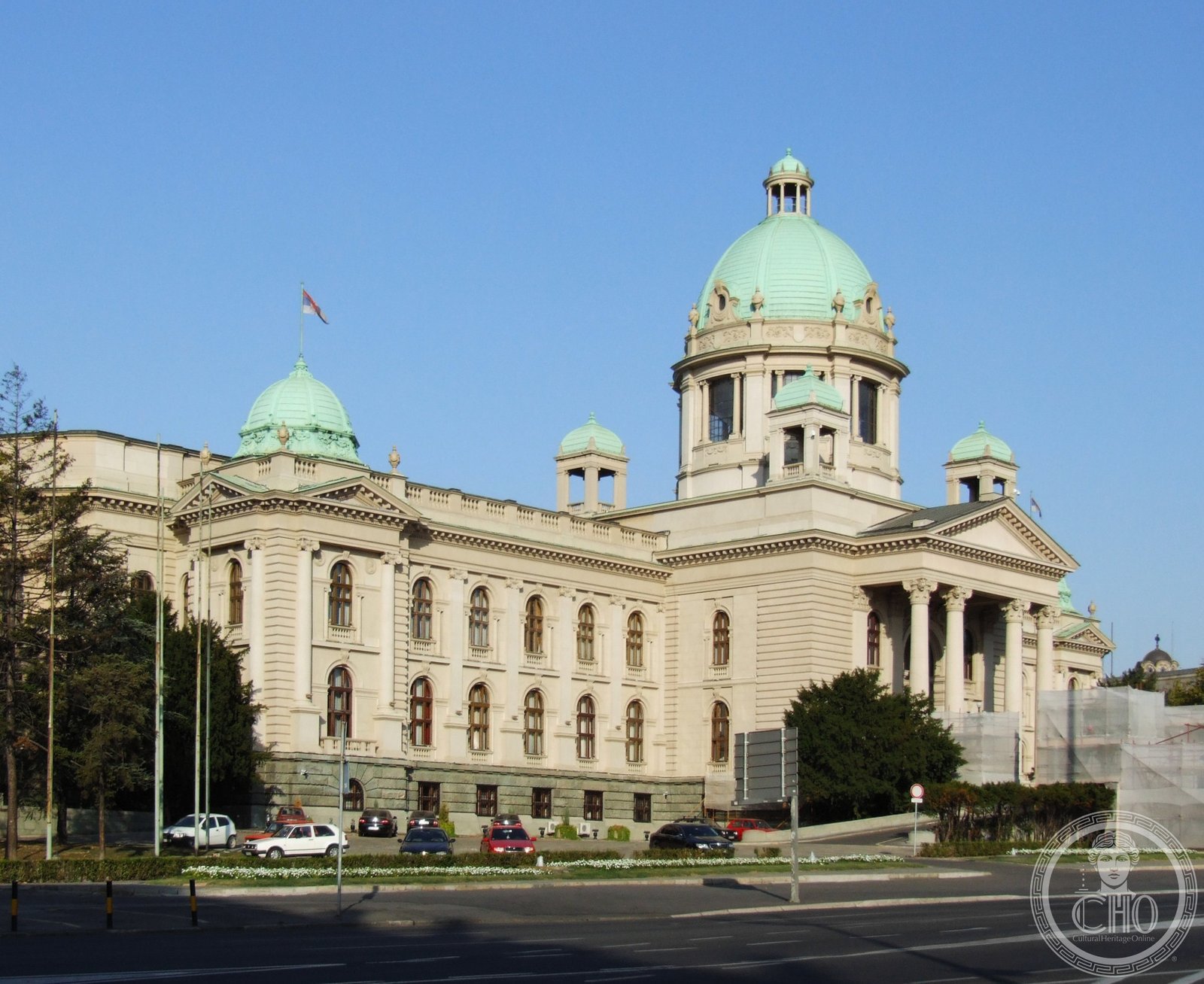
On the western edge of Nikola Pašić Square in Belgrade stands the building that Serbia waited three decades to finish — and that survived two world wars and the collapse of two states before it could fulfil its purpose. The National Assembly of Serbia, known in Serbian as the Dom Narodne Skupštine, was conceived in 1907 as a monument to constitutional government for the Kingdom of Serbia. Its architects blended the classical rigour of academic European tradition with elements drawn from Serbian national architecture, producing a limestone facade of monumental calm crowned by a green copper dome that has become as recognisable a Belgrade silhouette as the Kalemegdan fortress. Construction halted repeatedly — through the Balkan Wars, the First World War, occupation, and the reshaping of borders — finally concluding in 1936, by which time the Kingdom of Yugoslavia had absorbed the institution the building was meant to house. Today it is the seat of Serbia’s unicameral parliament and one of central Belgrade’s defining civic landmarks.
At a glance
- Type
- Parliament building
- Period
- 1907–1936
- Style
- Academicism / Serbian Renaissance
- Location
- Nikola Pašić Square, Belgrade, Serbia
- Coordinates
- 44.8117° N, 20.4658° E
- Architect(s)
- Jovan Ilkić & Konstantin Jovanović
Overview
The National Assembly building covers approximately 13,400 square metres and houses two legislative chambers, some one hundred offices, four conference rooms, a central vestibule under the main dome, and a first-floor library of more than sixty thousand volumes. Its principal facade faces Nikola Pašić Square with a symmetrical composition of pilasters, arched windows, and a central projecting portico. The interior follows the hierarchy of a classical public building — ceremonial stairs, high coffered ceilings, and parliamentary halls — dressed in marble and dark wood. The overall effect is imposing without ostentation, civic without coldness.
History
The decision to build a permanent home for the Serbian parliament was taken in 1907, nearly two decades after Serbia formally adopted constitutional government. Jovan Ilkić and Konstantin Jovanović won the architectural competition and construction began, but the Balkan Wars of 1912–13 suspended work almost immediately. The First World War brought occupation and further halt. In the interwar Kingdom of Yugoslavia, funds were repeatedly diverted. When the building finally opened in 1936, it entered service not as the National Assembly of Serbia but as the assembly hall of a multinational Yugoslav state — a political irony embedded in the stone. The building survived the Second World War, the socialist era, the NATO bombing of 1999 (which struck nearby government ministries), and the dissolution of Yugoslavia to emerge as the home of a restored Serbian republic.
Architecture & Design
Ilkić and Jovanović worked in the academic tradition prevalent in European civic architecture at the turn of the twentieth century, while incorporating decorative motifs drawn from Serbian medieval and folk heritage — an approach that paralleled contemporary nationalist architectural movements in Hungary, Romania, and Bohemia. The building’s most prominent external feature is its central copper dome, rising above a drum of arched windows and setting the building apart in Belgrade’s relatively flat urban fabric. The limestone facade is articulated with columns and pilasters on the main storey, rusticated at the base, and finished with carved detail around the principal entrance. Inside, the two chambers — the main plenary hall and a smaller session room — are lit by large clerestory windows and decorated with painted ceilings and carved wood.
Cultural significance
The building’s extended construction history mirrors Serbia’s turbulent path through the twentieth century: begun in optimism, interrupted by catastrophe, completed under a different political reality than intended. For Serbs it is not merely a seat of government but a physical record of national persistence. The assembly hall has witnessed the full arc of post-war Yugoslav politics, the wars of the 1990s, the democratic transition of 2000, and Serbia’s contemporary EU accession process. Its dome appears on postcards, stamps, and in virtually every documentary account of Serbian public life.
Visiting today
The National Assembly of Serbia offers guided tours when the parliament is not in session, typically bookable through the assembly’s public affairs office. The exterior and the square in front are freely accessible at all times. The building faces Nikola Pašić Square (Trg Nikole Pašića), Belgrade’s civic heart, surrounded by other landmark institutions. The surrounding neighbourhood — Terazije, Knez Mihailova Street — is the core of Belgrade’s historic city centre and easily explored on foot.
Getting there
The National Assembly building is at the northern end of Nikola Pašić Square, a ten-minute walk from Terazije, Belgrade’s central hub. City bus routes 26, 27, 31, and tram line 2 stop on or adjacent to the square. From Belgrade Centar railway station, take tram 2 northbound (three stops). From Belgrade Nikola Tesla Airport, take bus A1 to Slavija Square, then walk ten minutes north.
Sources & resources
Find it on the map
See this place and what’s around it →Record researched and written by Luigi De Marchi for Cultural Heritage Online, 2026.
📷 Become a Cultural Heritage Online photographer
Share your photos of places: they stay published under your name as the author. The more they're seen, the more you get noticed — and soon a contest will reward the most appreciated photos.
Log in or sign up free to add a photoIs this page about you?
This page is read by travellers and heritage enthusiasts who find it on Google. Tell us how you are connected to this place and we will take it from there.