
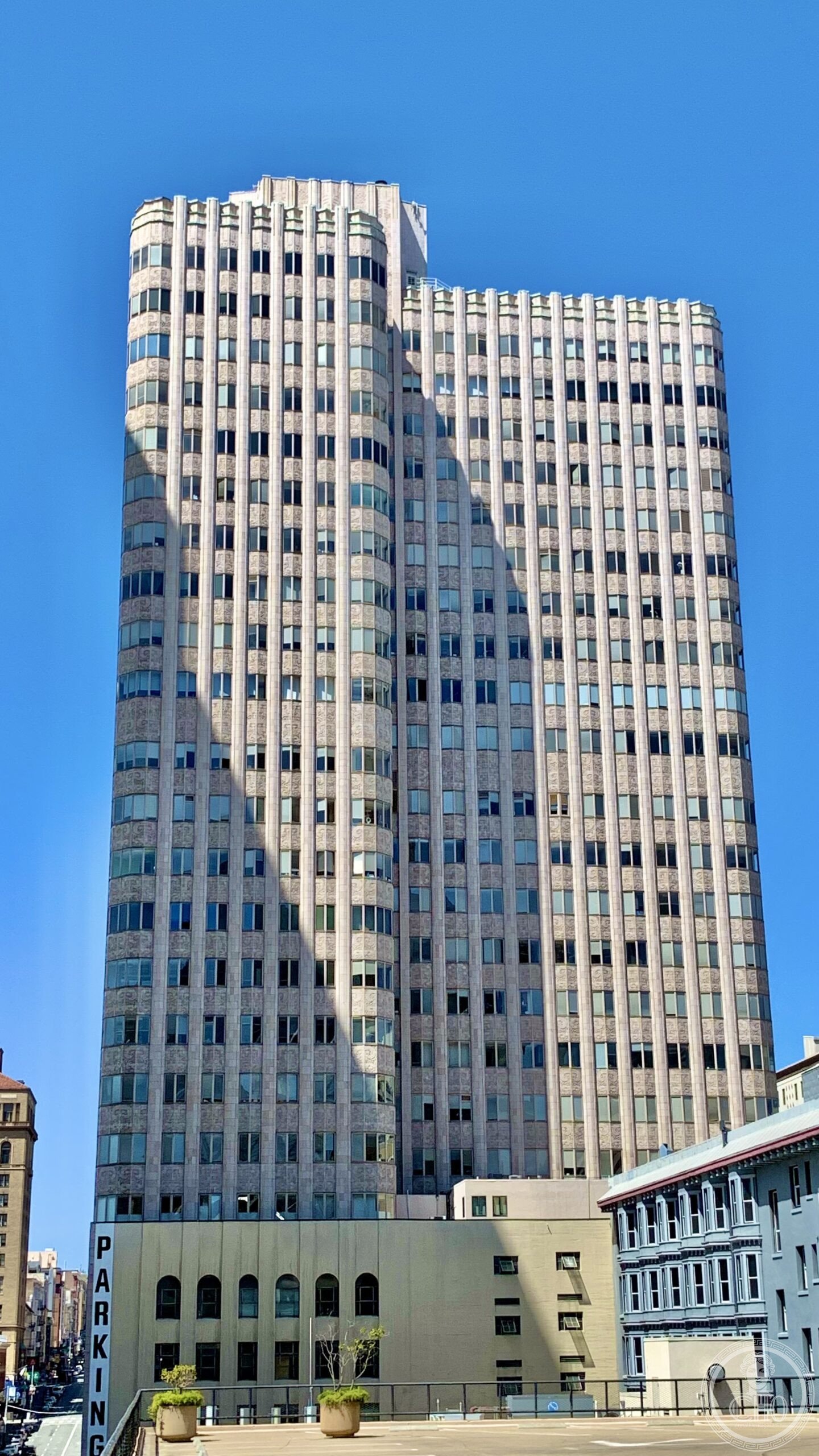
At 26 stories and 344 feet above San Francisco’s Nob Hill, 450 Sutter Street is one of the most architecturally ambitious skyscrapers built in the United States during the Art Deco decade. Completed on 15 October 1929 — two weeks before the stock-market crash that would end the era — the building fuses the sleek verticality of Jazz Age modernism with an extraordinary vocabulary of pre-Columbian Mayan ornament. Architect Timothy Pflueger covered the upper shaft in bands of Mayan geometric relief, while the lobby delivers a dazzling interior of gold and silver stylised motifs drawn from ancient Mesoamerican temples. Built as a medical-dental office tower, it still serves that function today, its tenant list a who’s-who of San Francisco specialists. Placed on the National Register of Historic Places in 2009, the building is also celebrated in popular culture: the Department of Death in LucasArts’s Grim Fandango was modelled directly on its lobby. No other skyscraper in North America deploys Maya Revival imagery at this scale or with such conviction.
At a glance
- Type
- Commercial office skyscraper
- Period
- 1929 — present
- Style
- Maya Revival / Art Deco
- Location
- 450 Sutter Street, Nob Hill, San Francisco, California, USA
- Coordinates
- 37.7895° N, 122.4077° W
- Architect(s)
- Timothy L. Pflueger (Miller and Pflueger)
Overview
450 Sutter Street — also known as the Four Fifty Sutter Building — rises 26 floors above San Francisco’s Sutter Street, its vertically faceted shaft clad in a continuous field of pre-Columbian Mayan geometric ornament. Timothy Pflueger, the most inventive commercial architect working in California at the time, combined the streamlined silhouette demanded by the skyscraper formula with surface decoration of unusual archaeological specificity. The building was added to the National Register of Historic Places in 2009 and remains one of the definitive works of American Art Deco architecture on the West Coast.
History
The building was commissioned as a premium medical-dental office tower to serve San Francisco’s growing professional class. Ground broke in 1928 and the tower was completed on 15 October 1929, just days before Black Tuesday ended the decade of prosperity that had funded it. Despite the Depression it remained fully tenanted, its medical use providing recession-proof occupancy. In the 1960s endocrinologist Harry Benjamin operated a practice here, one of the first physicians in the USA to provide clinical care to transgender patients. The building was recognised by the National Register of Historic Places in 2009 for its exceptional architectural significance.
Architecture & Design
Pflueger’s design is structured around a slender vertical shaft whose setbacks follow the 1922 zoning envelope, producing a silhouette that tapers elegantly from a broad base to a narrow crown. The entire exterior surface above the second floor is covered in Maya Revival ornament: interlocking geometric bands, stylised feathered serpents, stepped fret patterns, and abstract glyphic panels, all cast in terracotta and rendered in a pale stone-like finish. The lobby is the interior showpiece — a compressed sequence of gold and silver Mayan motifs applied to walls, ceiling panels, and elevator doors that together create one of the most spectacular Art Deco interiors on the West Coast.
Cultural significance
450 Sutter Street holds a double cultural legacy. Architecturally it is the fullest expression of Maya Revival style applied to a tall commercial building anywhere in the world, surpassing even the earlier Mayan Theatre in Los Angeles in the density and quality of its ornament. In popular culture it achieved global reach when Tim Schafer used its lobby as the visual model for the Department of Death in the acclaimed 1998 video game Grim Fandango, introducing its imagery to millions of players worldwide.
Visiting today
The building is an active commercial office tower housing medical and dental practices. The ornate lobby is accessible during business hours on weekdays and provides an unobstructed view of the Art Deco Mayan interior. No admission is charged to enter the lobby. The building itself does not offer tours, but the lobby alone justifies the visit. Photography is generally permitted in public areas.
Getting there
450 Sutter Street is located in Nob Hill, a short walk from Union Square. The nearest BART station is Powell Street (5-minute walk). The California Street cable car stops at Powell Street, one block south. Muni bus lines 2, 3, 27, and 38 stop on Sutter Street. Street parking is metered; garage parking is available at the Union Square Garage on Geary Street.
Sources & resources
Find it on the map
See this place and what’s around it →Record researched and written by Luigi De Marchi for Cultural Heritage Online, 2026.
📷 Become a Cultural Heritage Online photographer
Share your photos of places: they stay published under your name as the author. The more they're seen, the more you get noticed — and soon a contest will reward the most appreciated photos.
Log in or sign up free to add a photoIs this page about you?
This page is read by travellers and heritage enthusiasts who find it on Google. Tell us how you are connected to this place and we will take it from there.