
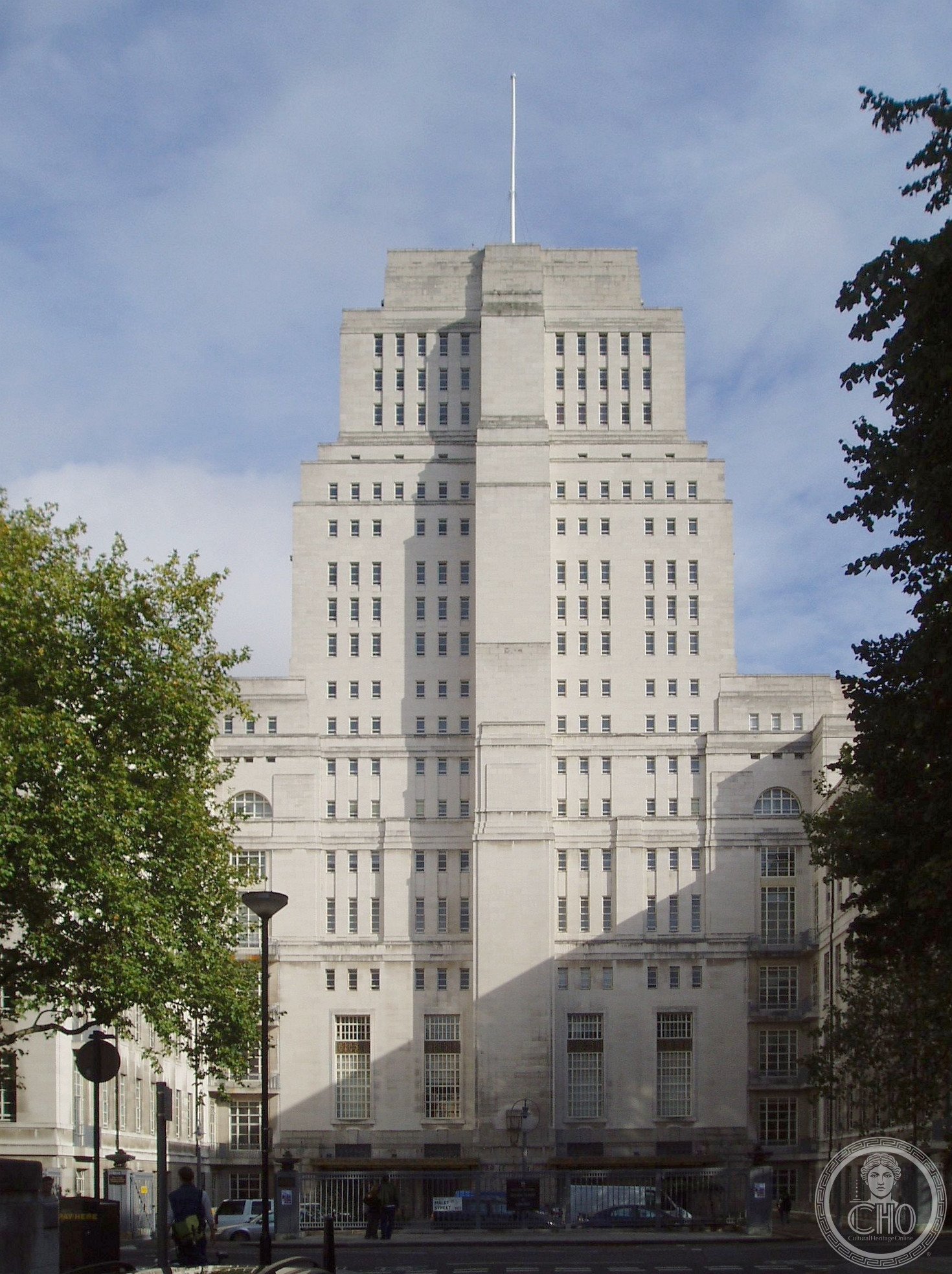
Rising nineteen floors above Bloomsbury on a base of Portland stone, Senate House is one of London’s most singular interwar monuments — a tower that feels simultaneously ancient and futuristic. Designed by Charles Holden and completed in 1937, it was the administrative nerve centre of the University of London from the moment its foundation stone was laid by King George V in 1933. The building’s stripped classical silhouette — Holden stripped away ornament until only mass, proportion, and light remained — became part of London’s consciousness before it was even finished. George Orwell, who lived nearby and watched the tower climb skyward during the war years when the Ministry of Information commandeered it, later transformed its looming presence into the Ministry of Truth in Nineteen Eighty-Four. Today Senate House remains in active university use, its library holding some three million volumes and its stone corridors still carrying the particular hush of institutional gravity.
At a glance
- Type
- University administrative tower
- Period
- 1932–1937
- Style
- Art Deco / Stripped Classical
- Location
- Malet Street, Bloomsbury, London WC1E 7HU, United Kingdom
- Coordinates
- 51.5210° N, 0.1287° W
- Architect(s)
- Charles Holden
Overview
Senate House stands at the heart of Bloomsbury as the centrepiece of Charles Holden’s ambitious — and only partially realised — campus vision for the University of London. At 64 metres, it was among the tallest secular buildings in London at its completion, and its status as a Grade II* listed structure reflects its architectural importance. The tower houses the University of London’s central administrative offices, the Senate House Library with its three million volumes, the vice-chancellor’s suite, and a constellation of research institutes. Its Portland stone cladding over a load-bearing brick frame gives the building its characteristic pale, monumental quality that shifts dramatically with the London light.
History
The University of London commissioned Charles Holden in 1931 to design a central campus in Bloomsbury, envisioning a complete academic quarter. King George V laid the foundation stone in June 1933, and the main tower was completed in 1937, though Holden’s fuller scheme was never realised due to funding constraints. During the Second World War, the building was requisitioned by the Ministry of Information — a fact that lodged in the memory of George Orwell, who drew on its overbearing mass for his fictional Ministry of Truth. The building was listed Grade II* in 1969 in recognition of its architectural significance, and underwent a major refurbishment in 2006. It has also become a favoured film location, appearing in Batman Begins, The Dark Knight Rises, and numerous other productions.
Architecture & Design
Holden’s design belongs to a strand of 1930s modernism that stripped classicism of its applied ornament, leaving pure geometry and mass to carry meaning. The tower rises from a broad podium in stepped setbacks — a form that echoes American skyscraper massing while remaining distinctly English in its restraint. Portland stone cladding over load-bearing brickwork gives the facades their pale, almost luminous quality. Vertical window bays emphasise height, while the absence of traditional cornices and entablatures creates an abstracted timelessness. The main entrance hall is generous but austere, its materials speaking of permanence rather than display. Interior spaces are rational and well-proportioned, designed for institutional use rather than spectacle.
Cultural significance
Senate House occupies an outsized place in British cultural imagination. Its association with George Orwell’s Ministry of Truth has given it a permanent literary afterlife, while its wartime role as the Ministry of Information — coordinating propaganda for the British war effort — lends it a genuinely Orwellian history before fiction. For architectural historians, the building represents a critical moment when British institutional architecture absorbed continental modernist influences without abandoning its own monumental traditions. It is also a touchstone for debates about the aesthetics of power: admired by some as noble restraint, criticised by others as authoritarian weight.
Visiting today
Senate House is an active university building open to registered users of the Senate House Library, which holds one of the largest academic collections in the United Kingdom. Public visitors can enter the main lobby and view the ground-floor spaces during library opening hours. Guided tours are occasionally offered through the University of London. The building is also a familiar filming location and frequently appears in period dramas and blockbusters, so exterior photography is always possible from the surrounding streets.
Getting there
Senate House sits in Bloomsbury, Central London. The closest Underground stations are Russell Square (Piccadilly line, five minutes on foot) and Goodge Street (Northern line, ten minutes). Euston and King’s Cross St Pancras mainline stations are within fifteen minutes by foot or two stops by Tube. Several bus routes serve Gower Street and Southampton Row. The building entrance is on Malet Street.
Sources & resources
Find it on the map
See this place and what’s around it →Record researched and written by Luigi De Marchi for Cultural Heritage Online, 2026.
📷 Become a Cultural Heritage Online photographer
Share your photos of places: they stay published under your name as the author. The more they're seen, the more you get noticed — and soon a contest will reward the most appreciated photos.
Log in or sign up free to add a photoIs this page about you?
This page is read by travellers and heritage enthusiasts who find it on Google. Tell us how you are connected to this place and we will take it from there.