
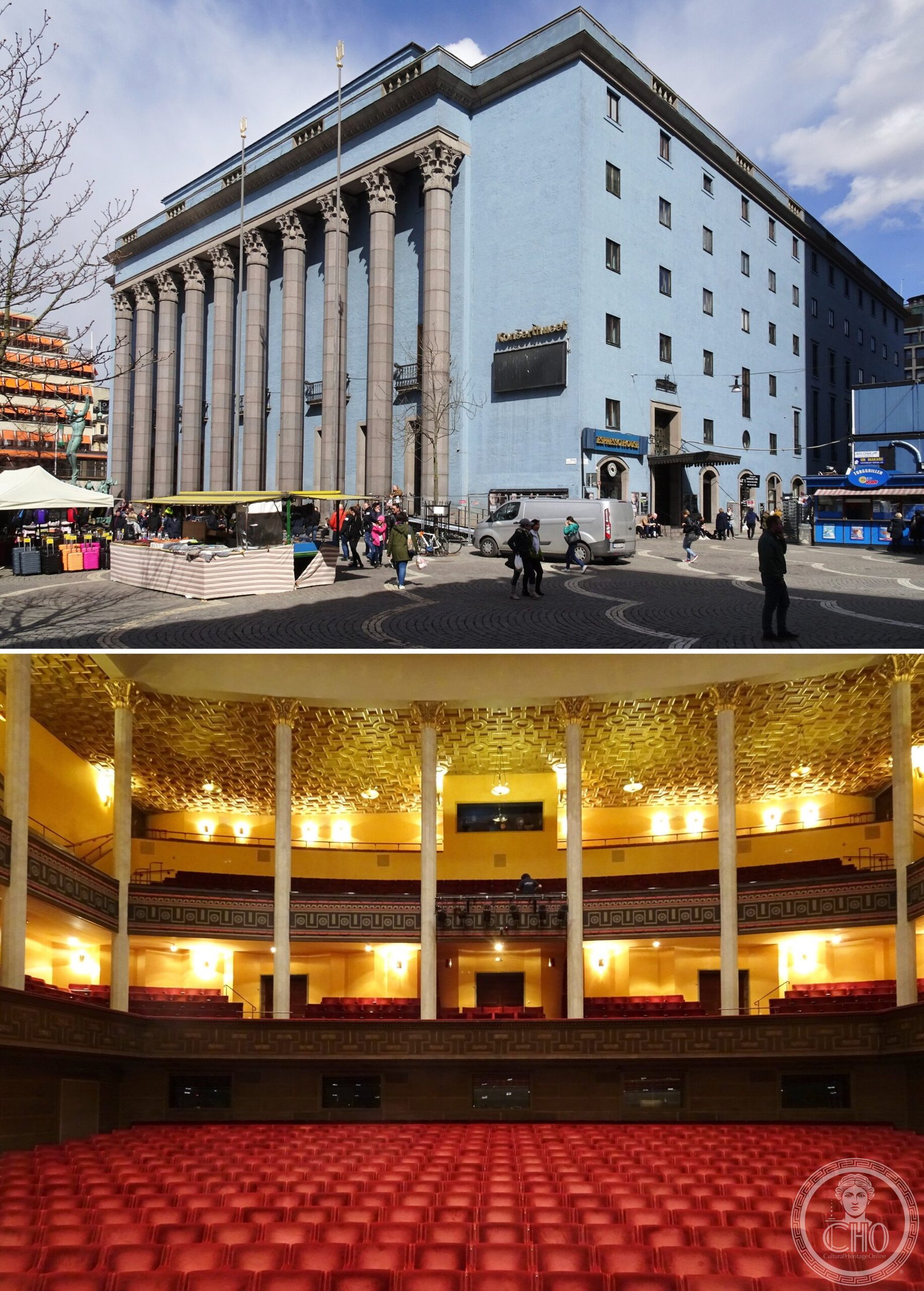
The Stockholm Concert Hall is Sweden’s most iconic public building of the interwar era — a monumental blue neoclassical colonnade that rises above the open-air market of Hotorget and has hosted the Nobel Prize award ceremony every December since 1926. Designed by Ivar Tengbom and inaugurated on 7 April 1926, the hall synthesises the restrained grandeur of Nordic Classicism with the precision of a modern performance venue. Its vast Corinthian portico, rendered in a distinctive azure blue, frames the square with patrician authority, while inside the Stora salen — seating 1,770 — provides acoustic conditions that have served the Royal Stockholm Philharmonic Orchestra for a century. Carl Milles’s bronze Orfeus fountain stands before the entrance, completing a civic ensemble that defines central Stockholm’s cultural identity.
At a glance
- Type
- Concert hall
- Period
- 1920–1926
- Style
- Swedish Grace / Nordic Classicism
- Location
- Hotorget 8, Stockholm, Sweden
- Coordinates
- 59.3350° N, 18.0631° E
- Architect(s)
- Ivar Tengbom
- Heritage
- Nationally significant historic building (Sweden)
Overview
The Stockholm Concert Hall serves as the primary orchestral venue in the Swedish capital and permanent home of the Royal Stockholm Philharmonic Orchestra. Its three performance spaces — the Stora salen (1,770 seats), the Grunewaldsalen (460), and the Aulinsalen (140) — host everything from symphonic concerts to rock and pop performances. The building is equally famous as the annual venue of the Nobel Prize ceremonies, where laureates receive their awards and medals from the Swedish monarch each December. Interior decorations by Ewald Dahlskog and muralist Isaac Grunewald give the spaces a warmth that tempers the classical exterior severity.
History
Planning for a dedicated concert venue in Stockholm began in the late nineteenth century as the city’s musical life outgrew existing spaces. Ivar Tengbom won the commission and construction proceeded through the early 1920s, partly funded by a testamentary donation from Rosa Nachmanson. The hall opened on 7 April 1926, and within months hosted the first Nobel Prize ceremony in its space, a tradition that has continued unbroken to the present day. The building has undergone careful acoustic and technical upgrades over the decades without altering its architectural character. Carl Milles’s Orfeus fountain was installed in front of the entrance in 1936, anchoring the hall visually to Hotorget square.
Architecture & Design
Tengbom’s design belongs to the Swedish Grace movement — a Nordic inflection of international Neo-Classicism that flourished in Scandinavia during the 1920s before Functionalism displaced it. The facade presents a giant-order Corinthian colonnade across its full width, painted in the distinctive blue that has become the building’s signature colour. Flanking wings frame the central portico without competing with it. The Stora salen interior features a coffered ceiling, warm wood panelling, and a colour palette devised by Isaac Grunewald that balances grandeur with intimacy. The Grunewaldsalen is decorated with Grunewald’s own monumental murals depicting Nordic mythology and the cycle of seasons.
Cultural significance
The Stockholm Concert Hall occupies a unique position at the intersection of music, civic identity, and global intellectual prestige. As the Nobel Prize venue it appears in television broadcasts watched by hundreds of millions annually, making its blue colonnade one of the most recognised architectural images in the world. For Sweden it functions as a secular cathedral of learning and culture — the physical stage where humanity’s highest achievements are publicly honoured. The building also demonstrated that Nordic Classicism could produce civic architecture of genuine international stature, influencing public buildings across Scandinavia and the Baltic through the late 1920s and 1930s.
Visiting today
The concert hall operates year-round with a full season programme from the Royal Stockholm Philharmonic Orchestra as well as visiting ensembles. Tickets can be purchased online through the hall’s box office. Guided tours of the building, including backstage areas, are offered periodically. The Nobel Prize ceremony in December draws global attention; tickets for the ceremony itself are by invitation only, but the public concert on Nobel Night is ticketed commercially. The Orfeus fountain outside is freely accessible at all times.
Getting there
The concert hall fronts Hotorget square in central Stockholm. The nearest metro station is Hotorget on the Green Line (T-bana lines 17, 18, 19), a two-minute walk. Numerous bus lines serve the square. From Stockholm Central Station the hall is a 10-minute walk northward along Vasagatan. Cycling is convenient via Stockholm’s extensive bike-lane network; cycle parking is available on the square.
Sources & resources
Find it on the map
See this place and what’s around it →📷 Become a Cultural Heritage Online photographer
Share your photos of places: they stay published under your name as the author. The more they're seen, the more you get noticed — and soon a contest will reward the most appreciated photos.
Log in or sign up free to add a photoDo you manage this place?
This page is read by travellers and heritage enthusiasts who find it on Google. Keep it accurate — and make it work for you. Free for non-profit heritage institutions.