
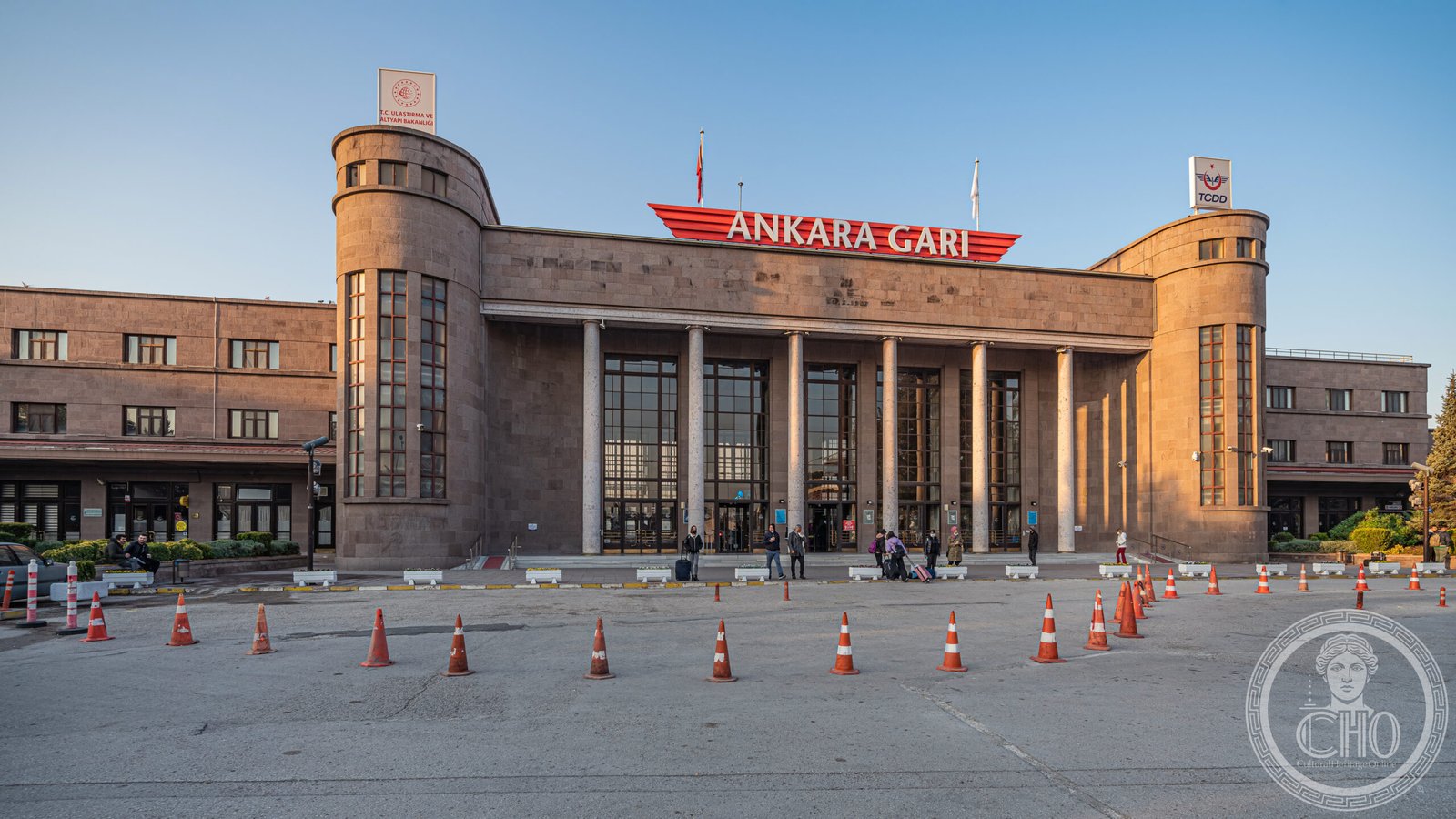
Standing at the symbolic heart of modern Turkey’s capital, Ankara Railway Station is one of the most eloquent expressions of the early Republican era’s architectural ambitions. Designed by architect Şekip Akalın and completed in 1937, the building speaks the language of European Modernism inflected with Art Deco monumentality — a deliberate statement by the young Turkish Republic that its capital deserved infrastructure to match the most advanced cities of the age. The station replaced an Ottoman-era structure dating to 1892, and its confident, horizontal massing and refined decorative details signalled a clean break with the past. For nearly a century it has processed the arrivals and departures of a nation in continuous transformation: from the founding of the Republic through the Cold War decades, from the opening of Turkey’s first high-speed railway to the tragedy of the 2015 bombings. Ankara Railway Station is simultaneously a functional transport hub and a monument to twentieth-century Turkish modernity.
At a glance
- Type
- Railway station
- Period
- Early Republican / interwar (1937)
- Style
- Modernist / Art Deco
- Location
- 19 Mayıs Square, Ankara, Turkey
- Coordinates
- 39.9364° N, 32.8438° E
- Architect(s)
- Şekip Akalın
Overview
Ankara Railway Station (Ankara Garı) serves as the primary rail terminus for Turkey’s capital and remains the country’s most important railway hub. The current Art Deco building, constructed in 1937 to designs by Şekip Akalın, replaced the original Ottoman station of 1892. With 13 tracks spread across six platforms, the station handles high-speed (YHT), intercity, regional, and commuter (Başkentray) services, connecting Ankara to Istanbul, Konya, Sivas, İzmir, and destinations across Anatolia.
History
The first Ankara station opened in 1892 under Ottoman railway administration, bringing the city into the nascent Anatolian rail network. Passenger services were interrupted during the First World War, and the subsequent War of Independence cemented Ankara’s new role as the seat of the nationalist government. From 1927, Turkish State Railways (TCDD) took control of operations. The 1937 station building was a flagship project of Atatürk’s modernisation programme. Rail connections expanded steadily through the twentieth century. In 2009, the opening of Turkey’s first high-speed line between Ankara and Eskişehir transformed the station into the country’s primary high-speed hub. The station was the site of devastating bombings in October 2015, which claimed over 105 lives, leaving a permanent mark on its history.
Architecture & Design
Şekip Akalın’s 1937 building exemplifies the architectural language adopted by the early Turkish Republic for its prestige public works: a rational, horizontal modernism with Art Deco ornamental accents that acknowledged international currents while asserting a distinctly Turkish institutional character. The facade is composed of clean stone-clad volumes arranged symmetrically around a central entrance block, with restrained decorative detailing at key junctions. The station’s interior combines functional clarity with ceremonial proportion appropriate to a national gateway. A separate high-speed terminal building (Ankara Tren Garı, ATG) was completed above the underground platforms in 2016, adding contemporary infrastructure while the historic 1937 building continues in active use.
Cultural significance
Ankara Railway Station occupies a unique place in Turkish national consciousness. As the capital’s principal gateway it has received heads of state, processed armies of migrant workers, and witnessed the comings and goings of a society undergoing rapid modernisation. The 1937 building embodies the aesthetic ambitions of the early Republic, and its survival alongside twenty-first-century high-speed infrastructure makes it a palimpsest of Turkish modernity. The station is also a site of collective trauma, the 2015 bombings having inscribed a painful chapter into its identity as a public space.
Visiting today
Ankara Railway Station remains in full operation as a major transport hub. High-speed trains to Istanbul depart frequently and take approximately four to four-and-a-half hours. The historic 1937 building is accessible to all rail passengers. The station is located on 19 Mayıs Square in central Ankara, close to Ulus, the city’s historic commercial core. The surrounding area includes several significant Republican-era public buildings worth visiting as part of an architectural walking tour.
Getting there
Ankara Railway Station is served by the Başkentray commuter rail network, with direct connections to Ankara’s main metro and bus interchange at Kızılay. Ankara Esenboğa Airport is connected to the city centre by express bus (Havaş service) or taxi; journey time is approximately 35–45 minutes. The station’s central location makes it accessible on foot from several city-centre hotels and from major bus stops on Cumhuriyet Bulvarı.
Sources & resources
Find it on the map
See this place and what’s around it →Record researched and written by Luigi De Marchi for Cultural Heritage Online, 2026.
📷 Become a Cultural Heritage Online photographer
Share your photos of places: they stay published under your name as the author. The more they're seen, the more you get noticed — and soon a contest will reward the most appreciated photos.
Log in or sign up free to add a photoIs this page about you?
This page is read by travellers and heritage enthusiasts who find it on Google. Tell us how you are connected to this place and we will take it from there.