
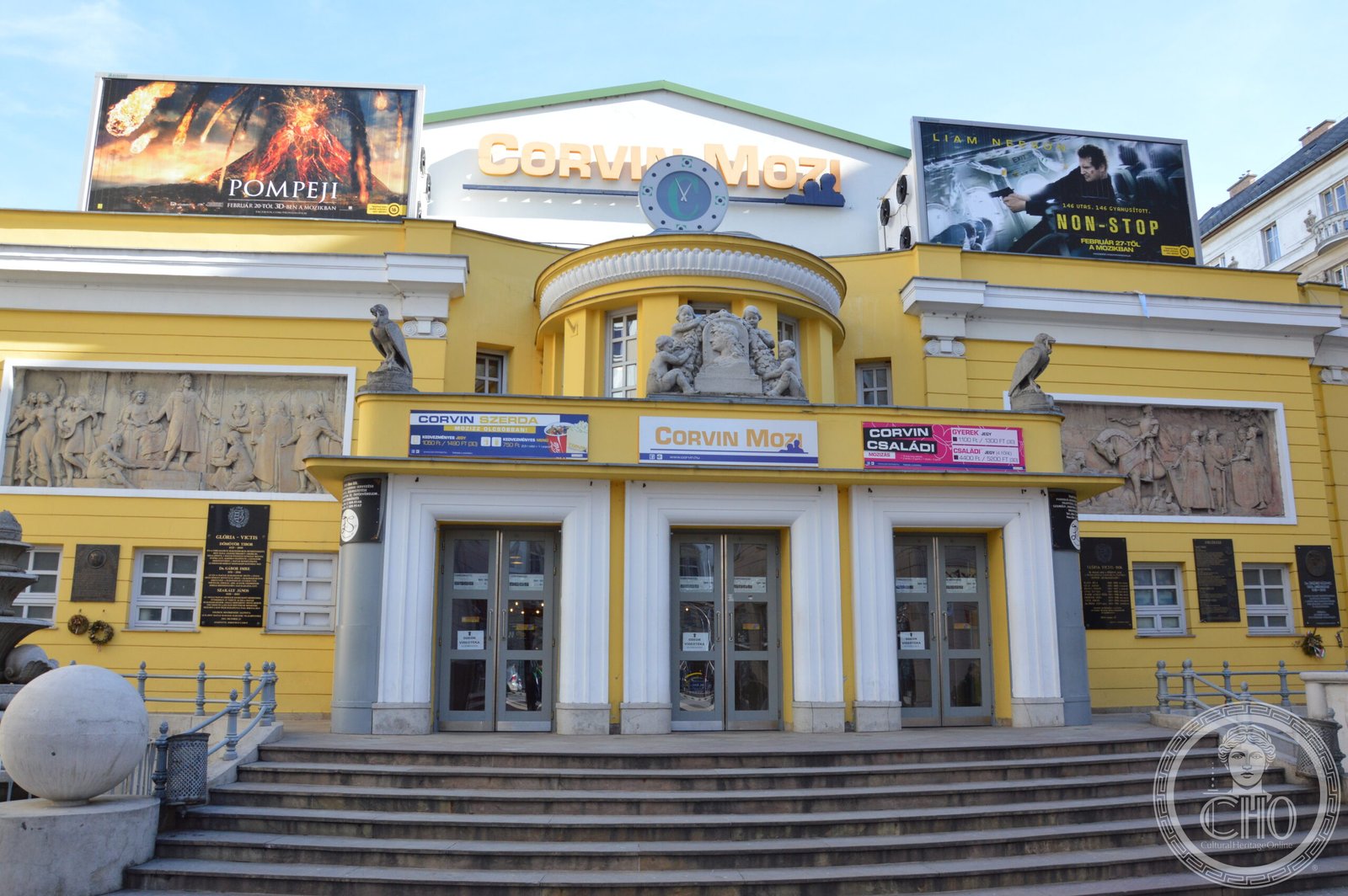
Anchored in the working-class heart of Budapest’s eighth district, the Corvin Cinema is one of Hungary’s most historically resonant entertainment venues. The site’s cultural identity was established in the early 1920s, when sculptor József Róna crowned the building’s entrance with a limestone relief of Matthias Corvinus — the great Renaissance king whose name the cinema still bears. That ornamental act linked the popular amusements of interwar Budapest to the grandeur of Hungarian history. The Corvin survived the Second World War, only to become a fortress of resistance during the Hungarian Revolution of 1956, when insurgents used its labyrinthine corridors and the adjacent Corvin köz passage as a command centre during some of the fiercest urban fighting of the Cold War era. Rebuilt and reopened as a multiplex in 1996, it remains a working cinema embedded in one of the city’s most historically layered districts.
At a glance
- Type
- Cinema / Entertainment venue
- Period
- Interwar (ornamental relief 1922; current structure 1996)
- Style
- Hungarian Art Deco
- Location
- Corvin köz, Józsefváros (District VIII), Budapest, Hungary
- Coordinates
- 47.4862° N, 19.0710° E
- Architect(s)
- Ornamental sculpture by József Róna (1922); reconstruction by László Rajk Jr. (1996)
Overview
The Corvin Cinema occupies a strategic corner of Józsefváros, the district that stretches south-east of Budapest’s Grand Boulevard and has historically been home to a dense, working-class urban fabric. The cinema’s name and decorative programme invoke Matthias Corvinus, the Hunyadi king celebrated as a patron of Renaissance learning and Hungarian national identity. This deliberate historicist gesture, applied to a popular entertainment venue in an industrial neighbourhood, typifies the way interwar Hungarian public culture navigated between populist ambition and elevated national mythology.
History
Budapest’s cinema culture flourished during the 1920s, with new purpose-built venues opening across the city to serve a rapidly urbanising population. The Corvin established itself as a neighbourhood institution in the interwar decades. During October 1956, the cinema and the adjacent Corvin passage became the headquarters of armed resistance fighters led by figures including László Iván Kovács and Gergely Pongrátz. The Battle of the Corvin Passage became one of the defining episodes of the Hungarian Revolution, etching the cinema’s name into national memory. After decades of operation through the communist period, the building was extensively reconstructed in 1996 by architect László Rajk Jr., reopening as Hungary’s first modern multiplex cinema while retaining its historic ornamentation.
Architecture & Design
The most significant surviving historic element of the Corvin Cinema is the limestone relief by sculptor József Róna, installed in 1922, depicting Matthias Corvinus. Róna was one of the leading Hungarian sculptors of his generation, and this work exemplifies the interwar tendency to dress popular commercial buildings in the language of national historical iconography. The 1996 reconstruction by László Rajk Jr. — one of Hungary’s most prominent architects — sought to reconcile the requirements of a modern multiplex with the site’s historic character and urban context in Józsefváros.
Cultural significance
The Corvin Cinema carries layers of meaning that few entertainment venues can match. As a site of the 1956 revolution it is a place of political memory, commemorated by a monument in the passage outside. As a working cinema it has served the cultural needs of one of Budapest’s most densely inhabited districts for a century. And as the bearer of the Corvinus name and the Róna relief, it connects everyday urban life to Hungary’s deepest layers of historical self-representation.
Visiting today
The Corvin Budapest Film Palace operates as a modern multiplex cinema showing Hungarian and international films. It is located in Corvin köz, District VIII, within the Corvin Promenade urban regeneration zone. The 1922 Matthias Corvinus relief by József Róna is visible above the main entrance and is free to view at any time. A memorial to the 1956 insurgents stands nearby in the passage. The surrounding Józsefváros district is undergoing significant urban renewal and offers numerous cafés and restaurants.
Getting there
The Corvin Cinema is served by Corvin-negyed station on Metro Line 3 (blue line), which sits directly adjacent to the complex. Numerous tram and bus routes also connect the area to central Pest and Buda. The cinema is approximately 15 minutes by metro from central Budapest (Deák Ferenc tér interchange). Cycling infrastructure in the district has been improved as part of the Corvin Promenade development.
Sources & resources
Find it on the map
See this place and what’s around it →Record researched and written by Luigi De Marchi for Cultural Heritage Online, 2026.
📷 Become a Cultural Heritage Online photographer
Share your photos of places: they stay published under your name as the author. The more they're seen, the more you get noticed — and soon a contest will reward the most appreciated photos.
Log in or sign up free to add a photoIs this page about you?
This page is read by travellers and heritage enthusiasts who find it on Google. Tell us how you are connected to this place and we will take it from there.