
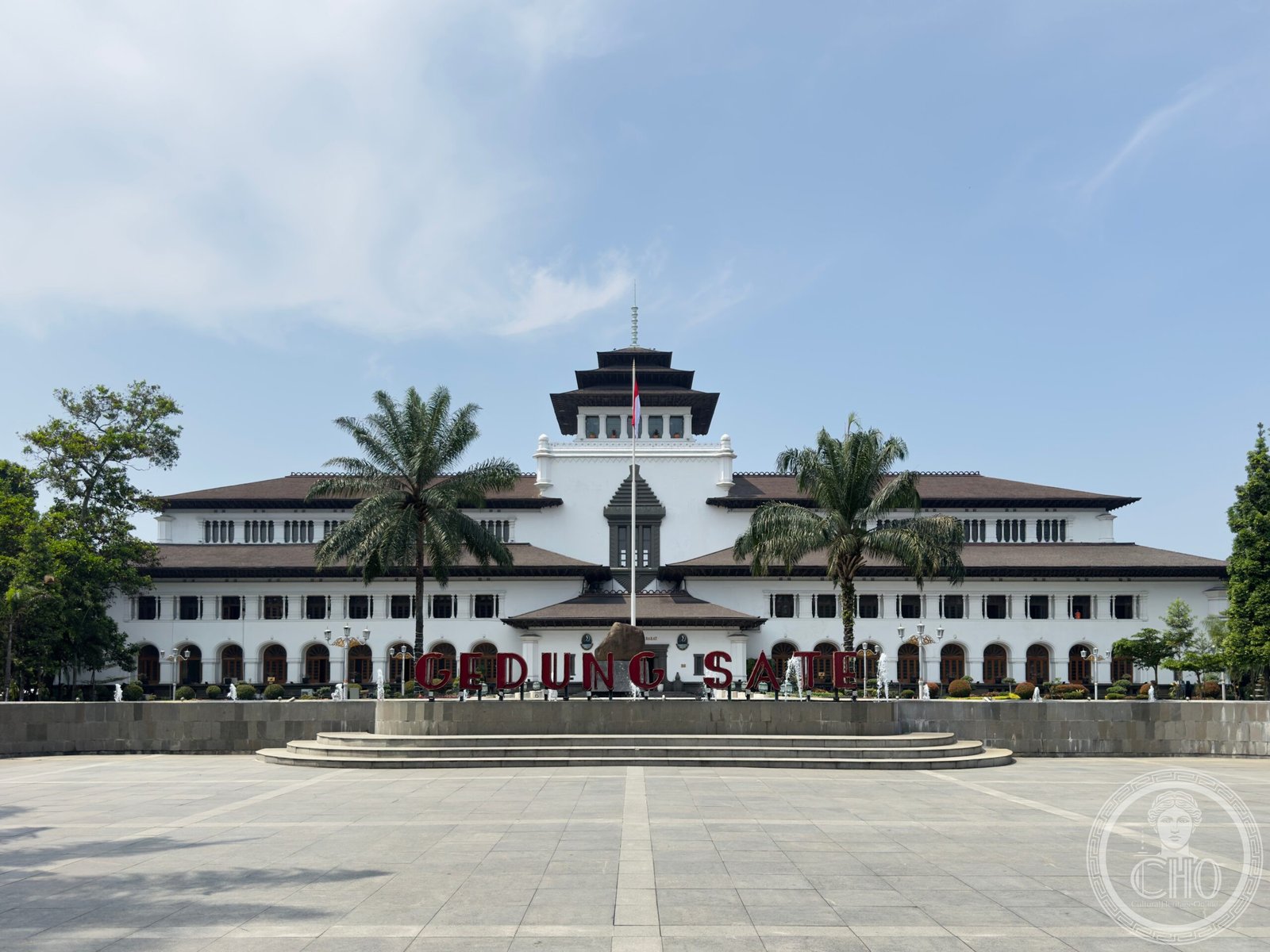
Gedung Sate — literally the “Satay Building” — is Bandung’s most recognisable colonial-era landmark, its distinctive central pinnacle crowned with six stacked spheres that locals liken to the skewered rounds of Indonesia’s beloved street food. Completed in 1924 to house the Dutch East Indies Department of Government Industries, the building was designed by Dutch architect J. Gerber in a bold neoclassical composition deliberately infused with Hindu-Buddhist motifs drawn from Javanese and Balinese temple architecture. The fusion was intentional: Dutch colonial policy in the 1920s sought an “Indo-European” architectural style that would signal permanence and cultural sensitivity in equal measure. The result is a building of unusual historical layering — Western imperial grandeur filtered through the forms of a deeply non-Western civilisation. Today Gedung Sate serves as the seat of the Governor of West Java and houses a small museum, remaining active in the political and civic life of the province it has presided over for a century.
At a glance
- Type
- Government building and museum
- Period
- Completed 1924
- Style
- Dutch Colonial / Indo-European (neoclassical with Hindu-Buddhist elements)
- Location
- Jalan Diponegoro 22, Citarum, Bandung Wetan, Bandung, West Java, Indonesia
- Coordinates
- 6.9025° S, 107.6187° E
- Architect(s)
- J. Gerber (Dutch architect, Department of Public Works)
Overview
Built as the colonial administrative headquarters for the Dutch East Indies’ Department of State Owned Enterprises (Departement van Gouvernmentsbedrijven), Gedung Sate was part of a broader Dutch plan to relocate the colonial capital from Batavia (now Jakarta) to Bandung’s cooler highland climate. The building cost six million guilders to construct — a figure memorialised in the six spheres of its pinnacle, each sphere representing one million guilders. Its unusual nickname, adopted by Bandung’s population, reflects the playful relationship between monumental colonial architecture and the everyday life of the city that grew up around it. The structure occupies a commanding position on Jalan Diponegoro, set back in a formal garden that enhances its visual authority.
History
Construction of Gedung Sate began in the early 1920s as part of the Dutch colonial government’s plan to transfer administrative functions from Batavia to Bandung, which Dutch urban planners envisioned as the future capital of the Dutch East Indies. J. Gerber was commissioned by the Department of Public Works to design a building that would express both Dutch authority and cultural sensitivity toward the indigenous population of the archipelago. The building was completed in 1924 and immediately became the most ambitious public building in West Java. During the Japanese occupation of 1942–1945, the building served Japanese military administration. Following Indonesian independence in 1945, Gedung Sate became a seat of provincial government and has remained so continuously. In October 1945, during the struggle for independence, seven young Indonesian workers died defending the building from Dutch forces — an episode commemorated by a monument on the grounds.
Architecture & Design
Gerber’s design for Gedung Sate represents one of the most sophisticated examples of the “Indo-European” architectural style promoted by Dutch colonial theorists in the early twentieth century. The building’s core is a neoclassical H-plan block rendered in white-painted concrete, with a symmetrical main façade flanked by projecting wings. Above the central entrance block rises a tall octagonal tower culminating in the famous six-sphere pinnacle — a form that references both Dutch Renaissance lanterns and the tiered merus of Balinese Hindu temples. The window surrounds, friezes, and ornamental details throughout the building incorporate motifs drawn from Hindu-Buddhist temple carving, including kala (demon face) masks and floral medallions. The main entrance hall features high coffered ceilings, terrazzo floors, and a grand staircase that projects colonial institutional authority while remaining climatically adapted to the tropics.
Cultural significance
Gedung Sate is the most potent symbol of Bandung’s dual colonial and post-colonial identity. As a piece of architecture it documents Dutch attempts to construct a hybrid “Indo-European” aesthetic that would legitimise colonial rule through apparent cultural respect. As a site of history, it witnessed the transition from Dutch to Japanese to Indonesian authority, and the deaths of the seven defenders in 1945 give it a martyr-site resonance in Indonesian national memory. The building also anchors Bandung’s status as one of Asia’s great Art Deco and colonial-modernist cities, attracting architectural historians from around the world. Its six-sphere pinnacle is among the most photographed structures in Indonesia.
Visiting today
Gedung Sate is an active government building and entry to the interior requires advance arrangement, though the exterior and formal gardens are freely accessible. A small museum on the premises documents the building’s history and the West Java provincial administration. The surrounding garden provides excellent views of the pinnacle. Visitors should note that government functions operate Monday to Friday; weekend visits are quieter and better suited to photography. The monument to the seven defenders stands in the grounds and is worth seeking out.
Getting there
Gedung Sate is located on Jalan Diponegoro in central Bandung, approximately two kilometres north of Bandung Railway Station (Stasiun Bandung). From the station, the building is reachable by taxi or ride-hail (Gojek/Grab) in around ten minutes, or on foot in about twenty-five minutes. Bandung is served by frequent intercity trains from Jakarta Gambir (approximately three hours via Argo Parahyangan express) and by Husein Sastranegara International Airport. The building is within easy reach of other colonial-era landmarks including Hotel Preanger and Gedung Merdeka.
Sources & resources
Find it on the map
See this place and what’s around it →📷 Become a Cultural Heritage Online photographer
Share your photos of places: they stay published under your name as the author. The more they're seen, the more you get noticed — and soon a contest will reward the most appreciated photos.
Log in or sign up free to add a photoDo you manage this place?
This page is read by travellers and heritage enthusiasts who find it on Google. Keep it accurate — and make it work for you. Free for non-profit heritage institutions.