
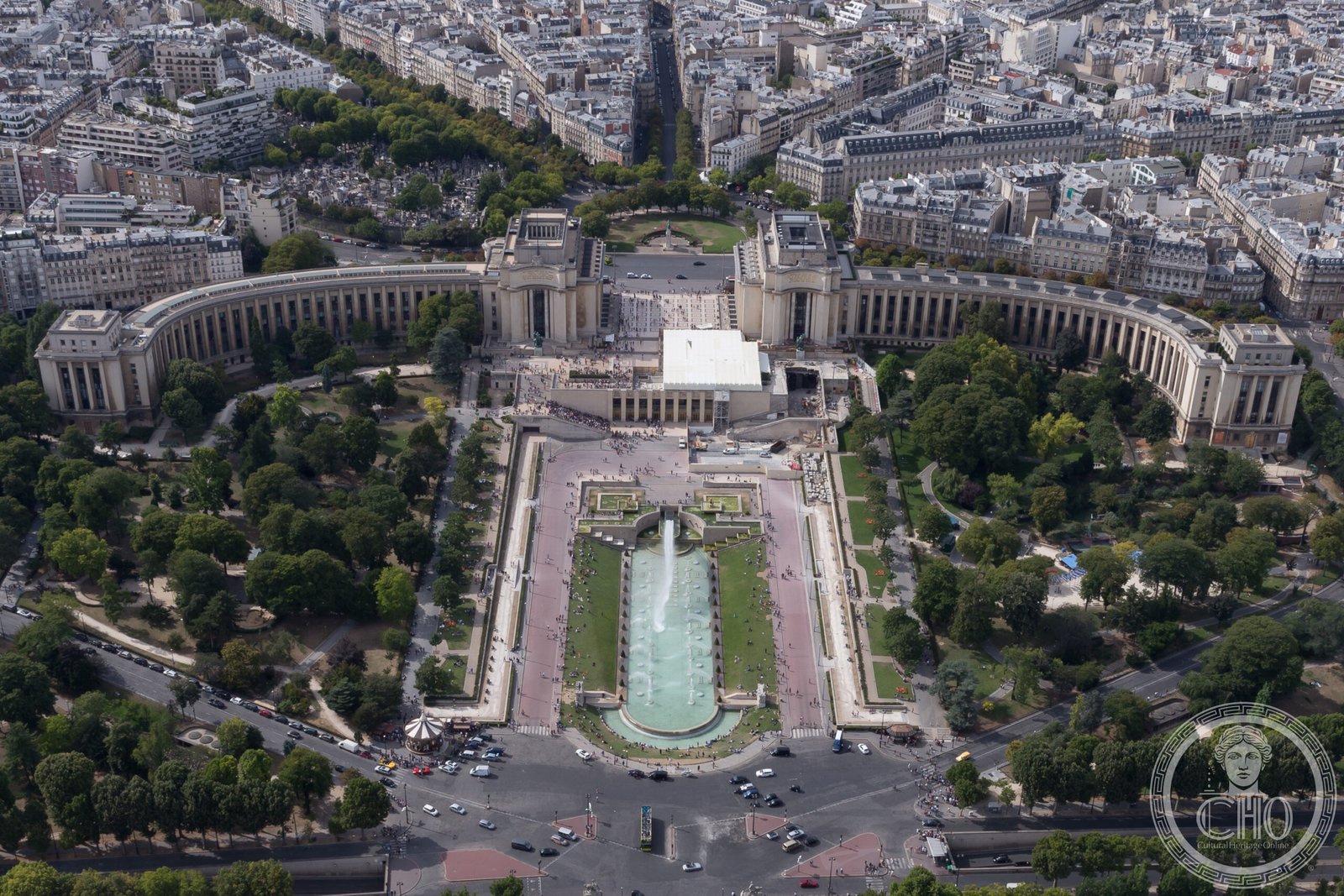
Crowning the Chaillot Hill above the Seine, the Palais de Chaillot commands one of the most theatrical urban panoramas in the world: its curved colonnaded wings embrace a wide esplanade from which the Eiffel Tower rises in perfect axial alignment across the Trocadéro gardens. Built for the 1937 Exposition Internationale des Arts et Techniques dans la Vie Moderne, the palace was designed by architects Louis-Hippolyte Boileau, Jacques Carlu, and Léon Azéma as a statement of French modernity that balanced classicising grandeur with streamlined Art Deco restraint. Its gilded bronze statues, Paul Valéry inscriptions, and monumental fountains transform the exterior into a sustained work of public sculpture. Inside, the palace has hosted events that changed history: the Universal Declaration of Human Rights was adopted here on 10 December 1948. Today the complex shelters major national museums, the National Theatre of Chaillot, and continues to be one of the most visited sites in Paris.
At a glance
- Type
- Cultural palace / museum complex
- Period
- 1935–1937
- Style
- Art Deco / Modernist Classicism
- Location
- 17 Place du Trocadéro, 16th arrondissement, Paris, France
- Coordinates
- 48.862° N, 2.288° E
- Architect(s)
- Louis-Hippolyte Boileau, Jacques Carlu, Léon Azéma
Overview
The Palais de Chaillot stands on the Chaillot Hill in the 16th arrondissement of Paris, facing the Champ de Mars and the Eiffel Tower across the Seine. Two curved wings — each 195 metres long — enclose a broad esplanade lined with gilded bronze sculptures and flanked by ornamental pools fed by spectacular fountains. The complex currently houses the Cité de l’Architecture et du Patrimoine, the Musée de la Marine, the Musée de l’Homme, and the Théâtre National de Chaillot. Its rooftop terraces offer some of the finest views of the Eiffel Tower available anywhere in Paris.
History
The Chaillot hill has been a site of monumental architecture since the Ancien Régime. The first Palais du Trocadéro was erected for the 1878 Universal Exposition; its Moorish-inspired rotunda defined the skyline for nearly sixty years. For the 1937 Exposition Internationale, the French government commissioned a wholesale rebuilding: Boileau, Carlu, and Azéma demolished most of the old palace but retained the curved footprint and the two lateral towers, cladding them in limestone and enriching the esplanade with Art Deco ornament. The palace gained enduring historical significance on 10 December 1948, when the United Nations General Assembly adopted the Universal Declaration of Human Rights in its theatre. It also served as temporary NATO headquarters from 1952 to 1959.
Architecture & Design
The palace’s plan consists of two curved wings meeting at an open esplanade rather than enclosing a closed courtyard, a deliberate move that frames the view toward the Eiffel Tower and Champ de Mars. The limestone facades are articulated with pilasters, relief sculpture, and large glazed openings that speak both to classical French grandeur and to 1930s streamlined modernism. Gilded bronze allegorical statues line the terrace parapet — among the finest examples of French Art Deco public sculpture. The esplanade’s central axis is punctuated by seventeen fountains capable of projecting water up to 50 metres. Quotations by Paul Valéry are inscribed in gold letters on the wings, blending architecture and literature in characteristically French fashion.
Cultural significance
The Palais de Chaillot is inseparable from the most consequential act of twentieth-century international law: the adoption of the Universal Declaration of Human Rights on 10 December 1948. A plaque in the theatre commemorates the vote. The esplanade was also the spot where Adolf Hitler was photographed during his brief visit to occupied Paris in June 1940, an image that became one of the most recognised photographs of the Second World War. Architecturally, the palace represents the French state’s ambition to define a national modern classicism distinct from both International Style modernism and fascist monumentalism.
Visiting today
The esplanade and exterior gardens are freely accessible at all hours. The Cité de l’Architecture et du Patrimoine and the Musée de la Marine each have independent opening hours and admission fees; check their websites before visiting. The Théâtre National de Chaillot programmes contemporary dance and theatre throughout the season. The terrace views toward the Eiffel Tower are spectacular at dusk and after dark when the tower lights are active.
Getting there
The Palais de Chaillot is directly served by Trocadéro station on Paris Métro lines 6 and 9. Several RER stations — Charles de Gaulle–Étoile (RER A) and Champ de Mars–Tour Eiffel (RER C) — are within walking distance. Buses 22, 30, 32, 63, and 72 stop at the Trocadéro. The palace is a short walk from the Bir-Hakeim bridge if arriving from the Left Bank.
Sources & resources
Find it on the map
See this place and what’s around it →Record researched and written by Luigi De Marchi for Cultural Heritage Online, 2026.
📷 Become a Cultural Heritage Online photographer
Share your photos of places: they stay published under your name as the author. The more they're seen, the more you get noticed — and soon a contest will reward the most appreciated photos.
Log in or sign up free to add a photoIs this page about you?
This page is read by travellers and heritage enthusiasts who find it on Google. Tell us how you are connected to this place and we will take it from there.