
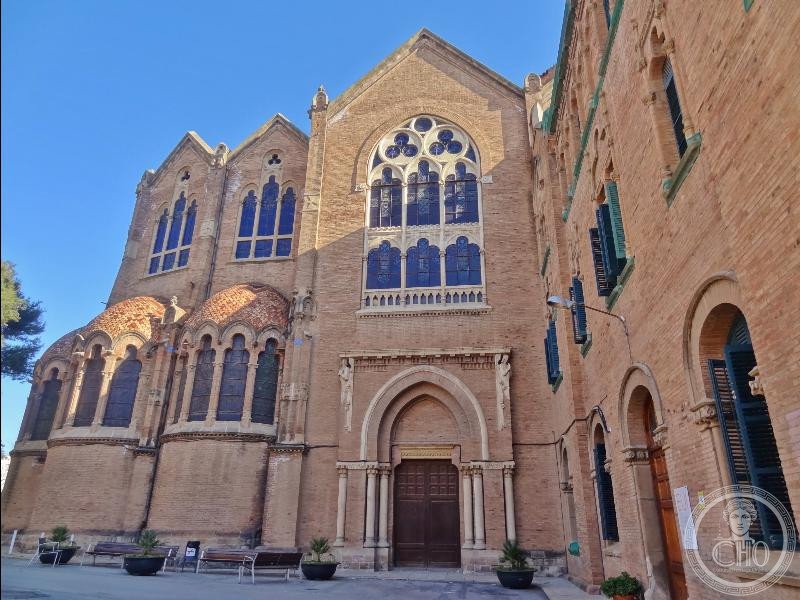
Lluís Domènech i Montaner built this hospital to heal through beauty—a 6.74-hectare complex of polychrome pavilions, underground galleries, and Art Nouveau ornament that remains the largest ensemble of Catalan modernisme ever constructed.
At a glance
The Recinte Modernista de Sant Pau occupies a full city block in Barcelona’s Eixample district, its axis deliberately tilted 45 degrees to face the Sagrada Família a kilometre to the south-east. Domènech i Montaner (1849–1923) designed 48 buildings; 27 were constructed between 1902 and 1930. Today 26 structures survive, connected by a network of underground service galleries that once allowed patients, staff, and supplies to circulate without crossing the open courtyards. After a century as a working hospital and a decade-long, €100 million restoration, the complex reopened in 2014 as a museum, cultural centre, and workspace for international health organisations including the WHO and UN-HABITAT.
Key facts
- Architect: Lluís Domènech i Montaner (1902–1913); continued by his son Pere Domènech i Roura (1914–1930)
- Style: Catalan modernisme (Art Nouveau)
- Construction: 1902–1930
- Site area: 6.74 hectares; built area 29,517 m²; outdoor space 31,052 m²
- UNESCO: World Heritage Site 1997 (criteria i, ii, iv; ref. 804bis-002), jointly with Palau de la Música Catalana
- Spanish heritage: Bien de Interés Cultural, declared 19 May 1978
- Hospital closed: June 2009; reopened as cultural centre 2014
- Current address: Carrer de Sant Antoni Maria Claret 167, Barcelona
History
The institutional story begins in 1401, when six small medieval hospitals merged to form the Hospital de la Santa Creu. Construction on the original complex in Barcelona’s Gothic Quarter started that same year and was completed by 1450; a Casa Convalescència was added in the seventeenth century. By the late nineteenth century, Barcelona’s rapid industrial growth had overwhelmed the medieval facility. The banker Pau Gil left a legacy to fund a new hospital on a generous plot in the expanding Eixample, and the name Sant Pau was appended in his honour.
Domènech i Montaner received the commission and began work in 1902 on a design that broke radically with the regimented hospital corridors of the era. He proposed 48 separate pavilions, each dedicated to a different medical function, connected underground so that patients could recover in daylight and garden air rather than in shared wards. He oversaw construction until his death in 1923. His son Pere Domènech i Roura continued from 1914 onward, completing the ensemble by 1930 with somewhat simpler, more eclectic forms.
The hospital operated continuously through the twentieth century, earning the St. George’s Cross from the Generalitat de Catalunya in 1991. A modern replacement building opened to the north in 2003, and the modernista complex ceased hospital operations in June 2009. The €100 million restoration that followed involved more than 30 specialist teams; it was substantially complete by 2014 and fully finished by 2020, with structural reinforcement, removal of later accretions, and meticulous restoration of the ornamental surfaces guided by historical archive research.
What you see
The pavilions are organised across the 45-degree-tilted grid in a formal landscape of gardens and paths, so every building receives even light throughout the day. Domènech i Montaner’s characteristic vocabulary is present at every scale: exposed chamfered brickwork defines the structural mass, while ceramic tiling, mosaic panels, stained glass, and ornamental ironwork layer colour and texture across façades, domes, and cornices. The result is not decorative excess but a deliberate therapeutic argument—light, ventilation, and beauty were considered clinical tools. Twelve of the original pavilions are connected by the underground gallery network, invisible from above.
The administration building anchors the main entrance on Carrer de Sant Antoni Maria Claret, its central tower and flanking wings framing the axial vista that stretches toward the Sagrada Família. The mosaics on the administration building’s exterior—polychrome ceramic scenes set against brickwork—demonstrate how Domènech i Montaner recruited painters, sculptors, and craftspeople rather than treating ornament as a contractor’s afterthought. His earlier manifesto of 1878, “En busca d’una arquitectura nacional,” had called for an architecture that synthesised structural honesty with Catalan cultural identity; Sant Pau is the fullest built answer to that argument.
UNESCO Heritage
UNESCO inscribed the complex in 1997 under criteria (i), (ii), and (iv), recognising it as a creative masterpiece, a significant example of human exchange at the turn of the twentieth century, and an outstanding illustration of the Catalan modernisme movement. The inscription was made jointly with the Palau de la Música Catalana, Domènech i Montaner’s concert hall completed between 1905 and 1908—both buildings are regarded as the architect’s defining achievements and together form the official World Heritage property “Palau de la Música Catalana and Hospital de Sant Pau, Barcelona” (reference 804bis-002). The protected area of 6.74 hectares is surrounded by a 23.14-hectare buffer zone. Sant Pau had already been listed as a Spanish Bien de Interés Cultural since May 1978.
The UNESCO dossier cites the complex as the largest Art Nouveau ensemble in the world. That claim rests on both scale—nearly 30,000 square metres of built fabric—and coherence: unlike most grand-scale heritage sites assembled over centuries, Sant Pau was designed as a unified whole within a single generation.
Art and decoration
Domènech i Montaner ran his architectural practice as a workshop, collaborating systematically with ceramicists, mosaic artists, ironworkers, and sculptors. The decorative programme at Sant Pau draws on Catalan symbolism, botanical forms, and the naturalistic vocabulary common to Art Nouveau across Europe. Flower and animal motifs integrate with structural elements—pilasters, dome ribs, window surrounds—rather than being applied as surface finish. Ceramic azulejos appear in both interior and exterior schemes, their glazed polychromy catching the Mediterranean light that saturates the garden courtyards.
Pere Domènech i Roura’s later pavilions, built after 1914, simplify the decorative register somewhat, with eclectic inflections alongside the modernista forms. The contrast is legible to an attentive visitor moving through the site chronologically: the earlier pavilions are denser in ornament, the later ones more geometrically restrained. The restoration between 2009 and 2020 addressed the ornamental surfaces specifically, using materials matched to the original specifications recovered from historical archives.
Visiting today
The Recinte Modernista de Sant Pau reopened as a public museum and cultural centre in 2014. The complex is open to visitors year-round, with guided and self-guided options. The historical archive housed on site is accessible to researchers and includes a reading room and reprographics service. Several of the original pavilions also serve as offices for international organisations, including the WHO and UN-HABITAT, which operate within the restored buildings alongside the public programme.
- Address: Carrer de Sant Antoni Maria Claret 167, 08025 Barcelona
- Getting there: Metro L5 (Hospital de Sant Pau station), directly adjacent to the main entrance
- Time needed: Allow 90–120 minutes for the exterior gardens and main pavilions; longer if visiting the archive or a temporary exhibition
- Footwear: Comfortable walking shoes; cobbled paths throughout the gardens
- Best light: Morning for the south-facing main façade; afternoon for the interior courtyards
Nearby heritage
- Sagrada Família (Antoni Gaudí, 1882–present) — approximately 1 km south-east along Avinguda de Gaudí, visible from the main entrance axis. Gaudí and Domènech i Montaner were contemporaries and rivals within Catalan modernisme; the juxtaposition rewards a half-day pairing.
- Casa Milà (La Pedrera) (Antoni Gaudí, 1906–1912) — approximately 2.2 km south-west on Passeig de Gràcia. Another UNESCO World Heritage property, part of the “Works of Antoni Gaudí” inscription.
- Palau de la Música Catalana (Lluís Domènech i Montaner, 1905–1908) — in the old city, co-inscribed with Sant Pau under the same UNESCO reference. The concert hall shares its architect and World Heritage status with this complex.
- Casa Lleó Morera and Casa Amatller — on the Manzana de la Discordia block of Passeig de Gràcia, approximately 2 km away; includes further work by Domènech i Montaner (Casa Lleó Morera, 1905).
Sources
- Wikipedia: Hospital de la Santa Creu i Sant Pau
- Wikipedia: Lluís Domènech i Montaner
- UNESCO World Heritage Centre: Palau de la Música Catalana and Hospital de Sant Pau, Barcelona (ref. 804bis-002)
- Recinte Modernista de Sant Pau official site: santpaubarcelona.org
Find it on the map
See this place and what’s around it →Record researched and written by Luigi De Marchi for Cultural Heritage Online, 2026.


📷 Become a Cultural Heritage Online photographer
Share your photos of places: they stay published under your name as the author. The more they're seen, the more you get noticed — and soon a contest will reward the most appreciated photos.
Log in or sign up free to add a photoIs this page about you?
This page is read by travellers and heritage enthusiasts who find it on Google. Tell us how you are connected to this place and we will take it from there.