
.jpg)
Casa Amatller
Josep Puig i Cadafalch’s stepped Flemish gable rises over the Passeig de Gràcia like a fragment of medieval Bruges transplanted to Barcelona — one of three competing architectural visions on the most argued-over city block in the history of Catalan Modernisme.
At a glance
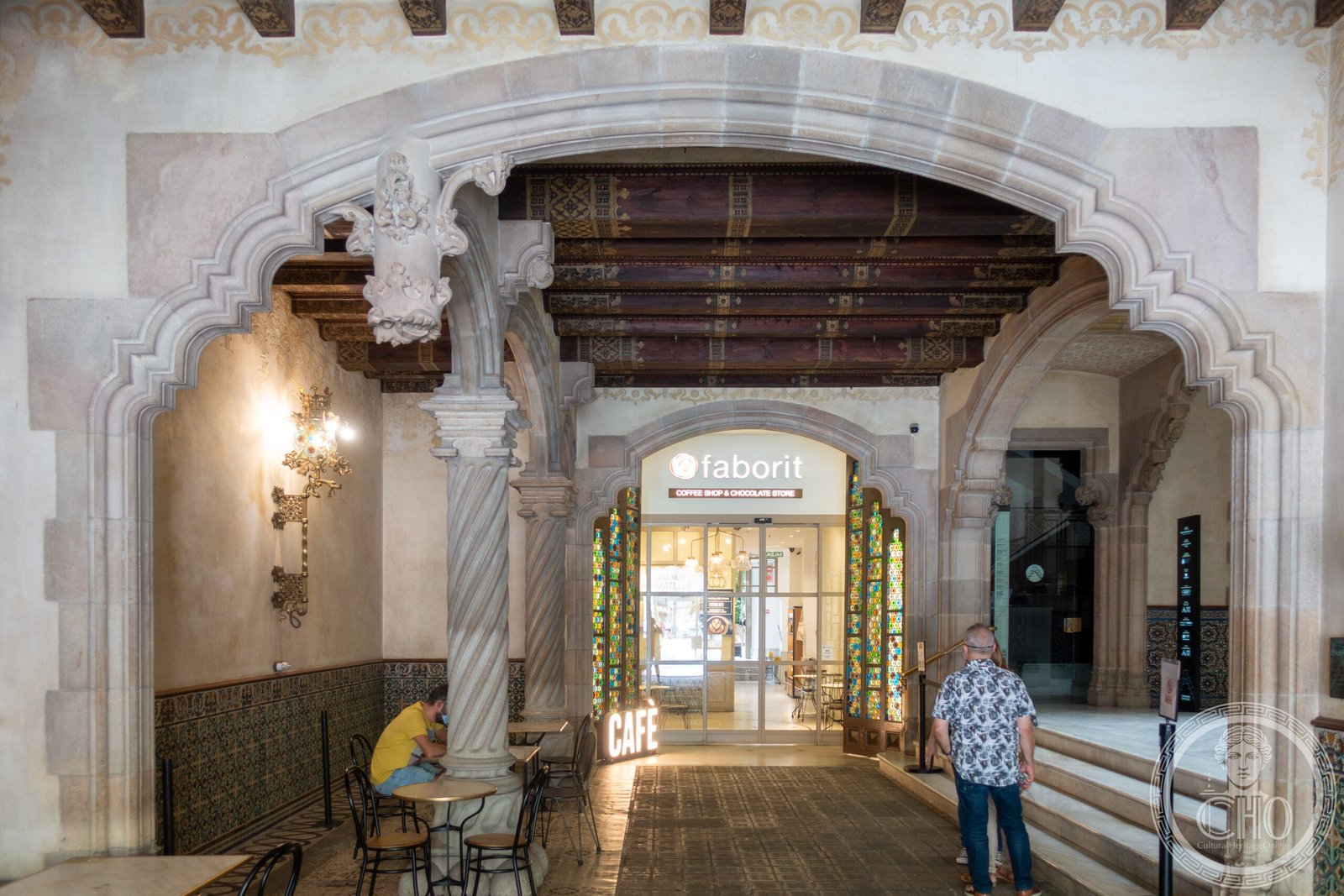
Casa Amatller occupies a corner of the Illa de la Discòrdia, the five-building stretch of Passeig de Gràcia where Puig i Cadafalch, Antoni Gaudí, and Lluís Domènech i Montaner each renovated a bourgeois townhouse within a decade of each other. The building was an existing 1875 structure when the chocolate manufacturer Antoni Amatller i Costa commissioned its radical transformation between 1898 and 1900. The result — neo-Gothic detailing mixed with Flemish silhouette and Catalan tile — was controversial from the start. That controversy gave the whole block its name. Today the ground floor hosts a working chocolate shop; the upper floors house the Amatller Institute of Hispanic Art, one of Spain’s foremost photographic archives.
Key facts
- Address: Passeig de Gràcia 41, 08007 Barcelona, Spain
- Architect: Josep Puig i Cadafalch (1867–1956)
- Original construction: 1875; redesigned 1898–1900
- Style: Catalan Modernisme with Flemish Gothic references
- Client: Antoni Amatller i Costa, chocolatier and photographer
- Heritage status: Bien de Interés Cultural, declared 9 January 1976 (Ref. RI-51-0004199)
- Current use: House museum, guided tours, café, Amatller Institute of Hispanic Art
- GPS: 41.39167, 2.16500 — Google Maps
History
Antoni Amatller i Costa built his fortune on chocolate. His family firm, Amatller Chocolate — founded in Barcelona in the mid-nineteenth century — grew into one of Catalonia’s most prominent confectionery brands, and with it came the wealth to commission a house that would signal cultural ambition as much as commercial success. Amatller was no passive client: he collected medieval art, photographed extensively on archaeological travels through Europe and the Near East, and expected his residence to reflect both passions.
He acquired the existing 1875 building at Passeig de Gràcia 41 and handed the renovation to the young Josep Puig i Cadafalch. Work ran from 1898 to 1900. The architect stripped the bourgeois façade and rebuilt it as a statement of Catalan identity filtered through Northern European Gothic sources — a deliberate counterpoint to the more organic, nature-derived language Gaudí was developing two doors down. Puig i Cadafalch had just completed Casa Martí, the building that housed Els Quatre Gats, and was establishing himself as the most intellectually rigorous of the Modernista generation.
Amatller died in 1910. His daughter Teresa continued to live in the house until her own death in 1960. The family’s long occupancy was, unexpectedly, the best conservation the building could have received: the 1900 interiors — stained glass doors, ceramic tilework, the carved stairwell — survived largely intact. The Amatller Institute of Hispanic Art was subsequently established in the upper floors, carrying forward the founder’s interest in art history through photographic documentation of Spanish and Latin American heritage.
What you see
The façade is the most readable argument in the whole Illa de la Discòrdia debate. Where Gaudí dissolved structure into organic curve at Casa Batlló next door, Puig i Cadafalch insisted on geometry: the stepped triangular gable that crowns the roofline is borrowed directly from Flemish civic architecture, the kind you find on guild halls in Ghent or Bruges. It sits atop a skin of polychrome ceramic tile — deep blue-green against the stone — that catches the Passeig de Gràcia light in a way no photograph quite captures. The scale compresses the visual effect; standing at pavement level, the gable appears to float.
Look closely at the sculptural programme on the main entry. A rat holds a camera — a direct reference to Amatller’s photography hobby, confirmed by contemporary accounts. The foyer beyond the stained-glass doors opens onto a vaulted stairwell that rises through all floors without interruption, the standard Catalan bourgeois townhouse section turned ceremonial. The dining rooms and salons on the principal floor retain their original 1900 furnishings: dark carved wood, wrought iron, and the kind of dense decorative programme that the Modernista generation considered inseparable from architecture. Puig i Cadafalch designed the interior as a total work.
Practical information
- Visits: Guided tours run on a fixed schedule; book in advance via the Casa Amatller website. Walk-in access to the ground-floor chocolate shop and café is unrestricted during opening hours.
- Time needed: Allow 60–75 minutes for the full guided tour; 20 minutes for the public rooms and shop alone.
- Best time: Morning light hits the east-facing façade directly; the polychrome tiles read best before noon.
- Accessibility: Ground floor and café accessible; full tour access varies — confirm with the venue when booking.
- Nearby: Casa Batlló (Gaudí, 1906) is immediately adjacent at No. 43; Casa Lleó Morera (Domènech i Montaner, 1905) is two doors down at No. 35.
Getting there
Passeig de Gràcia station (Metro lines L2 and L3, L4) puts you at street level on the boulevard, one short block from Casa Amatller. The building stands on the corner visible from the station exits. From the old city (Gothic Quarter or El Born), the walk north along Passeig de Gràcia takes roughly fifteen minutes. Barcelona–Sants rail station is served by the same metro lines; the journey from Sants is four stops on L3.
Nearby heritage
- Casa Batlló (Pg. de Gràcia 43) — Gaudí’s 1906 renovation, UNESCO World Heritage. The organic stone façade and dragon-spine roof directly face Casa Amatller.
- Casa Lleó Morera (Pg. de Gràcia 35) — Lluís Domènech i Montaner, 1905. The third anchor of the Illa de la Discòrdia, notable for its elaborate floral stucco and Modernista stained glass.
- La Pedrera / Casa Milà (Pg. de Gràcia 92) — Gaudí’s later masterpiece, four blocks north on the same boulevard, also UNESCO World Heritage.
- Palau del Baró de Quadras — another Puig i Cadafalch building (1906), showing the architect’s later, more refined phase, now the Casa Àsia cultural centre.
Sources
- Wikipedia: Casa Amatller — construction dates, heritage designation, current use.
- Wikipedia: Block of Discord (Illa de la Discòrdia) — five-building block context, name origin.
- Wikipedia: Josep Puig i Cadafalch — architect biography, career timeline.
- Spanish Ministry of Culture: Heritage registration RI-51-0004199, declared Bien de Interés Cultural 9 January 1976.
- Wikimedia Commons: Hero image — photographer Kent Wang, CC BY-SA 2.0.
Find it on the map
See this place and what’s around it →📷 Diventa un fotografo di Cultural Heritage Online
Condividi le tue foto dei luoghi: restano pubblicate con la tua firma come autore. Più vengono viste, più ti fai conoscere — e presto un concorso premierà le foto più apprezzate.
Accedi o registrati gratis per aggiungere una fotoDo you manage this place?
This page is read by travellers and heritage enthusiasts who find it on Google. Keep it accurate — and make it work for you. Free for non-profit heritage institutions.