
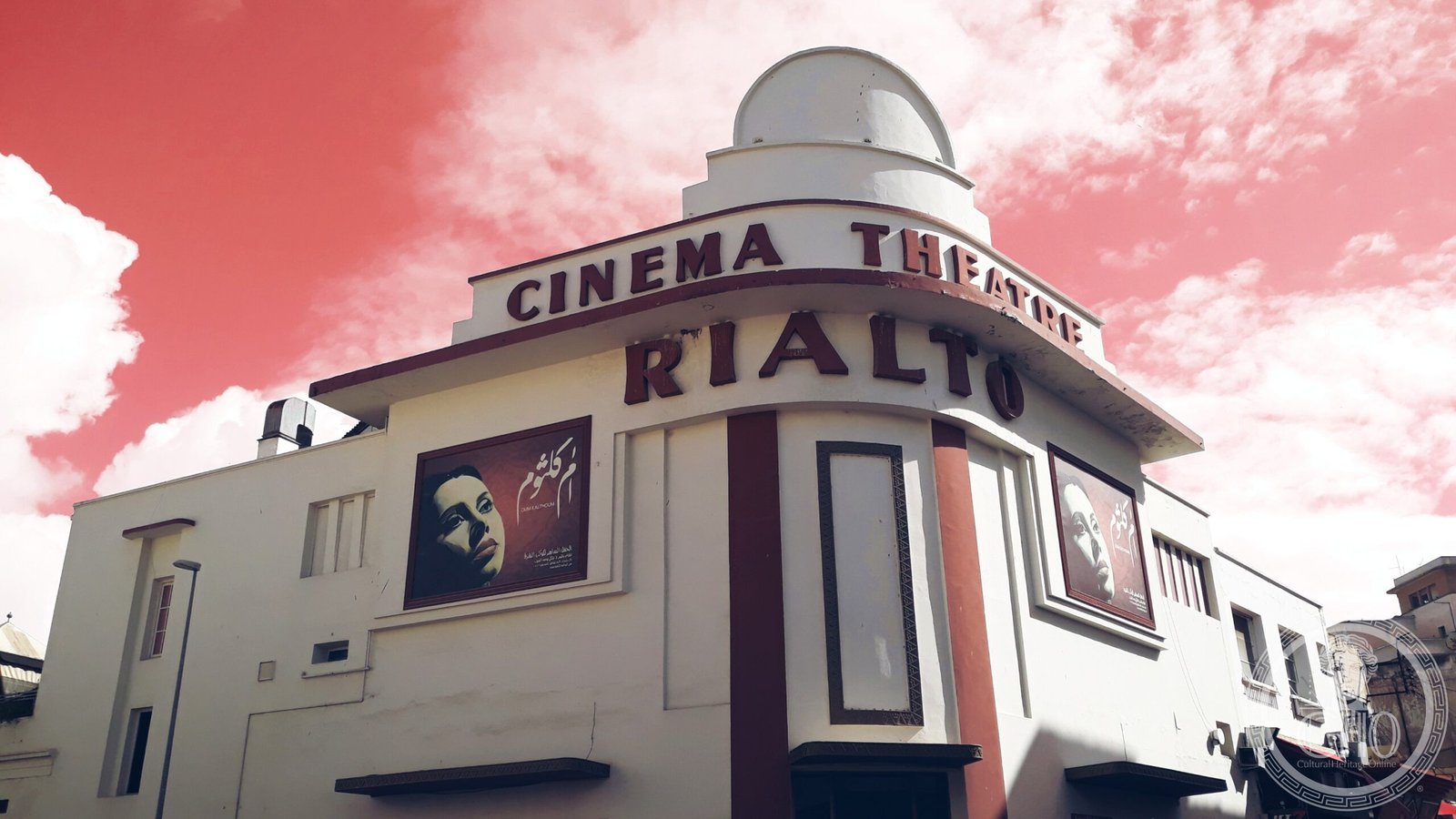
Cinema Rialto is one of the oldest surviving cinemas in Morocco, built in 1929 in the heart of Casablanca during the French Protectorate era. A quintessential example of Art Déco colonial architecture, the Rialto has long been a beloved cultural institution in a city whose interwar European quarter was once filled with dozens of picture palaces. The cinema’s ornate facade, with its characteristic Art Déco lettering and decorative detailing, remains one of the most photographed street-level heritage monuments in Casablanca. Now managed by the Bouchentouf family, the Rialto continues to screen films and host cultural events, keeping alive a tradition of public cinema-going that has defined the cultural life of the city for nearly a century.
At a glance
- Type
- Cinema / Cultural venue
- Period
- Built 1929
- Style
- Art Déco Colonial
- Location
- Central Casablanca, Morocco
- Coordinates
- 33.5941° N, 7.6144° W
- Status
- Active cinema and cultural venue
Overview
Cinema Rialto occupies a prominent position in the cultural geography of Casablanca. Built in 1929, it belongs to a generation of Art Déco picture palaces that once characterised the European quarter of the city, alongside now-lost venues such as Cinema Lynx and Cinema Vox, the latter reportedly the largest cinema in Africa at its peak. While many of its contemporaries have been demolished or converted, the Rialto has persisted as an active cinema, making it one of the most tangible survivors of Casablanca’s golden age of public entertainment architecture. Its continued operation connects present-day audiences directly to the cultural ambitions of the French Protectorate city.
History
Cinema Rialto was established in 1929, at the height of Casablanca’s rapid urban development under the French Protectorate. The first half of the twentieth century saw Casablanca become one of the most intensively cinema-going cities in Africa, with a network of theatres serving both the European settler community and the growing Moroccan urban population. The Rialto was among the most enduring of these venues. Following Moroccan independence in 1956 and the gradual decline of French settler culture, many of Casablanca’s historic cinemas closed. The Rialto survived and was subsequently acquired by the Bouchentouf family, who have worked to maintain it as both a functioning cinema and a heritage landmark.
Architecture & Design
The Rialto’s facade is a well-preserved example of the Art Déco colonial aesthetic that French architects brought to Casablanca during the late 1920s. The design features the bold geometric ornament, strong vertical and horizontal composition, and decorative lettering that defined cinema architecture of the period worldwide, here inflected with the warm materiality and occasional Moorish detail characteristic of Moroccan Protectorate-era buildings. The interior, originally designed to provide a glamorous and immersive entertainment experience, reflects the ambition of early cinema operators to make film-going a theatrical event. The overall effect is of a building that aspired to compete with the great picture palaces of Paris or Marseille, transplanted to the Atlantic coast of Africa.
Cultural significance
Cinema Rialto is among the most culturally resonant heritage buildings in Casablanca. As one of the few surviving interwar cinemas in a city that once boasted some of the most spectacular picture palaces in Africa, it functions as a living archive of popular culture, colonial urbanism, and architectural history. Its continued use as a working cinema rather than a converted commercial space or museum gives it an authenticity that heritage scholars and conservationists value highly. The building is also a touchstone for Moroccan cinematic memory, representing an era when Casablanca was a hub of film culture connecting European, North African, and sub-Saharan audiences. Its colonial context is part of a complex legacy that Moroccan cultural institutions are increasingly acknowledging and reinterpreting.
Visiting today
Cinema Rialto is an active venue that screens films and hosts cultural events; check local listings for current programming. The exterior facade is freely visible from the street and is a popular subject for architecture and heritage photography. Entry to screenings is ticketed. The cinema sits in the heart of Casablanca’s historic European quarter, surrounded by other Art Déco buildings and within easy reach of Place Mohammed V, the medina, and the city’s main commercial streets. Guided architectural walking tours of Casablanca’s Art Déco heritage frequently include a stop at the Rialto.
Getting there
The cinema is located in central Casablanca and is accessible on foot from most points in the historic European quarter. The Casablanca Tramway network serves the city centre, with stops within a short walking distance. Casa-Port railway station is approximately one kilometre away, reachable on foot or by a brief taxi journey. From Mohammed V International Airport, the Airport Express train to Casa-Voyageurs followed by a tram or taxi brings visitors to the city centre in under an hour. Taxis are readily available throughout the city centre at all hours.
Sources & resources
Find it on the map
See this place and what’s around it →Record researched and written by Luigi De Marchi for Cultural Heritage Online, 2026.
📷 Become a Cultural Heritage Online photographer
Share your photos of places: they stay published under your name as the author. The more they're seen, the more you get noticed — and soon a contest will reward the most appreciated photos.
Log in or sign up free to add a photoIs this page about you?
This page is read by travellers and heritage enthusiasts who find it on Google. Tell us how you are connected to this place and we will take it from there.