
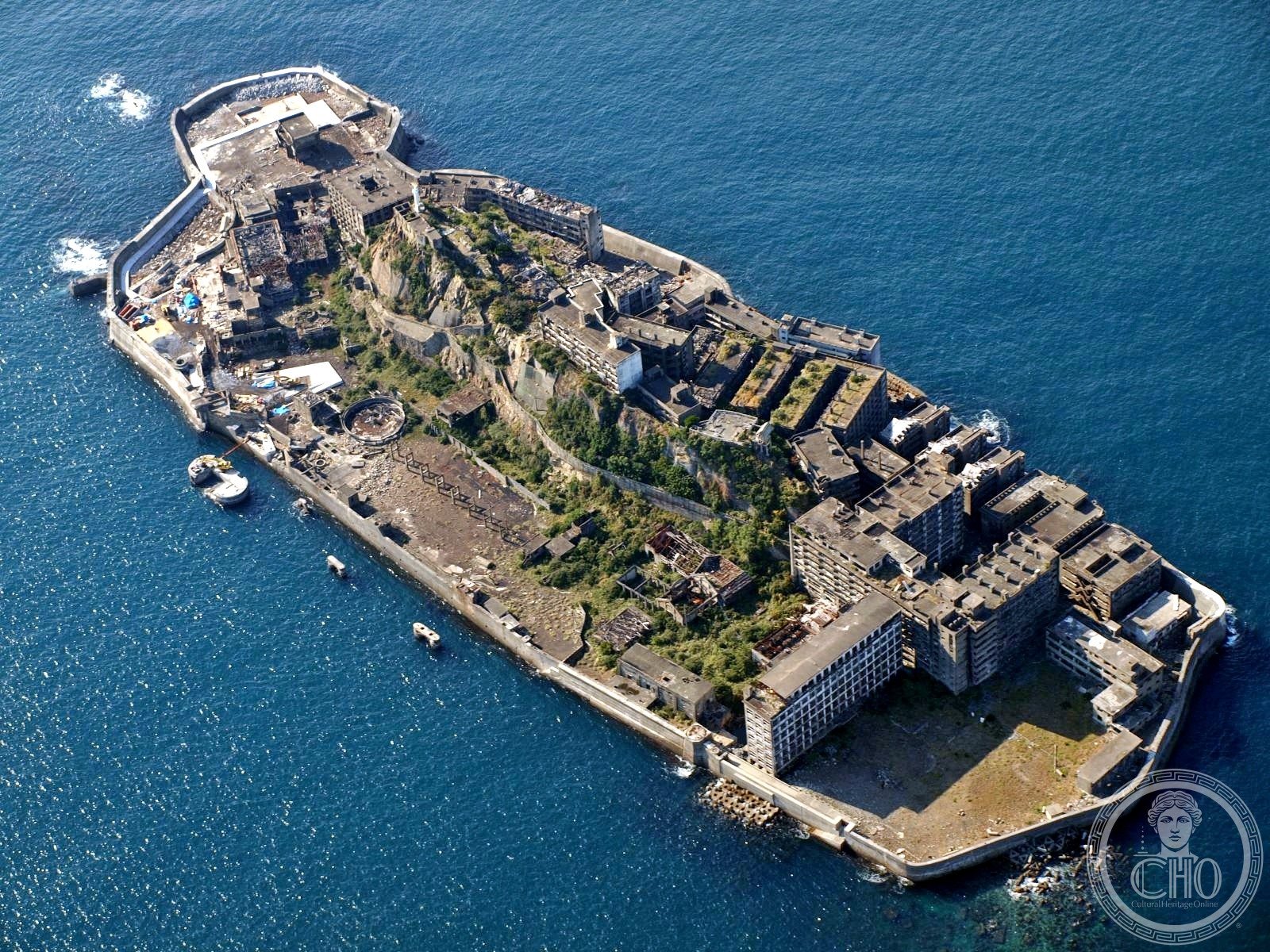
What Is Hashima Island?
Hashima Island — universally known as Gunkanjima, or Battleship Island, for the silhouette its sea walls cut against the horizon — is a 6.3-hectare concrete island 15 kilometres southwest of Nagasaki in Kyushu, Japan. In 1959, at the peak of its coal-mining operations, its population density reached 83,500 people per square kilometre — a figure unmatched anywhere on Earth before or since. Today it is entirely abandoned: a grid of rusting apartment towers, a school, a hospital, a cinema, and a pachinko parlour stand sealed behind the sea walls that once protected the miners from the East China Sea.
From Seabed Coal to Mitsubishi Empire
The Mitsubishi Corporation began extracting sub-sea coal from the island in 1887, tunnelling shafts to a seam 600 metres below the ocean floor. The company literally built the island upward: sea walls, then multi-story reinforced-concrete apartment blocks — among the first in Japan — to house an ever-growing workforce and their families. At its height, the island contained everything a city needs: a school that ran from elementary through secondary, a Buddhist temple, a Shinto shrine, a hospital, shops, rooftop gardens, and a bathhouse fed by desalinated seawater. No cars were possible on the narrow walkways; residents moved through a dense vertical labyrinth.
The Overnight Abandonment
Japan’s 1960s shift from coal to petroleum made sub-sea coal uneconomical. In January 1974, Mitsubishi announced closure. Within nine months — by April 1974 — the entire island had been evacuated. Residents departed so quickly that furniture, clothing, personal photographs, school books, and kitchen utensils were left in place. The mine shafts were sealed, the gates locked, and the sea walls left to hold the ruins against the tides. For 35 years, Hashima was off-limits; the vacant buildings aged, cracked, and were colonised by vegetation without any human maintenance.
The Architecture of Density
At its densest, the island held over 5,000 residents on a footprint smaller than many city blocks. The tallest building — Block 65, built in 1916, originally nine stories — was among the first large reinforced-concrete apartment structures in Japan. The island has no flat ground to spare: every square metre was assigned. Walkways pass through buildings; staircases cut through shared walls. The concrete, never maintained after 1974, has cracked under the chemistry of salt-sea air, producing the rust-streaked, vegetation-threaded texture that gives Hashima its visual identity as an emblem of industrial ruin.
Forced Labor and the UNESCO Controversy
Between 1943 and 1945, Korean and Chinese workers were conscripted under Japan’s wartime mobilisation and put to work in the undersea mine shafts. When Hashima was inscribed on the UNESCO World Heritage List in 2015 as part of the “Sites of Japan’s Meiji Industrial Revolution,” South Korea challenged the inscription, arguing that the forced-labor history was insufficiently acknowledged. Japan committed to “measures that allow an understanding of the full history of each site, including those who were forced to work under harsh conditions.” The controversy remains diplomatically active.
Skyfall and the Digital Ghost
Hashima Island reached a global audience through Skyfall (Sam Mendes, 2012), the twenty-third James Bond film. The villain Silva’s abandoned island lair is a digital recreation of Hashima built by production designer Dennis Gassner at Pinewood Studios. Director Mendes and Gassner cited Hashima directly as their primary reference. Real access was restricted during pre-production; the island was recreated entirely in CGI. Javier Bardem, who plays Silva, cited Hashima’s history of isolation and forced labor as biographical backstory for his character. The film brought the island’s image to audiences in more than 50 countries and generated the first wave of sustained international tourism. Hashima also appears in Ghost in the Shell (Rupert Sanders, 2017) and the documentary No Man’s Island (2019).
UNESCO Recognition (2015)
Hashima was inscribed as part of the serial property “Sites of Japan’s Meiji Industrial Revolution: Iron and Steel, Shipbuilding and Coal Mining” in 2015, recognised for its outstanding universal value as evidence of Japan’s rapid industrialisation in the Meiji and Taishō eras. The site is managed by Nagasaki City; guided boat tours from Nagasaki Port began in 2009 and are the only authorised means of access. Landings are permitted on a single quay, with visitor movement restricted to a small designated perimeter path.
Visiting Hashima Island
Day trips depart from Nagasaki Port (Tokiwa Terminal) aboard licensed operator vessels; the crossing takes approximately 50 minutes. Landings are subject to sea conditions — East China Sea swells cancel tours frequently between autumn and spring. Book several days in advance in peak season (April–October). Tours are conducted in Japanese; English-speaking guides are available with advance arrangement. The viewing circuit covers approximately 300 metres; binoculars are recommended for the interior ruins visible from the perimeter walkway.
- Location
- 15 km southwest of Nagasaki, Nagasaki Prefecture, Japan
- Coordinates
- 32°37′N 129°44′E
- Area
- 6.3 hectares
- Peak population (1959)
- ~5,259 residents
- Peak density
- 83,500 people/km² — highest recorded on Earth
- Active mining period
- 1887–1974 (Mitsubishi Corporation)
- Abandoned
- April 1974
- Tourism reopened
- 2009
- UNESCO inscription
- 2015 — Sites of Japan’s Meiji Industrial Revolution
- Film appearances
- Skyfall (2012), Ghost in the Shell (2017), No Man’s Island (2019)
Find it on the map
See this place and what’s around it →Historical events at this place (2)
📷 Become a Cultural Heritage Online photographer
Share your photos of places: they stay published under your name as the author. The more they're seen, the more you get noticed — and soon a contest will reward the most appreciated photos.
Log in or sign up free to add a photo