

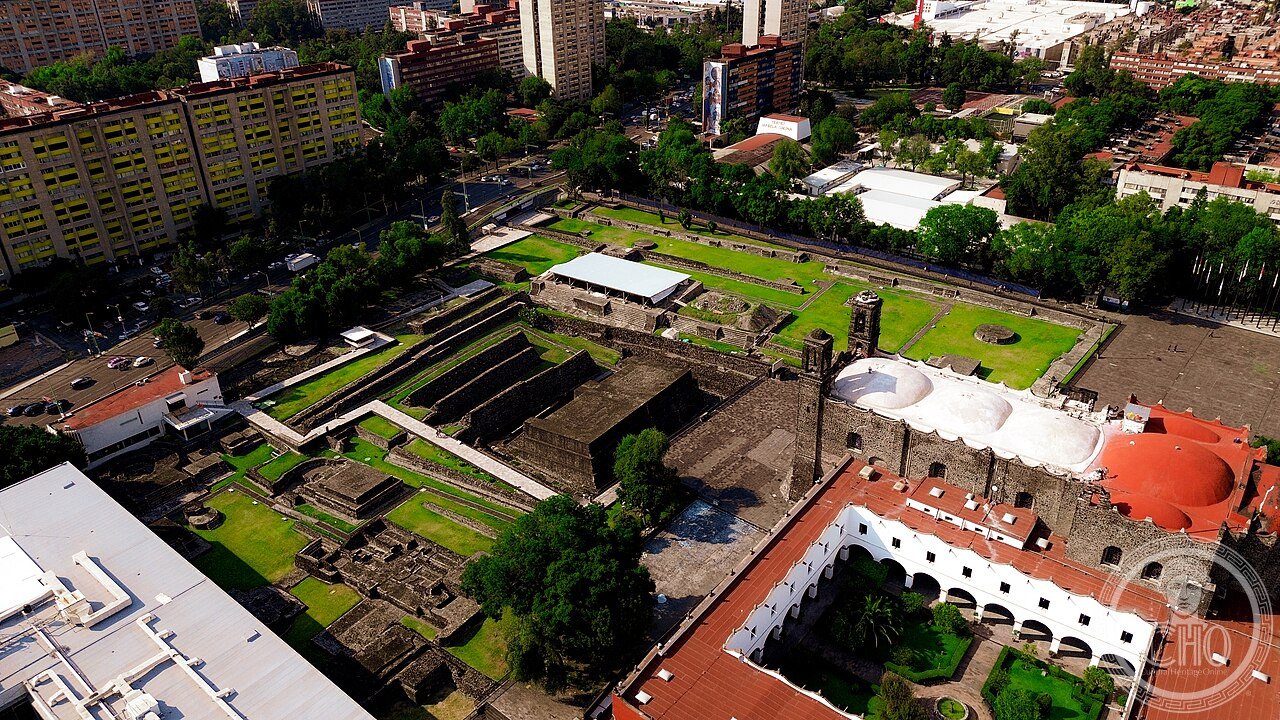
In a single plaza you stand above three eras stacked in stone: the Aztec pyramid where 60,000 traders gathered daily; the colonial church built from its rubble; and the concrete esplanade where, ten days before the 1968 Olympics, the Mexican government opened fire on a student demonstration. A plaque at the foot of the pyramid reads: This was neither a triumph nor a defeat but the painful birth of the mestizo people that is Mexico today.
At a Glance
- Location
- Cuauhtémoc, Mexico City, Mexico
- Aztec period
- Founded 1337 AD; fell 13 August 1521
- Colonial church
- Church of Santiago Tlatelolco, 1609
- 1968 massacre
- 2 October 1968 — estimated 300–400 killed; cover-up lifted 2001
- Archaeological status
- Active excavation zone; site open to public
- Access
- Metro Line 3, Tlatelolco station; open daily, free entry to plaza
The Aztec City
Tlatelolco was founded in 1337, a decade after its twin city Tenochtitlan, on an adjacent island in Lake Texcoco. Where Tenochtitlan was the political and ceremonial capital of the Aztec Empire, Tlatelolco was its commercial heart. The market of Tlatelolco — the tianguis — was the largest in the pre-Columbian Americas. Spanish conquistador Hernán Cortés, writing to King Charles I of Spain in 1520, reported that 60,000 people gathered here daily to trade. His companion Bernal Díaz del Castillo recalled being struck speechless by its scale and organisation: sections for goldsmiths, feather-workers, potters, weavers, slave traders, food sellers, and pharmacists, each in its own designated lane.
The main pyramid of Tlatelolco — the Templo Mayor de Tlatelolco — was dedicated to Huitzilopochtli and Tlaloc, the same pairing as the great Templo Mayor of Tenochtitlan six hundred metres to the south. The two cities were rivals. In 1473, Tenochtitlan conquered Tlatelolco and absorbed it as a subordinate district. The market, however, continued to operate under Aztec imperial rule, maintaining its status as the commercial centre of Mesoamerica.
The last battle of the Aztec Empire was fought at Tlatelolco. On 13 August 1521, after 75 days of siege, the last tlatoani (emperor), Cuauhtémoc, was captured here while attempting to escape by canoe across Lake Texcoco. The Aztec resistance ended. The plaque placed at the site in 1964 carries the words written by the Mexican poet and diplomat Carlos Pellicer: Aquí estuvo Tlatelolco. Este fue el fin del dominio azteca. Ni fue triunfo ni derrota, fue el doloroso nacimiento del pueblo mestizo que es el México de hoy. — Here was Tlatelolco. This was the end of Aztec rule. This was neither a triumph nor a defeat but the painful birth of the mestizo people that is Mexico today.
The Colonial Church
The Spanish did not simply replace Tlatelolco with something new: they quarried the pyramid for material to build with. The Church of Santiago Tlatelolco, completed in 1609, was constructed using stones taken directly from the Aztec pyramid that stood on the same ground. The church walls contain blocks carved with Aztec motifs, incorporated upside-down or reversed, stripped of their original meaning but still visibly present if you look closely.
The church holds historical significance beyond its architecture. Fray Bernardino de Sahagún, the Franciscan friar who compiled the most comprehensive ethnographic record of Aztec society — the Florentine Codex — worked at the Colegio de la Santa Cruz de Tlatelolco adjoining the church. The college, founded in 1536, was one of the first institutions of higher learning in the Americas and was intended to educate sons of Aztec nobility. The codex that Sahagún produced here is now a primary source for our knowledge of Aztec religion, medicine, agriculture, and social structure. Without Tlatelolco, much of that knowledge would be lost.
The 1968 Massacre
On 2 October 1968, ten days before the opening of the Mexico City Olympic Games, a student demonstration gathered in the Plaza de las Tres Culturas. Several thousand students and workers had assembled to protest the authoritarian government of President Gustavo Díaz Ordaz. The Mexican military and the Olimpia Battalion — a plainclothes paramilitary force — surrounded the plaza and opened fire.
The Mexican government announced that 25 people had been killed in a clash initiated by student snipers. Subsequent investigations, accounts from survivors, and documents declassified in 2001 from the Mexican national archives and from US government files (the CIA had agents present) established that the death toll was far higher — estimates range from 200 to 400 killed, with hundreds more arrested and tortured. The bodies were removed before dawn. The plaza was washed. The Olympics opened on schedule.
For more than three decades, the massacre was officially minimised or denied. The Mexican press, under government censorship, published the official account. Journalist Elena Poniatowska collected testimonies from survivors and published La Noche de Tlatelolco in 1971 (published in English as Massacre in Mexico). The book was banned in Mexico but circulated widely. It remains the foundational document of the event’s memory.
The memorial stone in the plaza — a simple plaque set into the pavement, inscribed with the date — is where Mexicans gather on 2 October each year. The anniversary march from the plaza to the Zócalo remains one of the largest annual demonstrations in Mexico City.
The Archaeological Zone
Below the plaza, excavations that began in the 1960s and continued through the 1980s and 1990s uncovered the multi-phase construction history of the pyramid. Like all major Aztec temples, it was built in successive layers: each new ruler added an outer skin over the previous structure, preserving earlier phases within. The exposed platform visible today shows several construction phases, with stairways from different periods visible on different faces.
The archaeological zone is managed by the Instituto Nacional de Antropología e Historia (INAH) and is open to visitors who walk through the site. Display panels explain the stratigraphy. The excavated areas are unfenced and accessible at ground level, allowing an unusually direct physical encounter with the Aztec stonework — you walk among the platform bases and altar stones rather than viewing them from a barrier.
Three Cultures, One Plaza
The name Plaza de las Tres Culturas — Plaza of Three Cultures — was given to the site in 1966 when the architect Mario Pani designed the surrounding urban complex. The three cultures are present simultaneously in the one space: the pre-Hispanic (the pyramid platform), the colonial (the church), and the modern (the 1960s Nonoalco-Tlatelolco housing project, one of the largest urban developments in Latin American history, whose towers frame the plaza on three sides).
The juxtaposition is more unsettling than harmonious. The pyramid stones were taken for the church; the housing complex was built partly to demolish older neighbourhoods; the 1985 earthquake killed hundreds of residents in the towers whose structural failures were partly attributed to cost-cutting. The three-cultures idea is also, unavoidably, the location of the 1968 massacre. The plaza holds the full weight of Mexican historical consciousness — conquest, cultural survival, authoritarian violence, urban modernity — in a space you can walk across in five minutes.
Plan Your Visit
- Metro: Line 3 (Olive), Tlatelolco station. The plaza is 400 metres from the exit.
- The archaeological zone and plaza are open daily; free entry. The Church of Santiago Tlatelolco is open during morning and evening masses.
- The Memorial del 68 museum (inside the Secretaría de Relaciones Exteriores building on the plaza) documents the 1968 massacre with photographs, testimonies, and film footage. Free entry.
- Combination visit: the Templo Mayor of Tenochtitlan is 2 km south in the historic centre (Metro Zócalo) — the two sites together give a complete picture of Aztec Mexico City.
- 2 October: the annual commemorative march begins at Tlatelolco. Expect large crowds and a politically charged atmosphere.
Find it on the map
See this place and what’s around it →📷 Become a Cultural Heritage Online photographer
Share your photos of places: they stay published under your name as the author. The more they're seen, the more you get noticed — and soon a contest will reward the most appreciated photos.
Log in or sign up free to add a photo