
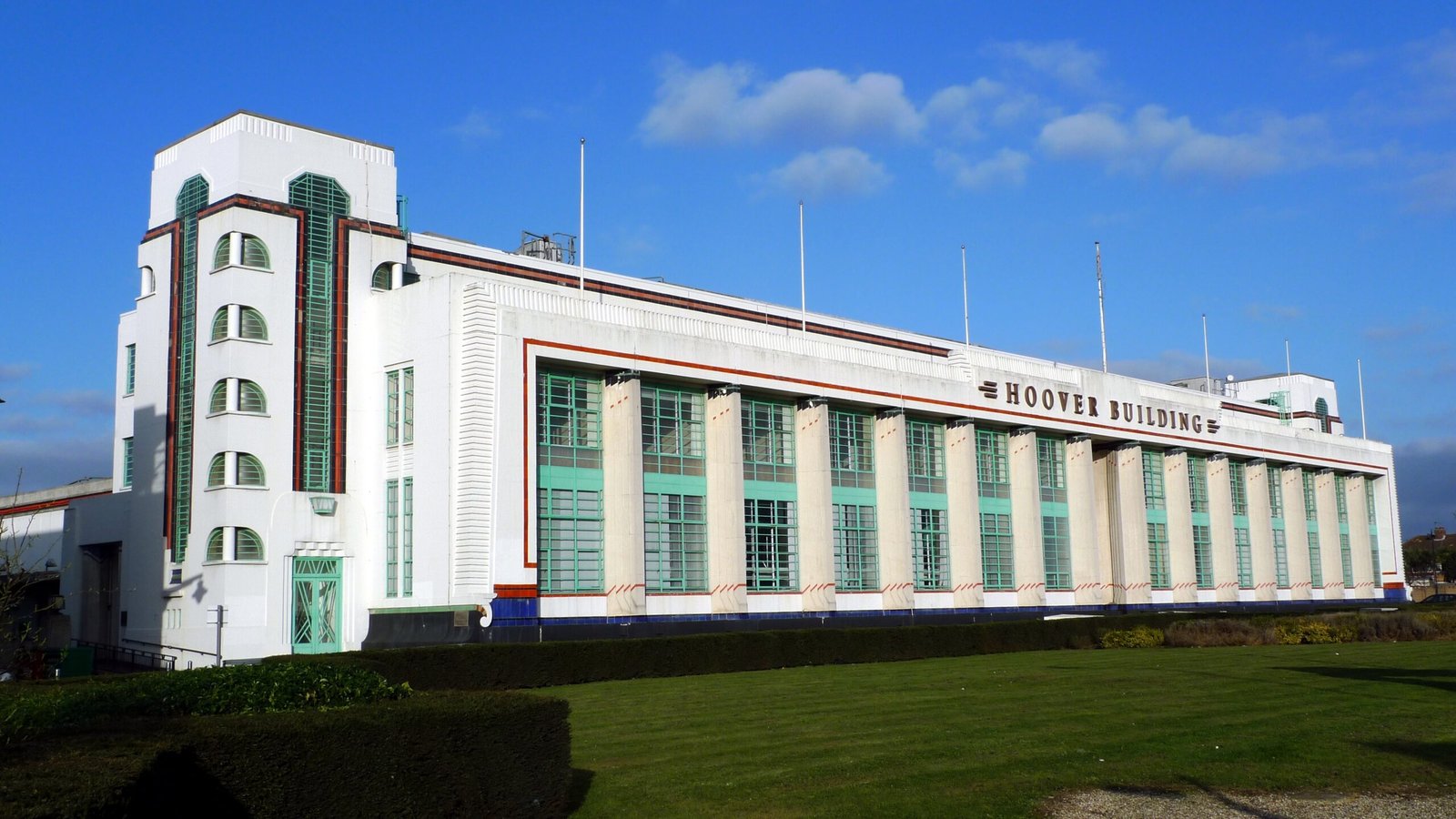
A vacuum-cleaner factory dressed like a palace of the future. The Hoover Building turned the new arterial road into a stage for Art Deco optimism.
At a glance
The Hoover Building is a former factory on Western Avenue in Perivale, west London, designed by the firm Wallis, Gilbert and Partners and completed in 1933 for the Hoover company. It is one of Britain’s most admired examples of the Art Deco “factory aesthetic,” in which manufacturers used bold modern architecture as advertising along the new motor roads. Its white frontage with coloured trim made it a landmark for passing drivers. The rear became a supermarket in 1989, and the front block was later converted into apartments.
Key facts
- Architects: Wallis, Gilbert and Partners
- Completed: 1933
- Original use: factory and offices for the Hoover company
- Style: Art Deco / Moderne “factory aesthetic”
- Status: Grade II* listed; converted to apartments, supermarket to the rear
History
In the inter-war years new arterial roads on London’s edge, lined with cheap land, drew a wave of modern factories. Companies treated the buildings as billboards, and Wallis, Gilbert and Partners specialised in giving them eye-catching Deco fronts. The Hoover Building was the most famous of these.
Production wound down after the Second World War, and the site eventually closed as a factory. In 1989 the supermarket chain Tesco built a store behind the listed front while preserving the showpiece facade. The main block was converted into flats in the 2010s, keeping the exterior intact.
What you see
The long white facade faces the road with a symmetrical, almost ceremonial front, its central entrance framed by columns and bands of coloured faience in green, red and blue. Sunburst and chevron motifs, the stock vocabulary of Art Deco, run across the detailing.
The effect is theatrical rather than industrial: glazed corners, a flat roofline and crisp geometric ornament that catches the light. It was built to be read at speed from a passing car, and it still works that way today.
Practical information
- Function: private apartments with a supermarket behind; admired from the exterior
- Setting: Western Avenue (A40), Perivale, west London
- Time needed: 20–30 minutes for the exterior
Getting there
The building stands on the A40 in Perivale. Perivale station on the Central line is a short walk away, and the site is easily seen from Western Avenue. Central London is about 30 minutes by tube.
Nearby
- Battersea Power Station, across the city, a brick Art Deco icon
- Eltham Palace, south-east London, Art Deco interiors
- London — William Morris and the Arts & Crafts Movement (CHO city guide)
Sources
- Historic England, listed building record for the Hoover Building
- Twentieth Century Society, building histories (c20society.org.uk)
- Encyclopaedia Britannica, “Art Deco”
Find it on the map
See this place and what’s around it →Record researched and written by Luigi De Marchi for Cultural Heritage Online, 2026.
📷 Become a Cultural Heritage Online photographer
Share your photos of places: they stay published under your name as the author. The more they're seen, the more you get noticed — and soon a contest will reward the most appreciated photos.
Log in or sign up free to add a photoIs this page about you?
This page is read by travellers and heritage enthusiasts who find it on Google. Tell us how you are connected to this place and we will take it from there.