
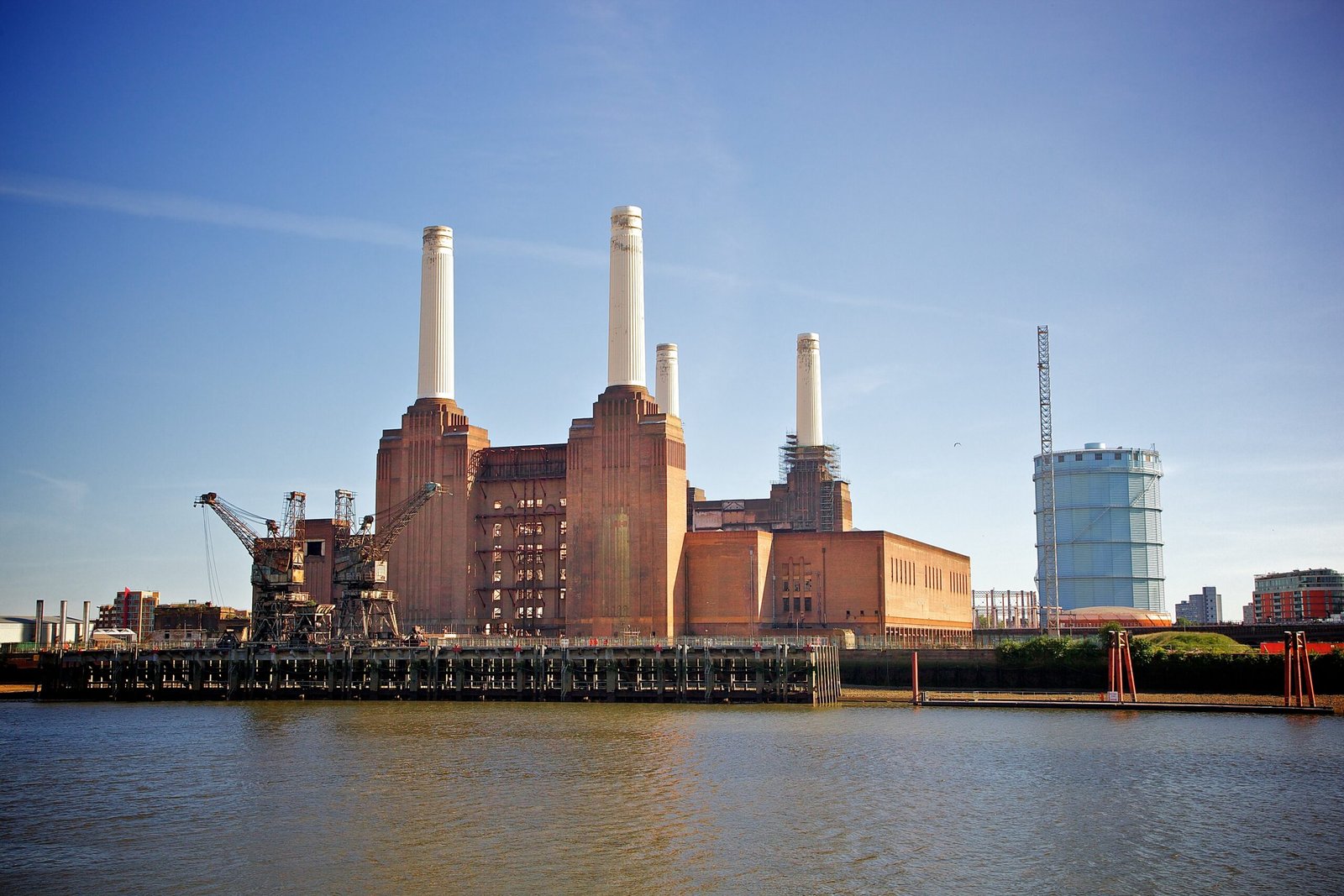
A power station that the public asked to be made beautiful. Giles Gilbert Scott wrapped its turbines in a brick cathedral, and Art Deco detailing reached even the control room.
At a glance
Battersea Power Station is a former coal-fired power station on the south bank of the Thames, famous for the brick monumentality given to it by the architect Sir Giles Gilbert Scott (1880–1960), who also designed the red telephone box. Built in two stages between 1929 and 1955, it gained its four-chimney silhouette only with the second half. Its Art Deco interiors, especially Control Room A, made it as much a civic monument as an industrial plant. Decommissioned in 1983, it reopened in 2022 as a mixed-use destination.
Key facts
- Architectural treatment: Sir Giles Gilbert Scott
- Built: A station 1929–1935; B station 1937–1955
- Style: brick Art Deco, “industrial cathedral”
- Closed: generating ended in 1983
- Status: Grade II* listed; reopened 2022 after redevelopment
History
When the London Power Company proposed a huge station beside the Thames in the late 1920s, there was public concern about so large a structure in the city. Scott was brought in to give the building a dignified architectural skin, and the result was admired enough to become a landmark almost at once.
The first half, with two chimneys, was completed in 1935. The matching second half was built after the war and finished in 1955, producing the symmetrical four-chimney form that became an icon of the London skyline, later borrowed for an album cover.
Generating stopped in 1983, and the listed shell stood derelict for decades through several failed schemes. A long redevelopment rebuilt the chimneys and converted the interior, and the station reopened to the public in 2022 with shops, offices and homes.
What you see
From the river the station is a vast cliff of brick, its corners rising into the four fluted concrete chimneys. The scale is deliberately heroic, and the brickwork is detailed with the care usually given to a public building rather than a factory.
Inside, the surviving Art Deco control rooms are the prize: polished stone, Italian marble, chrome and ranks of dials, designed when electricity itself felt like a civic promise. The redevelopment has opened parts of these spaces to visitors.
Practical information
- Function: shops, restaurants, offices and homes; public riverside
- Setting: Nine Elms, on the south bank of the Thames
- Time needed: 1–2 hours including the riverside
Getting there
The station has its own Underground stop, Battersea Power Station, on the Northern line, and is a short walk from the Thames riverboat pier. London city-centre stations are a few minutes away by tube.
Nearby
- Pimlico and the Tate Britain, across the river
- Hoover Building, west London, another Art Deco landmark
- London — William Morris and the Arts & Crafts Movement (CHO city guide)
Sources
- Historic England, listed building record for Battersea Power Station
- Battersea Power Station, official history (batterseapowerstation.co.uk)
- Encyclopaedia Britannica, “Giles Gilbert Scott”
Find it on the map
See this place and what’s around it →Record researched and written by Luigi De Marchi for Cultural Heritage Online, 2026.

📷 Become a Cultural Heritage Online photographer
Share your photos of places: they stay published under your name as the author. The more they're seen, the more you get noticed — and soon a contest will reward the most appreciated photos.
Log in or sign up free to add a photoIs this page about you?
This page is read by travellers and heritage enthusiasts who find it on Google. Tell us how you are connected to this place and we will take it from there.