
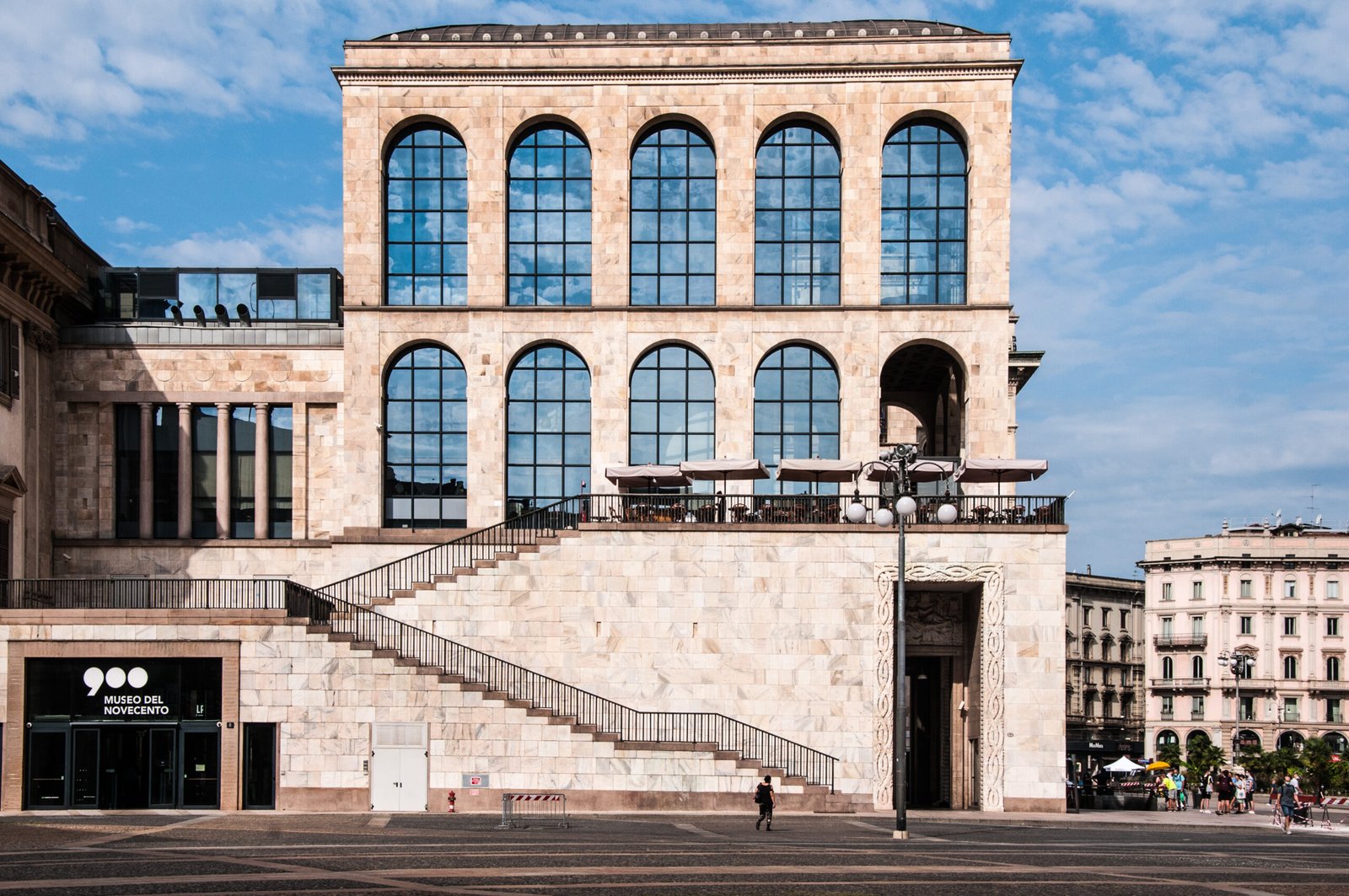
Two symmetrical stone towers close the southern end of Piazza del Duomo. Designed in 1937 by Portaluppi, Muzio, Magistretti and Griffini, begun in 1939 and finished only in 1956, the Arengario started as a Fascist civic platform and ended as the home of the Museo del Novecento, Milan’s public collection of twentieth-century Italian art.
- Address
- Piazza del Duomo 8, 20122 Milano MI
- Period
- Design competition 1937; construction 1939–1956
- Architects
- Piero Portaluppi, Giovanni Muzio, Pier Giulio Magistretti, Enrico Agostino Griffini
- Sculptors
- Arturo Martini (bas-reliefs on the south tower); Giacomo Manzù (bronze portals)
- Style
- Late Italian rationalism with stripped-classical massing in Candoglia marble
- Current use
- Museo del Novecento (south tower, opened 6 December 2010); municipal offices and ceremonial spaces (north tower)
- Coordinates
- 45.4636° N, 9.1900° E
- Notes
- The 2003–2010 conversion into the Museo del Novecento was designed by Italo Rota and Fabio Fornasari; the museum is connected to Palazzo Reale by an aerial walkway over Via Marconi
Visit on the map
Piazza del Duomo 8 · 45.4636° N, 9.1900° E
Take it with you
A single waypoint, ready for GPS apps, navigators, and contacts.
Story
The Arengario was conceived in 1937 as the urban hinge of Fascist Milan. The brief, set by a competition that gathered the city’s leading architects, asked for a ceremonial platform from which the regime’s authorities could address crowds in Piazza del Duomo — the name itself revives the medieval Lombard word for the seat of public assembly. The winning team of Piero Portaluppi, Giovanni Muzio, Pier Giulio Magistretti and Enrico Agostino Griffini produced a solution that broke the programme into two mirrored towers, set back from the cathedral and framing the new opening onto Via Marconi: a stripped-classical mass clad in Candoglia marble, the same stone as the Duomo, rising in three superimposed loggias above a deep arcade.
Construction began in 1939, then dragged across the war years. The towers were shelled during the Allied bombings of Milan in 1943 and stood as roofless masonry for most of the following decade. They were completed only in 1956, when the loggia from which Mussolini was supposed to harangue the piazza had become an awkward inheritance and the building was quietly absorbed into civic use as offices for the Comune and Provincia. Arturo Martini’s bas-reliefs survived on the south tower; Giacomo Manzù finished the bronze portals after the war, marking the threshold between two political worlds with a sculptor whose Catholic humanism could not have been further from the regime that started the project.
The current life of the building began in 2003, when the City of Milan launched an international call to convert the south tower into a permanent home for its twentieth-century art collection. Italo Rota and Fabio Fornasari won the commission with a project that hollowed the interior around a continuous helical ramp rising from the piazza, glassed the corner facing the Duomo, and added an aerial walkway across Via Marconi linking the Arengario to Palazzo Reale. The Museo del Novecento opened on 6 December 2010 with Umberto Boccioni’s Forme uniche della continuità nello spazio placed in the rotunda — a futurist bronze visible from the cathedral square, looking back at the building that had been designed to celebrate a very different idea of modernity.
“Begun as a Fascist monument but only completed in the 1950s.”
Wikipedia, Arengario
What you read across the square today is the layered result of those three campaigns: a 1930s competition mass, a 1950s pragmatic completion, and a 2000s museum insertion that turned a Fascist tribune into a public viewing platform over Milan. The north tower still serves municipal functions and is closed to visitors; the south tower is open daily as the Museo del Novecento, with the upper loggia — the one originally intended for the regime’s speeches — now offering one of the most direct views onto the Duomo’s lateral facade.
Sources & resources
Editorial picks across Wikipedia, photo archives, and the official museum portal.
See the place
Find it on the map
See this place and what’s around it →
Historical events at this place (6)
- 2020 Sospesa: Mostra dedicata alla grande astrattista Carla Accardi
- 2020 L'immagine sottratta, di Franco Guerzoni
- 2021 Mario Sironi – Sintesi e grandiosità
- 2022 Avanguardie al Museo del 900
- 2024 Mostra: Masbedo - Ritratto di Città (20/20.000Hz)
- 2024 Magali Reus | Off Script Premio Pomodoro per la Scultura
📷 Become a Cultural Heritage Online photographer
Share your photos of places: they stay published under your name as the author. The more they're seen, the more you get noticed — and soon a contest will reward the most appreciated photos.
Log in or sign up free to add a photoIs this page about you?
This page is read by travellers and heritage enthusiasts who find it on Google. Tell us how you are connected to this place and we will take it from there.