
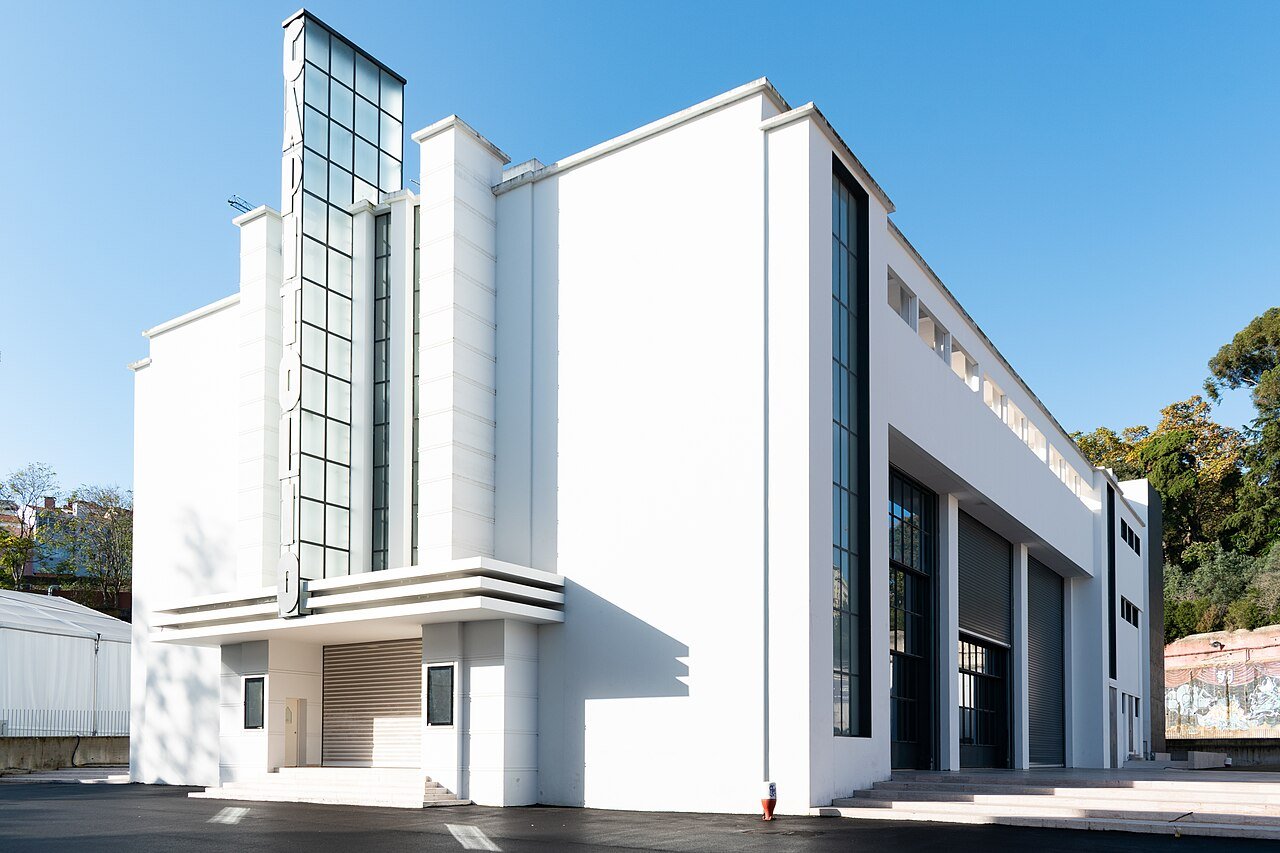
Portugal called its Art Nouveau Arte Nova, and Lisbon wore it in tiled shopfronts and ironwork. Two decades later the Déco cinemas of the avenues rewrote the same streets in concrete.
At a glance
Lisbon does not announce its early-twentieth-century architecture the way Barcelona or Paris does, which is part of the pleasure of finding it. The Portuguese answer to Art Nouveau, known locally as Arte Nova, settled into the city as decoration rather than spectacle: tiled shop facades, curling wrought iron, painted glass over doorways. By the 1920s and 1930s a sharper, geometric Art Déco took over the new boulevards, above all in the cinemas and theatres that became the social engines of the modern city. The two movements sit a short walk apart, from the streets around the Rossio to the long sweep of the Avenida da Liberdade and the small theatre district of Parque Mayer.
Key facts
- Country: Portugal
- Key period: 1900s Arte Nova → 1920s–30s Art Déco
- Essential sites: Teatro Capitólio (Parque Mayer, 1931); Cineteatro Éden (Praça dos Restauradores, 1937); the Avenida da Liberdade boulevard; surviving Arte Nova azulejo shopfronts in the central streets
- City centre coordinates: 38.7253° N, 9.1500° W
- Local name for Art Nouveau: Arte Nova
History
The boulevard that organises modern Lisbon came first. The Avenida da Liberdade was constructed between 1879 and 1886 under Frederico Ressano Garcia, chief engineer of the city council, and was modelled after the Champs-Élysées in Paris: roughly 1,100 metres long and 90 metres wide, it connects the Marquis of Pombal Square to the Praça dos Restauradores. That straight, generous corridor became the stage on which the city’s twentieth-century taste played out.
Arte Nova arrived around the turn of the century as part of the wider European current that Portugal named, simply, the new art. It rarely produced the full sculptural facades of Brussels or Barcelona; instead it lived in the surface trades Lisbon already excelled at — glazed azulejo tilework, ornamental ironwork, carved and painted shop fronts. Much of it survives in fragments along the older commercial streets, easy to miss and rewarding to look for.
The Déco chapter is more concentrated and more confident. In 1931 the architect Luís Cristino da Silva completed the Teatro Capitólio in Parque Mayer, a reinforced-concrete building that has been recognised as the first work of the Modern movement in Portugal, conceived as a single multifunctional space for theatre, music-hall and cinema. A few years later, in 1937, the Cineteatro Éden opened on the Praça dos Restauradores to a design by Cassiano Branco (1897–1970), one of the most important Portuguese architects of the first half of the century and the author of some of the country’s best-known Art Déco. Together these buildings mark the moment Lisbon’s modern architecture stepped out of the decorative and into the monumental.
What you see
The Arte Nova that remains is a matter of looking up and looking closely. Glazed azulejo panels sheath the fronts of older shops and houses, their colours holding up under a century of weather; wrought iron twists around balconies, marquees and entrance grilles; painted lettering and curved glass survive above a handful of doorways in the central streets. None of it is monumental, and that is the point — Lisbon absorbed the new art into its everyday building fabric rather than reserving it for showpieces.
The Déco landmarks are the opposite: deliberate, public, built to be seen. Cristino da Silva’s Capitólio reads as clean horizontal volumes in pale concrete, an early statement of modern form in the city. Cassiano Branco’s Éden presents a tall, rhythmic stone facade to the Restauradores square; today the building serves as a hotel and only that original front survives, which makes it a useful lesson in how much of this heritage now lives at street level. Plan an unhurried walk from the streets around the Rossio up the Avenida da Liberdade to Parque Mayer, and the two eras line up in sequence.
Practical information
- The core sights cluster between Praça dos Restauradores, the Avenida da Liberdade and Parque Mayer — comfortably walkable in an afternoon.
- The Teatro Capitólio reopened after restoration in 2016 and operates as a working cineteatro; check current programming for interior access.
- The Éden’s facade is visible from the public square at any time; the interior is now a hotel.
- Arte Nova details reward slow walking through the central commercial streets rather than a fixed itinerary.
- Mornings give the best light on the Capitólio’s pale, west-of-park frontage.
Getting there
Lisbon Airport sits inside the city and connects to the centre by metro. The Avenida and Restauradores districts are served directly by the Lisbon Metro, with stations along the Avenida da Liberdade, and the area is an easy walk from the Rossio and Restauradores transport hubs. From there everything in this guide is reachable on foot.
Related in CHO
- Barcelona — Gaudí and the Catalan Modernisme
- Paris — Belle Époque, Art Nouveau & Modernism
- Miami — South Beach and Tropical Art Déco
Sources
Find it on the map
See this place and what’s around it →Record researched and written by Luigi De Marchi for Cultural Heritage Online, 2026.
Events here — now on & upcoming
- Birth Anniversary: Alfredo d'Andrade — August 26, 183926 Aug 2027See the event →
📷 Become a Cultural Heritage Online photographer
Share your photos of places: they stay published under your name as the author. The more they're seen, the more you get noticed — and soon a contest will reward the most appreciated photos.
Log in or sign up free to add a photo