
On 3 February 1931 an earthquake flattened the centre of Napier. The town that rose from the rubble is one of the most concentrated Art Déco townscapes anywhere in the world.
At a glance
Napier sits on the east coast of New Zealand’s North Island, on Hawke’s Bay. When the 1931 earthquake levelled most of the commercial centre, the town was rebuilt almost from scratch over the following few years, in the styles current at that moment: Art Déco, Spanish Mission, and a stripped, geometric classicism. Because the reconstruction was compressed into a short window and the building codes that followed favoured low, reinforced structures, the result is unusually coherent — block after block of two- and three-storey façades with zigzags, sunbursts, fountains and stepped parapets. A number of buildings also carry Māori-derived decorative motifs, a local inflection sometimes called “Māori Deco.” The Art Deco Trust, founded in the town, looks after this heritage and runs the guided walks and the festival that draw visitors each year.
Key facts
- Country: New Zealand
- Key period: 1931–1933 reconstruction
- Catalyst: Hawke’s Bay earthquake, 3 February 1931 (killed 256 people; raised some 4,000 hectares of land by up to 2.7 m)
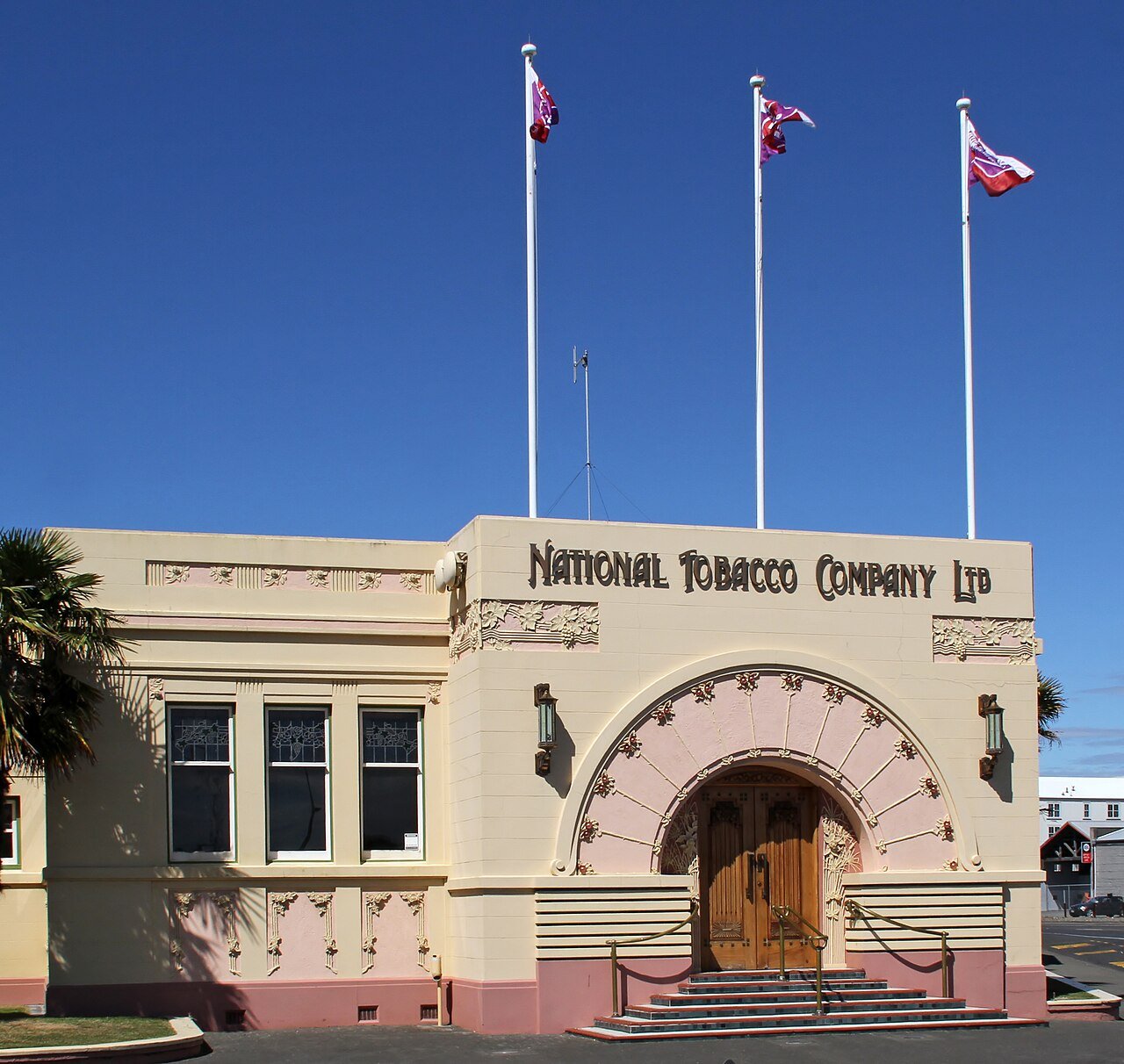
- Essential sites: Emerson Street, the Daily Telegraph Building (1932), the National Tobacco Company Building (Ahuriri, 1933), the Art Deco Trust
- Architectural styles: Art Déco, Spanish Mission, Stripped Classical, with Māori-motif “Māori Deco” detailing
History
At 10.47 on the morning of 3 February 1931, a powerful earthquake struck Hawke’s Bay. Most of Napier and nearby Hastings was levelled, and the collapse of buildings and the fires that followed killed 256 people. The seismic event also reshaped the coast: roughly 4,000 hectares that had been underwater were lifted above sea level, with a maximum of about 2.7 metres of uplift — new land on which part of the modern town now stands.
Reconstruction began almost immediately and was largely complete within a few years. The timing was decisive. The rebuild coincided with the Art Déco era and with the depths of the Great Depression, when little comparable “main-street” construction was happening anywhere else. Local architects — among them J. A. Louis Hay, who joined the reconstruction effort and helped ensure the work stayed in local hands — designed in the idiom of the moment. New regulations limited heights and demanded earthquake-resistant reinforced concrete, which is why Napier reads as a low, horizontal town rather than a city of towers.
Because so much went up at once, in related styles, by a small group of architects, the centre acquired a stylistic unity that has since become its defining feature and its principal draw.
What you see
The vocabulary is classic 1930s Déco: stepped parapets, vertical fluting, zigzags, sunbursts and stylised fountains, often picked out in low relief and pastel render. Spanish Mission buildings sit alongside, with their arches, tiled hoods and warm stucco. Among the set pieces are the Daily Telegraph Building of 1932, with its crisp geometric façade, and the National Tobacco Company Building at Ahuriri (1933), Louis Hay’s best-known work, whose richly modelled entrance — its arch wreathed in roses and raupo — blends Art Déco with Art Nouveau and Arts and Crafts influences. What gives Napier its local character is the recurring use of Māori-derived ornament, the so-called “Māori Deco,” woven into otherwise international forms.
The best way to take it in is on foot. Emerson Street, the pedestrianised commercial spine, lets you read one façade after another at eye level, while the civic buildings, the Soundshell and the seafront frame the ensemble. Looking up — above the modern shopfronts — is the trick to seeing the original 1930s detailing intact.
Practical information
- The Art Deco Trust runs daily guided walking tours of the town centre; book through the Trust.
- The Tremains Art Deco Festival takes place each February and draws large crowds in period dress.
- Allow half a day to a full day for the centre on foot; add time for Ahuriri to see the National Tobacco Company Building.
- Most key buildings are within a compact, walkable area around Emerson and Tennyson Streets.
- Look above ground-floor shopfronts — much of the original ornament survives at parapet level.
Getting there
Napier is served by Hawke’s Bay Airport (IATA: NPE) at Westshore, just north of the centre, with domestic flights from the main New Zealand hubs. By road the town is reached from Wellington to the south and from Auckland and the Bay of Plenty to the north; both are long but straightforward drives across the North Island, and Napier is a common stop on east-coast touring routes.
Related in CHO
- Miami — South Beach and Tropical Art Déco
- Mumbai — Marine Drive and the Art Déco Ensembles
- Shanghai — The Bund and the Art Déco of the East
Sources
Find it on the map
See this place and what’s around it →Record researched and written by Luigi De Marchi for Cultural Heritage Online, 2026.
📷 Become a Cultural Heritage Online photographer
Share your photos of places: they stay published under your name as the author. The more they're seen, the more you get noticed — and soon a contest will reward the most appreciated photos.
Log in or sign up free to add a photo