
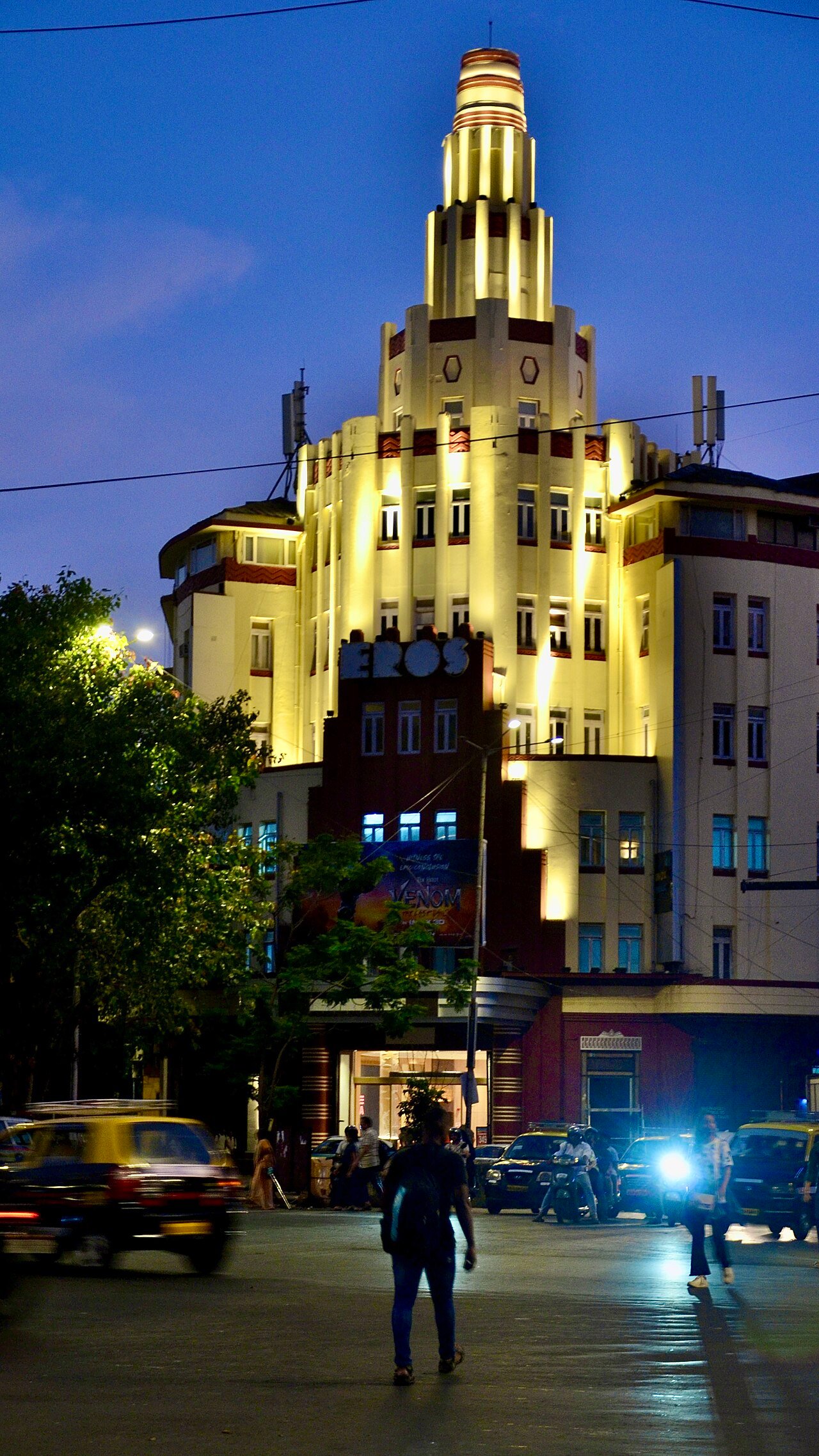
Along the curve of Marine Drive and the western edge of the Oval Maidan, Mumbai built one of the largest concentrations of Art Déco in the world. The style arrived with reclaimed land and a rising Indian middle class.
At a glance
Between the Victorian Gothic public buildings of the Fort and the Arabian Sea, Mumbai assembled a remarkable run of Art Déco apartment blocks, offices and cinemas in the 1930s and 1940s. The set is anchored by the Oval Maidan, a recreational green whose eastern flank carries nineteenth-century Gothic Revival institutions and whose western flank is lined with twentieth-century Déco residences. The same vocabulary runs north along Marine Drive, the crescent promenade reclaimed from the bay. In 2018 UNESCO inscribed the whole ensemble — ninety-four structures across the Fort precinct — as a single World Heritage property, recognising the deliberate dialogue between the two architectural eras that face each other across the maidan.
Key facts
- Country: India
- Key period: 1930s–1940s
- UNESCO: The Victorian Gothic and Art Deco Ensembles of Bombay, inscribed 2018 (94 structures, criteria ii and iv)
- Essential sites: Oval Maidan, Marine Drive, Eros Cinema, Regal Cinema
- Context: built on the Back Bay Reclamation, the Déco blocks line the western maidan and the seafront promenade
History
For most of the nineteenth century the open ground south of Churchgate — the Oval, together with the Azad, Cooperage and Cross maidans — formed the Esplanade, a band of cleared land outside the old Fort walls. Along its eastern edge the colonial administration raised the great Gothic Revival institutions: the High Court, the University of Bombay and its Rajabai Tower. By the 1920s the city’s appetite for land was met by the Back Bay Reclamation, an ambitious scheme that pushed new ground into the Arabian Sea and created the building plots that would define modern South Mumbai.
The Art Déco that filled those plots was not imported wholesale. It was carried by a confident Indian clientele — the Parsi business community prominent among them — who commissioned apartment blocks with names such as Kapur Mahal, Zaver Mahal and Keval Mahal, built between 1937 and 1939 along the new seafront. The promenade itself, Marine Drive, was constructed by Pallonji Mistry in 1940 and quickly earned the nickname “Queen’s Necklace” for the way its streetlights curve like a string of pearls when seen at night.
The cinemas gave the movement its most public faces. Regal Cinema opened in Colaba in 1933, designed by Charles Stevens — son of the Gothic architect F. W. Stevens — and was recorded as the first air-conditioned theatre in India. Eros Cinema followed at Churchgate, its foundation laid in 1935 and its doors opened on 10 February 1938. Together these buildings made Déco the everyday architecture of a generation, a status confirmed when UNESCO inscribed the ensemble in 2018.
What you see
Walk the western side of the Oval Maidan and the grammar of the style declares itself: rounded corners, horizontal banding, projecting concrete “eyebrows” shading the windows, stepped ziggurat parapets and bold sans-serif lettering naming each block. This is a tropical Déco adapted to monsoon and sun — the eyebrows and deep balconies are climate devices as much as ornament. Nautical and sunburst motifs recur, fitting for buildings that look out to sea, and the palette runs to cream stucco warmed by panels of stone.
The cinemas concentrate the drama. Eros, designed by Shorabji Bhedwar in the Streamline Moderne idiom, is partly faced in red Agra sandstone and painted cream, with a foyer of white and black marble touched with gold. Regal, with interiors by the Czech artist Karl Schara, set sunray motifs in pale orange and jade green against extensive mirror-work. For the visitor the most rewarding route is simply the curve of Marine Drive at dusk and a slow circuit of the Oval, where Gothic spires on one side and Déco parapets on the other frame the same green.
Practical information
- The ensemble is an open urban district — the maidans, Marine Drive and the building exteriors are free to see at any time.
- Best appreciated on foot: the Oval Maidan to Marine Drive walk is short and flat.
- Marine Drive is at its most photogenic at sunset and after dark, when the “Queen’s Necklace” lights up.
- Eros Cinema reopened as a heritage venue in February 2024; check current programming for interior access.
- Most apartment blocks are private residences — admire the facades from the street.
Getting there
Mumbai is served by Chhatrapati Shivaji Maharaj International Airport (BOM). For the ensemble itself, Churchgate station on the Western Line sits a few minutes’ walk from the Oval Maidan and the northern end of Marine Drive, making the train the simplest approach from across the city.
Related in CHO
- Miami — South Beach and Tropical Art Déco
- New York — Tiffany, the Gilded Age and Art Déco
- London — William Morris and the Arts & Crafts Movement
Sources
Find it on the map
See this place and what’s around it →Record researched and written by Luigi De Marchi for Cultural Heritage Online, 2026.
📷 Become a Cultural Heritage Online photographer
Share your photos of places: they stay published under your name as the author. The more they're seen, the more you get noticed — and soon a contest will reward the most appreciated photos.
Log in or sign up free to add a photo