
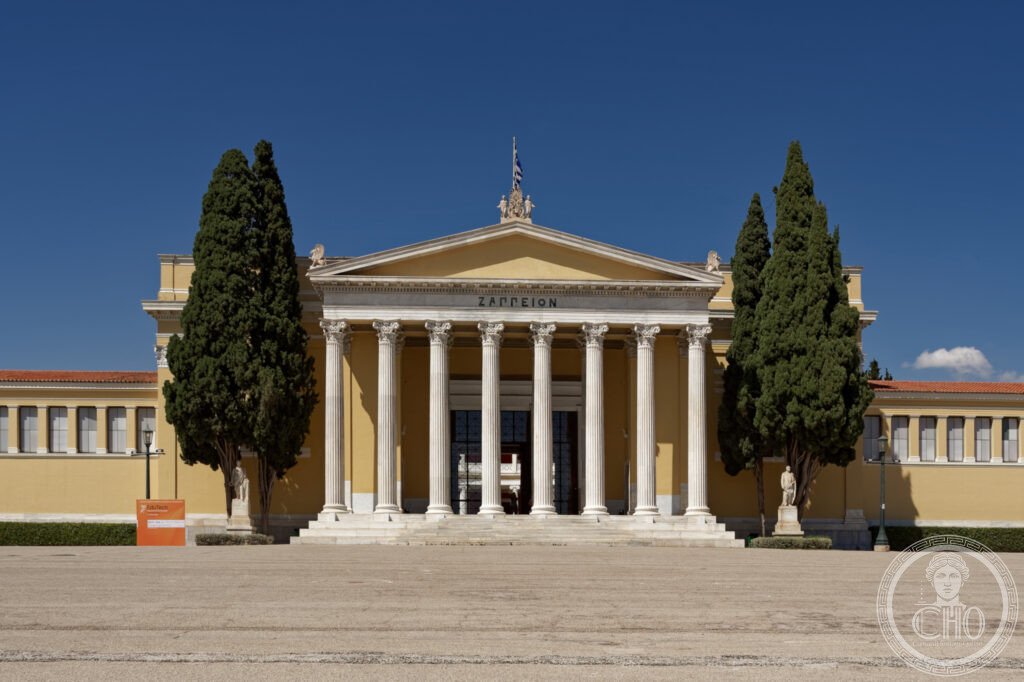
Theophil Hansen’s 1888 Neoclassical congress hall in the National Garden was built to revive the Olympic Games — and its circular courtyard was the fencing arena for the first modern Olympiad of 1896.
At a glance
The Zappeion stands among the plane trees of the National Garden in central Athens, a compact Neoclassical building whose Corinthian colonnade and circular peristyle court face the Panathenaic Stadium across the Ilissos valley. Designed by Danish-Austrian architect Theophil Hansen and completed in 1888, twenty-three years after his initial design and long after his death, it was the first purpose-built structure for the revival of the Olympic Games. Its patron, Evangelos Zappas (1800–1865), was a Greek-Romanian businessman who had successfully lobbied the Greek government in 1856 to revive the Olympics; he died before the hall was finished. The building hosted the fencing competition at the 1896 Athens Olympics and the swimming and gymnastics events at the 1906 Intercalated Games. Greece signed its accession to the European Community here on 28 May 1979.
Key facts
- Architect: Theophil Hansen (1813–1891, Danish-Austrian); completed under supervision of Ernst Ziller (1837–1923)
- Built: designed 1862; construction 1874–1888; inaugurated 20 October 1888
- Patron: Evangelos Zappas (1800–1865), Greek-Romanian entrepreneur; additional funds from his cousin Konstantinos Zappas
- Style: Greek Revival / Neoclassical; Pentelic marble; Corinthian order throughout
- Olympic venue: fencing 1896 Athens Olympics; swimming and gymnastics 1906 Intercalated Games
- Historical event: Greece’s EU accession treaty signed here, 28 May 1979
- GPS: 37.9714° N, 23.7364° E
History
Evangelos Zappas made his fortune in Romania as a military contractor and agricultural entrepreneur before dedicating his later years and substantial wealth to the revival of the Olympic Games in Greece. In 1856 he successfully petitioned King Otto to stage the first modern Greek Olympics (held 1859 and 1870); he simultaneously left funds in his will to construct a permanent hall for the games and for agricultural exhibitions. Theophil Hansen, who was already shaping central Athens through the design of the Academy, the National Library, and the University — the so-called Hansen Trilogy — received the commission and submitted his design in 1862.
Construction was delayed by bureaucratic and funding complications for over a decade, beginning in earnest only in 1874. Hansen died in 1891 without seeing the hall finished; his pupil Ernst Ziller, who had settled permanently in Athens, oversaw the final stages. The building was inaugurated on 20 October 1888 with agricultural, industrial, and arts exhibitions — the format Zappas had envisioned, with the Olympic competitions to follow.
When the International Olympic Committee chose Athens for the first modern Olympics in 1896, the Zappeion became a natural venue for the fencing competitions and a lodging facility for athletes. The 1906 Intercalated Games expanded its role. Through the twentieth century the building served as a refugee shelter (1922–1923, during the population exchange with Turkey), a broadcasting centre (1941–1944 under German occupation), and conference hall. Greece signed the EEC accession treaty in the main hall in 1979.
What you see
From Vasilissis Amalias Avenue, the Zappeion presents a semicircular Ionic portico flanked by garden walls. The main body of the building, set back among the trees, is a square block with a circular colonnaded court at its centre — a peristyle of 52 Corinthian columns in Pentelic marble, open to the sky, that functions as an outdoor amphitheatre. The dome above the main entrance hall is shallow and coffered, drawing on the Panthéon in Rome at much reduced scale. The exterior stonework is Pentelic marble throughout, the same material used for the Parthenon; it shares the pale gold tone that distinguishes Athenian Neoclassical architecture from its Northern European equivalents.
The interior main hall is a rectangular space with painted vaulted ceilings and marble floors, now used for exhibitions, diplomatic receptions, and conferences. The circular peristyle court — where the 1896 fencing took place — is still used for outdoor events. At night, when the columns are lit from below, the Zappeion is among the most elegantly illuminated landmarks in Athens.
Practical information
- Address: Zappeion, National Garden, Athens 105 57, Greece
- Status: event venue; exterior and peristyle court generally accessible during daylight hours
- Best time to visit: morning or late afternoon for best light on the marble; National Garden provides shade in summer
- Photography: exterior freely accessible; interior access depends on scheduled events
- Time needed: 20–30 minutes for exterior and courtyard; longer if an exhibition is open
Getting there
The Zappeion is at the south end of the National Garden, 15 minutes on foot from Syntagma Square via the park. Metro station Syntagma (Lines 2 and 3) is the closest stop. Athens International Airport Eleftherios Venizelos is 30 km east; Metro Line 3 connects to Syntagma in 40 minutes. GPS: 37.9714, 23.7364.
Nearby
- Panathenaic Stadium (Kallimármaro) — the 1896 Olympic stadium in Pentelic marble, ten minutes on foot east
- Temple of Olympian Zeus — Hadrianic temple and monumental gateway, five minutes south
- Acropolis of Athens — the Parthenon complex, visible from the Zappeion gardens, 20 minutes on foot
- Benaki Museum — Greek cultural history museum on Vasilissis Sofias Avenue, 15 minutes north
Sources
- Wikipedia, Zappeion, accessed June 2026
- Athens & Epidaurus Festival, Zappeion venue documentation
- Hellenic Ministry of Culture and Sports, heritage listing for Zappeion
- David C. Young, The Modern Olympics: A Struggle for Revival, Johns Hopkins, 1996
Find it on the map
See this place and what’s around it →📷 Become a Cultural Heritage Online photographer
Share your photos of places: they stay published under your name as the author. The more they're seen, the more you get noticed — and soon a contest will reward the most appreciated photos.
Log in or sign up free to add a photoIs this page about you?
This page is read by travellers and heritage enthusiasts who find it on Google. Tell us how you are connected to this place and we will take it from there.