
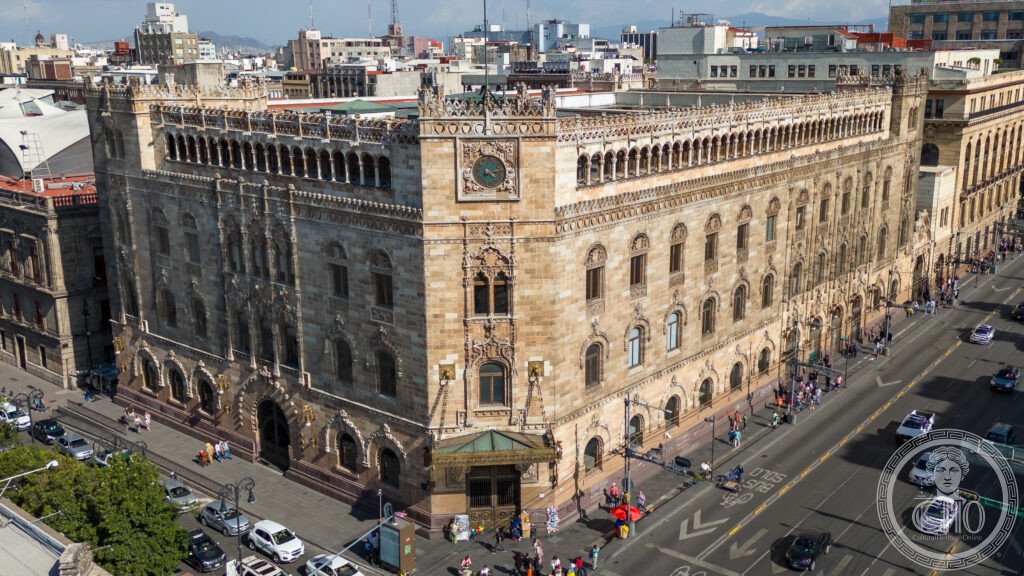
Adamo Boari’s 1907 central post office is one of the most exuberant buildings in the Americas — a gilded Venetian Gothic and Art Nouveau confection that rises, white and gold, directly across from his own Palacio de Bellas Artes.
At a glance
The Palacio de Correos de México — popularly called the Correo Mayor — occupies a full city block on Eje Central Lázaro Cárdenas in the historic centre of Mexico City, directly opposite the Palacio de Bellas Artes with which it forms a monumental civic ensemble. Designed by Italian architect Adamo Boari and inaugurated on 17 February 1907 under President Porfirio Díaz, the building drew on Venetian Gothic, Spanish Plateresque, Italian Renaissance, and Art Nouveau ornamental vocabularies simultaneously, producing a surface so densely carved that the white Chiluca limestone reads as lace from the street. The building still functions as Mexico’s central post office; its public interior, now also a postal museum, is among the most remarkable interior spaces in Latin America.
Key facts
- Architect: Adamo Boari (1863–1928), Italian architect also responsible for the nearby Palacio de Bellas Artes
- Built: 1902–1907; inaugurated 17 February 1907
- Style: Venetian Gothic + Spanish Plateresque + Art Nouveau ornament; white Chiluca limestone cladding
- Still in use: active central post office + Museo del Palacio Postal (free admission)
- Heritage: part of the UNESCO Historic Centre of Mexico City (1987)
- Patron: commissioned by President Porfirio Díaz as part of the Porfirian modernisation of Mexico City
- GPS: 19.4357° N, 99.1404° W
History
Porfirio Díaz’s administration (1876–1911) transformed the centre of Mexico City through a systematic building campaign aligned with the Paris of Haussmann and the Vienna of the Ringstrasse. New civic buildings were to project the image of a modern nation; their architects were almost entirely European. Adamo Boari, who had trained in Florence and worked in Chicago before arriving in Mexico City, was engaged in 1897 for two projects simultaneously: a new national theatre (the Bellas Artes, begun 1904) and a new central post office on the adjacent site. The post office, the smaller commission, was completed first.
Construction began in 1902 on a difficult site: the soft lacustrine soils of the former Lake Texcoco required deep concrete piling. Boari specified Chiluca limestone from Querétaro and bronze hardware cast in the United States; the steel structural frame came from American manufacturers. The eclectic ornamental programme — Gothic arcade, Plateresque window surrounds, Mudéjar tile accents — was executed by a mixed team of Mexican and Italian craftsmen. The inauguration on 17 February 1907 was attended by Díaz and the diplomatic corps, with the building functioning as a post office from day one.
The building survived the 1985 earthquake with minimal structural damage and underwent major restoration in the 1990s. Today it operates simultaneously as a working post office, a museum of Mexican postal history, and an architectural landmark visited by hundreds of thousands of tourists annually. Access to the public floors and the central stair hall is free.
What you see
The exterior is the most ornate street elevation in Mexico City’s historic centre. The façade runs across two streets and presents three distinct rhythms: a rusticated arcade at street level, a piano nobile of Gothic-pointed window frames carved with floral and figural motifs, and a mansard-inflected roofline bristling with wrought-iron cresting. The white Chiluca stone weathers to a warm cream; gilded bronze details at the upper bays flash in morning light. The corner entrance — a triumphal porch with polychrome marble floor, bronze doors, and a ceramic tile dado in green and white — is the threshold between the street and the interior world.
Inside, the atrium rises three floors to a glass-and-iron skylight roof, ringed by open galleries with elaborate cast-iron railings. The central stair occupies the full height of the building, its marble treads worn smooth by more than a century of postal traffic. Service windows in green marble and oak run along the ground floor. The Museo del Palacio Postal occupies several rooms on the upper gallery, displaying historical postage stamps, postal uniforms, and the original 1907 mechanical sorting equipment.
Practical information
- Address: Eje Central Lázaro Cárdenas 1, Centro Histórico, Mexico City 06000
- Opening hours: Monday–Friday 09:00–20:00; Saturday 09:00–16:00
- Admission: free (museum and public areas)
- Post office: operational; stamps and philatelic items available for purchase
- Time needed: 30–45 minutes for the museum and main spaces
- Photography: permitted throughout the public floors
Getting there
The building faces Eje Central Lázaro Cárdenas at the corner of Tacuba, directly opposite the Palacio de Bellas Artes. Metro station Bellas Artes (Lines 2 and 8) is two minutes on foot. Benito Juárez International Airport is 12 km east via Metro Line 1. GPS: 19.4357, -99.1404.
Nearby
- Palacio de Bellas Artes — Boari’s masterwork across the street; one of the finest Art Nouveau buildings in the Americas
- Gran Hotel Ciudad de México — Tiffany stained-glass skylight atrium, five minutes east on Av. 16 de Septiembre
- Zócalo (Plaza de la Constitución) — Mexico City’s main square with the Metropolitan Cathedral, ten minutes on foot
- Museo Nacional de Arte (MUNAL) — Italian Renaissance palace, five minutes east, with Mexican art from the 16th to 20th century
Sources
- Wikipedia, Palacio de Correos de México, accessed June 2026
- UNESCO, Historic Centre of Mexico City, WHS reference 412, inscribed 1987
- INAH (Instituto Nacional de Antropología e Historia), heritage listing
- Official museum: Museo del Palacio Postal, sepomex.gob.mx
Find it on the map
See this place and what’s around it →📷 Become a Cultural Heritage Online photographer
Share your photos of places: they stay published under your name as the author. The more they're seen, the more you get noticed — and soon a contest will reward the most appreciated photos.
Log in or sign up free to add a photoIs this page about you?
This page is read by travellers and heritage enthusiasts who find it on Google. Tell us how you are connected to this place and we will take it from there.