
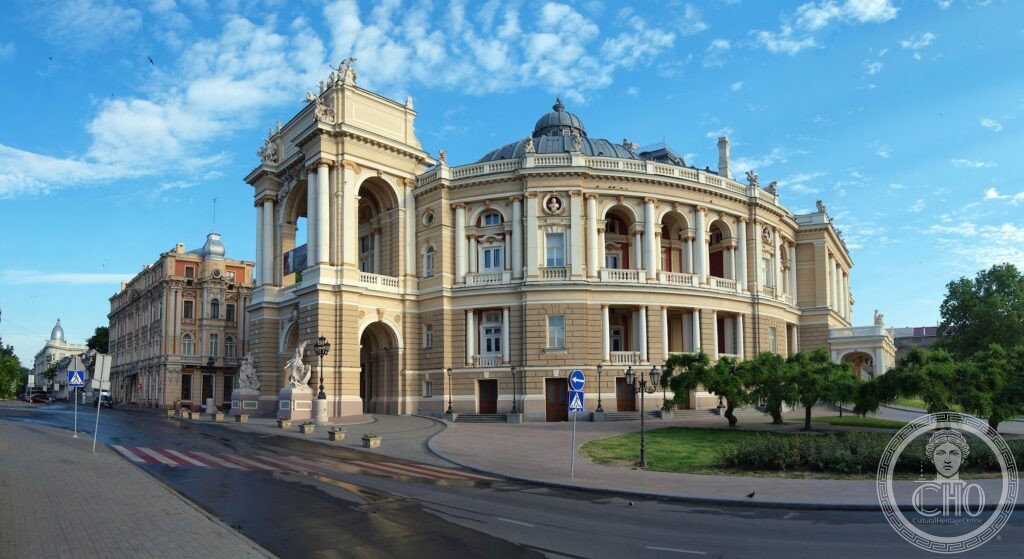
Vienna’s most prolific opera-house practice, Fellner & Helmer, designed this Baroque Revival masterpiece for Odessa in 1887 — and it has been performing, through wars and sieges, without interruption ever since.
At a glance
The Odesa National Academic Opera and Ballet Theatre stands on Teatralna Square in the heart of the city, its polychrome facade and copper-clad dome constituting what many critics and audiences place among the five finest opera houses in Europe. Designed by the Vienna-based firm of Ferdinand Fellner and Hermann Helmer — who built more than 60 theatres across Central Europe — and inaugurated on 1 October 1887 with a performance of Bellini’s La sonnambula, the building has withstood the Siege of Odessa in 1941, Soviet-era closures, and attacks during the 2022–2024 conflict while continuing to mount opera and ballet seasons.
Key facts
- Architects: Ferdinand Fellner (1847–1916) and Hermann Helmer (1849–1919), Vienna; the most productive theatre-building practice in 19th-century Europe (~60 opera houses)
- Built: 1884–1887; inaugurated 1 October 1887 with Bellini’s La sonnambula
- Style: Vienna Baroque Revival / Italian Renaissance with rococo interior detailing; four-storey horseshoe auditorium
- Capacity: approximately 1,636 seats
- Famous performances: Enrico Caruso, Fyodor Chaliapin, and Sarah Bernhardt all appeared on the Odessa stage before 1914
- Heritage status: Ukrainian cultural monument; on UNESCO tentative list for the Historic Centre of Odesa
- GPS: 46.4854° N, 30.7412° E
History
Odessa — founded by Catherine the Great in 1794 and built as a Mediterranean-facing free port — developed by the mid-19th century into one of the Russian Empire’s wealthiest and most cosmopolitan cities. The city’s first opera house, an Italian-designed building of 1810, burned down in 1873. The municipal authorities commissioned a replacement from Fellner & Helmer, who had already built the Vienna Volksoper, the Prague National Theatre (Nové české divadlo), and numerous other theatres across the empire. The Odessa commission was among their most ambitious: a full-scale opera house with four tiers, a grand proscenium, and an exterior that competed with the best of Central Europe.
Construction ran from 1884 to 1887 at a reported cost of three million roubles. The interior was decorated by leading Viennese craftsmen, with ceiling paintings by Ukrainian and Polish artists. The auditorium’s horseshoe form, with projecting boxes at each tier, produces the superb acoustic that audiences had expected from the outset. From 1887 to 1914, the theatre was on the touring circuit of every major European opera company; the Russian bass Fyodor Chaliapin made some of his earliest appearances here, and Enrico Caruso sang Otello on this stage in 1902.
The 20th century brought interruptions the founders could not have anticipated. German and Romanian forces bombed the city in 1941; the theatre survived with structural damage later repaired. Soviet-era management maintained a full season. The Ukrainian government declared the opera house a national monument of architectural heritage after 1991. The building’s location on UNESCO’s tentative list reflects its status within the Historic Centre of Odesa, which was inscribed as a World Heritage Site in 2023. Despite drone strikes on the city during the 2022–2024 conflict, the opera continued to perform.
What you see
The exterior presents the Fellner & Helmer signature: a two-storey rusticated base with arcaded windows, a piano nobile of pedimented bays, and a roofline punctuated by allegorical figure groups in stucco. The central facade carries a deep entrance loggia with composite columns, its tympanum filled by a relief of Apollo and the Muses. The copper-clad dome, added to the profile that Fellner & Helmer repeated across their portfolio with variations, reads as a domestic-scaled echo of the Vienna State Opera. The polychrome banding — cream, ochre, and terracotta — is unusually rich by the firm’s generally restrained exterior standards.
Inside, the horseshoe auditorium runs four tiers of boxes and open galleries curving toward the proscenium. The ceiling fresco — an allegory of the four seasons — occupies the dome above the stalls; it was restored in the 1990s using photographs and surviving fragments of the original 1887 work. The golden and ivory colour scheme of the box fronts and the heavily gilded proscenium arch belong to the Viennese rococo tradition that Fellner & Helmer transported to every city they worked in. The acoustic, shaped by the horseshoe plan and the wooden box floors, is regarded as among the finest in Europe.
Practical information
- Address: Teatralna Square 1 (Teatralʹna ploshcha), Odesa 65026, Ukraine
- Season: September to June; check the theatre’s current schedule in the context of ongoing security conditions in Ukraine
- Tickets: available online at the theatre’s official website; advance booking recommended for opera and ballet premieres
- Dress code: smart casual to formal; evening dress expected at galas
- Time needed: 2.5–3.5 hours for most opera and ballet productions
- Note: Visitors should verify current travel advisories for Ukraine before planning a trip
Getting there
The opera house stands on Teatralna Square in central Odesa, a ten-minute walk from Primorsky Boulevard and the Potemkin Stairs. Odesa International Airport (pre-war status: recheck current conditions) is 8 km from the centre. Odesa railway station connects to Kyiv (overnight train, approximately 8 hours) and other Ukrainian cities. GPS: 46.4854, 30.7412.
Nearby
- Primorsky Boulevard — Odesa’s grand sea-facing promenade, ten minutes on foot south; lined with 19th-century eclectic palaces
- Potemkin Stairs — the 192-step neo-Baroque stairway to the Black Sea port, made internationally famous by Eisenstein’s 1925 film
- Deribasivska Street — the main pedestrian shopping street of central Odesa, five minutes north of the opera
- Odessa Fine Arts Museum — housed in a Count Tolstoy palace from 1802, ten minutes on foot
Sources
- Wikipedia, Odessa National Academic Opera and Ballet Theatre, accessed June 2026
- UNESCO, Historic Centre of Odesa, inscribed 2023 (World Heritage Site)
- Official theatre website: opera.odessa.ua
- Austrian Cultural Forum, Fellner & Helmer: Theatre Architects to the Empire, 2018
Find it on the map
See this place and what’s around it →📷 Become a Cultural Heritage Online photographer
Share your photos of places: they stay published under your name as the author. The more they're seen, the more you get noticed — and soon a contest will reward the most appreciated photos.
Log in or sign up free to add a photoIs this page about you?
This page is read by travellers and heritage enthusiasts who find it on Google. Tell us how you are connected to this place and we will take it from there.